

Ātman, Jīva, Mahāprāṇa, Prāṇa and Mind
Understanding Consciousness, Life and Departure from the Body
Words such as Ātman, jīva, prāṇa, Mahāprāṇa, mind, soul and spirit are frequently used as though they mean the same thing. This creates confusion. A few questions naturally arise:
- What gives life to the body?
- Is Ātman a type of energy?
- Who thinks — the mind or Ātman?
- Who leaves the body at death? What happens to prāṇa?
The Upaniṣads, the Bhagavad Gītā and the teachings of Sri Sathya Sai Baba and Swami Rama together help distinguish these principles.
The whole teaching can be held in one sentence — a summary formulated by the author from these sources, not a scriptural quotation:
“The body acts. Prāṇa energises. Mind thinks. Jīva experiences. Ātman illumines.”
Here, “illumines” means makes conscious experience possible. It does not mean that Ātman produces physical light or biological energy.
1. Ātman: The Eternal Conscious Self
Ātman is not the physical body, the breath, thoughts, emotions or personality. It is the eternal conscious Self.
The Bhagavad Gītā declares that the Ātman is unborn, eternal and indestructible. The destruction of the physical body does not destroy the Self:
न जायते म्रियते वा कदाचिन्
नायं भूत्वा भविता वा न भूयः ।
अजो नित्यः शाश्वतोऽयं पुराणो
न हन्यते हन्यमाने शरीरे ॥ २.२० ॥
Literal translation: The Self is never born, nor does it ever die. Having once existed, it never ceases to be. It is unborn, eternal, everlasting and ancient. It is not slain when the body is slain. (Bhagavad Gītā 2.20)
The body passes through childhood, youth, maturity and old age. The mind, too, changes continually — thoughts arise and disappear, emotions move from happiness to sadness, confidence to fear, and peace to restlessness. Yet we remain aware of all these changes.
We say:
- “My body is tired.”
- “My breathing is rapid.”
- “My mind is worried.”
- “I know that I am worried.”
In each case, the body, breath and mind are being observed. Vedānta uses the term Ātman for the deepest conscious principle by whose presence these experiences are known.
Sri Sathya Sai Baba teaches that the jīva-tattva, the individual life-principle, rests upon the deeper Ātma-tattva, the Ātmic principle. Asking rhetorically what the basis of the jīva-tattva is, he answers, “It is only the Atma-Tatwa.” In the same discourse he explains that the divine power is the motivating, coordinating and illuminating principle behind the mind, senses and bodily organs, and that the Ātman remains the Seer, never becoming an object that can itself be seen. (Sri Sathya Sai Baba, “The Inner Motivator”, Sathya Sai Speaks, Vol. 24, Discourse 11, Brindavan, 25 May 1991, official SSSBPT PDF, p. 57.)
2. What Does “Ātman Illumines” Mean?
The expression “Ātman illumines” does not refer to visible light. It means that Ātman makes an experience consciously knowable.
श्रोत्रस्य श्रोत्रं मनसो मनो यद्
वाचो ह वाचं स उ प्राणस्य प्राणः ।
चक्षुषश्चक्षुरतिमुच्य धीराः
प्रेत्यास्माल्लोकादमृता भवन्ति ॥ १.२ ॥
Literal translation: That which is the Ear of the ear, the Mind of the mind, the Speech of speech, the Prāṇa of prāṇa and the Eye of the eye — the wise, relinquishing identification with the instruments, become immortal. (Kena Upaniṣad 1.2)
This mantra does not say that Ātman physically hears, sees, speaks or breathes. It indicates the deeper conscious principle because of whose presence the senses, mind and prāṇa can perform their respective functions.
This is why the summary sentence used in this article is philosophically sound:
Ātman illumines — it makes conscious experience possible.
The sentence should be understood as the author’s explanatory summary of the teaching, not a direct scriptural quotation.
Consider sunlight entering a room. The sunlight does not arrange the furniture or perform the activities taking place there — it simply makes everything visible. In the same way:
- The senses perceive.
- The mind thinks.
- Prāṇa supplies vitality.
- The body performs actions.
- Ātman makes the whole experience consciously known.
Sri Sathya Sai Baba explains that the characteristic of the mind is to merge the distant Ātman with the proximate body:
“The characteristic of the mind is to merge the distant Atma with the proximate body.”
The body is gross, the Ātman is subtle, and the mind is what connects the two. False identification arises when a person believes that the temporary body alone is the true Self — spiritual enquiry corrects this identification. (Sri Sathya Sai Baba, “Thath Thwam Asi—That Thou Art”, Summer Showers in Brindavan 1991, Discourse 3, 23 May 1991, printed p. 14; official PDF p. 16.)
“Ātman is not another bodily instrument. It is the conscious foundation through whose presence the instruments are experienced.”
3. Is Ātman a Form of Energy?
It is best not to describe Ātman merely as “energy”. Energy moves, changes, increases, decreases and produces observable effects — prāṇa may be weak or strong, breathing rapid or slow, bodily vitality high or low. Ātman, by contrast, is described as the unchanging conscious Self.
Sri Sathya Sai Baba states this distinction directly:
“The Atma is not the five senses, the intellect, the vital airs, or the life force.”
He explains that the body depends on prāṇa and is influenced by the mind and the desires that agitate it — one of the clearest sources for the distinction drawn in this article. (Sri Sathya Sai Baba, Prasanthi Vāhinī, “Peace, Love, and the Atma,” official SSSBPT interactive PDF, pp. 9–10)
“Prāṇa is life-force; Ātman is consciousness.” This means consciousness and life-force are related, but they should not be treated as identical.
4. Mahāprāṇa: The Universal Life-Force
The word “Mahāprāṇa“ literally means “great prāṇa.” In many yogic explanations, it refers to the universal life-force that pervades creation, while individual prāṇa refers to the vital force functioning through a particular living being.
It should be noted that the Kena, Praśna and Bṛhadāraṇyaka passages cited in this article use the word prāṇa, not Mahāprāṇa. They do not establish Mahāprāṇa as a separate, formally defined entity in the way they discuss Ātman, jīva and prāṇa. In this article, Mahāprāṇa is therefore used as an explanatory yogic term for the universal or cosmic life-force and should not be confused with pure Ātman, nor presented as if the Upaniṣads themselves use this exact term.
Mahāprāṇa must not be confused with Ātman:
| Ātman | Mahāprāṇa |
| Pure consciousness | Universal life-force |
| The conscious foundation | The vital, energising principle |
| Unchanging | Expressed through movement and activity |
| Not biological energy | Sustains the processes of life |
| Makes experience knowable | Makes living functions possible |
“Ātman is consciousness; Mahāprāṇa is universal life-power.”
Ātman does not “help” Mahāprāṇa as one person assists another, nor does it pump energy into creation. Rather, all vital and mental activity is understood to rest ultimately upon the deeper reality of consciousness.
5. Prāṇa: The Vital Force Within the Individual
Prāṇa is the vital principle that operates through a living organism. The Praśna Upaniṣad teaches that prāṇa arises from Ātman and depends on it, just as a shadow depends on the person who casts it; prāṇa enters and functions in embodiment through the agency of the mind.
आत्मन एष प्राणो जायते ।
यथैषा पुरुषे छायैतस्मिन्नेतदाततं
मनोकृतेनायात्यस्मिञ्शरीरे ॥ ३.३ ॥
Literal translation: This prāṇa arises from Ātman. Just as a shadow is dependent upon a person, prāṇa is extended from the Self; through the activity of mind, it comes into this body. (Praśna Upaniṣad 3.3)
The shadow analogy indicates dependence:
- The shadow depends upon the person.
- The person does not depend upon the shadow.
- Similarly, prāṇa depends upon the deeper Self.
- Ātman is not dependent upon individual prāṇa.
The expression “arises from Ātman” should not be read as a physical manufacturing process. It describes philosophical dependence, not a mechanical one.
Prāṇa functions mainly through five expressions:
| Prāṇic Function | Principal Role |
| Prāṇa-vāyu | Breathing, reception and inward movement |
| Apāna | Elimination and downward movement |
| Samāna | Digestion and assimilation |
| Vyāna | Circulation and distribution |
| Udāna | Speech, upward movement and transition |
These are not five unrelated substances but five principal functions of one vital force (Praśna Upaniṣad, Third Question).
Sri Sathya Sai Baba also explains that control of inhalation, exhalation and retention is connected with regulating the vital airs and developing inward vision. (Sri Sathya Sai Baba, “Turn Your Mind Inward to the Atma,” Summer Showers in Brindavan 1973, Discourse 7, 26 May 1973, printed pp. 78–81)
6. The Relationship Between Mind and Prāṇa
Terminological note: In this article, the English word mind is used broadly for the inner mental instrument. In stricter Vedāntic usage, manas refers particularly to the faculty that considers, doubts, imagines and processes sensory information. Buddhi, ahaṅkāra and citta represent other functions of the inner instrument.
Mind and prāṇa are closely connected. The mind thinks, feels, desires, remembers, imagines and reacts; prāṇa provides the vitality through which mental and bodily functions are expressed.
Swami Rama expresses this connection directly: “The breath is the bridge between the body and the mind.”
He explains that inhalation and exhalation are the vehicles through which prāṇa, the vital force, moves in the body, and that as long as the body receives prāṇa through breathing, the body–mind relationship is maintained; when this connection is disrupted, bodily life ends. A short time later he adds, “The breath and the mind are interdependent.”
(Swami Rama, Meditation and Its Practice, Himalayan Institute Press, 1998 printing, ISBN 0-89389-153-3, Chapter 5, “Breathing Practices,” printed pp. 48–49. A newer printing carries ISBN 978-0-89389-153-4, in which page numbers may differ.)
The state of mind affects breathing and prāṇic movement, and the reverse is equally true:
Fearful or agitated thought
↓
Rapid or irregular breathing
↓
Disturbed prāṇic movement
↓
Physical and emotional restlessness
Slow, balanced breathing
↓
Steadier prāṇic movement
↓
Reduced restlessness
↓
A calmer mind
This reciprocal relationship underlies the yogic use of prāṇāyāma: regulating the breath influences the vital force, and a steadier prāṇic condition can help quieten the mind.
Sri Sathya Sai Baba teaches that the body depends on prāṇa and is also affected by the mind and its desires; he therefore emphasises calming and purifying the mind as an essential spiritual discipline (Prasanthi Vāhinī, “Peace, Love, and the Atma”).
“Mind affects and directs prāṇa, while prāṇa energises and influences the mind.”
Yet the mind itself is not the ultimate, independent authority it appears to be. Swami Rama teaches that the mind governs the body, breath and senses, but receives its power from the centre of consciousness, or individual soul, and has no completely independent existence apart from this inner conscious principle. (Swami Rama, Meditation and Its Practice, Chapter 6, “A Program for Progress in Meditation,” printed pp. 69–70.)
The mind thinks and directs, but its functioning ultimately depends upon the deeper conscious principle. Thoughts, feelings, memories and confusion can all be observed — they change, while the fact of conscious awareness remains.
7. What Is the Jīva?
The jīva is the individual living or embodied being.
Put simply, the jīva is the individual conscious being associated with mind, intellect, ego, karmic impressions, subtle senses, prāṇa and a particular body.
The jīva ordinarily says:
- “I am this person.”
- “This is my body.”
- “These are my experiences.”
- “I am happy.”
- “I am suffering.”
The jīva is therefore the personal experiencer that operates through a particular mind-body complex.
Different Vedāntic schools explain the relationship between jīva, Ātman and Brahman differently. Advaita emphasises their ultimate non-difference, while Viśiṣṭādvaita and Dvaita preserve important distinctions between the individual self and the Supreme. A balanced account therefore distinguishes two levels:
- Ātman: the eternal conscious Self.
- Jīva: the individual conscious being associated with embodiment and karma.
Sri Sathya Sai Baba describes Jīva-tattva, the individual life-principle, as having its basis in Ātma-tattva, the Ātmic principle (Sathya Sai Speaks, Vol. 24, Discourse 11).
8. Ātman and Jīva: What Is the Difference?
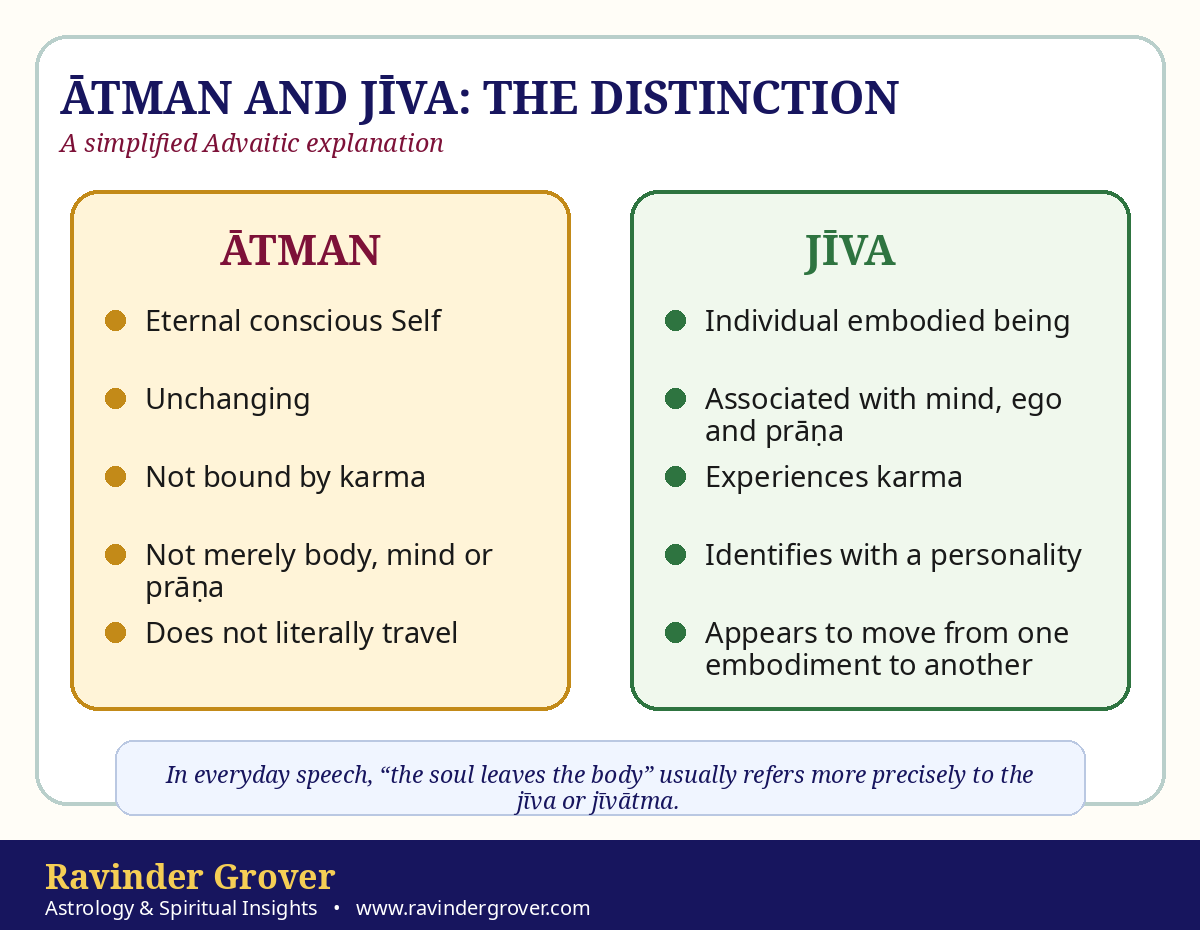
In everyday devotional language, people often use the word ātmā when they more precisely mean jīva or jīvātma. Thus people commonly say: “The ātmā has left the body.” This is understandable in ordinary speech. Philosophically, a more precise statement is:
“The jīva, associated with its subtle faculties, prāṇa and karmic impressions, departs from the gross physical body.”
9. Who Leaves the Physical Body?
The Bhagavad Gītā teaches that the jīva is associated with the mind and senses:
ममैवांशो जीवलोके जीवभूतः सनातनः ।
मनःषष्ठानीन्द्रियाणि प्रकृतिस्थानि कर्षति ॥ १५.७ ॥
Literal translation: An eternal portion of Me, having become the jīva in the world of living beings, draws to itself the five senses, with the mind as the sixth, abiding in prakṛti. (Bhagavad Gītā 15.7)
When it leaves one physical body and proceeds to another embodiment, it carries these subtle faculties, just as the wind carries fragrance:
शरीरं यदवाप्नोति यच्चाप्युत्क्रामतीश्वरः ।
गृहीत्वैतानि संयाति वायुर्गन्धानिवाशयात् ॥ १५.८ ॥
Literal translation: When the embodied lord obtains a body and when it departs from one, it carries these — the mind and senses — just as the wind carries fragrances from their source. (Bhagavad Gītā 15.8)
The word “these” (etāni) in verse 15.8 refers back to the mind and five senses named in verse 15.7, so the two verses should be read and cited together (Bhagavad Gītā 15.7–8), not verse 15.8 alone. This verse refers to the embodied individual principle, commonly understood as the jīva. Pure Ātman, understood as all-pervading consciousness, is not a material object travelling from one location to another — which is a stronger and more precise basis for this article’s teaching than simply saying that “the Ātman leaves the body.”
“The jīva departs from the physical body; pure Ātman neither comes nor goes.”
This wording especially reflects the Advaitic distinction between pure Ātman and the embodied jīva. Other Vedāntic traditions describe the enduring individual self differently, but all distinguish the eternal self from the temporary gross body.
Sri Sathya Sai Baba’s writings similarly use the term jīvātma, the embodied soul, when discussing the being’s onward journey after the body is dropped (Sathya Sai Vāhinī, Chapter VIII, “Bondage”).
10. What Happens at Death?
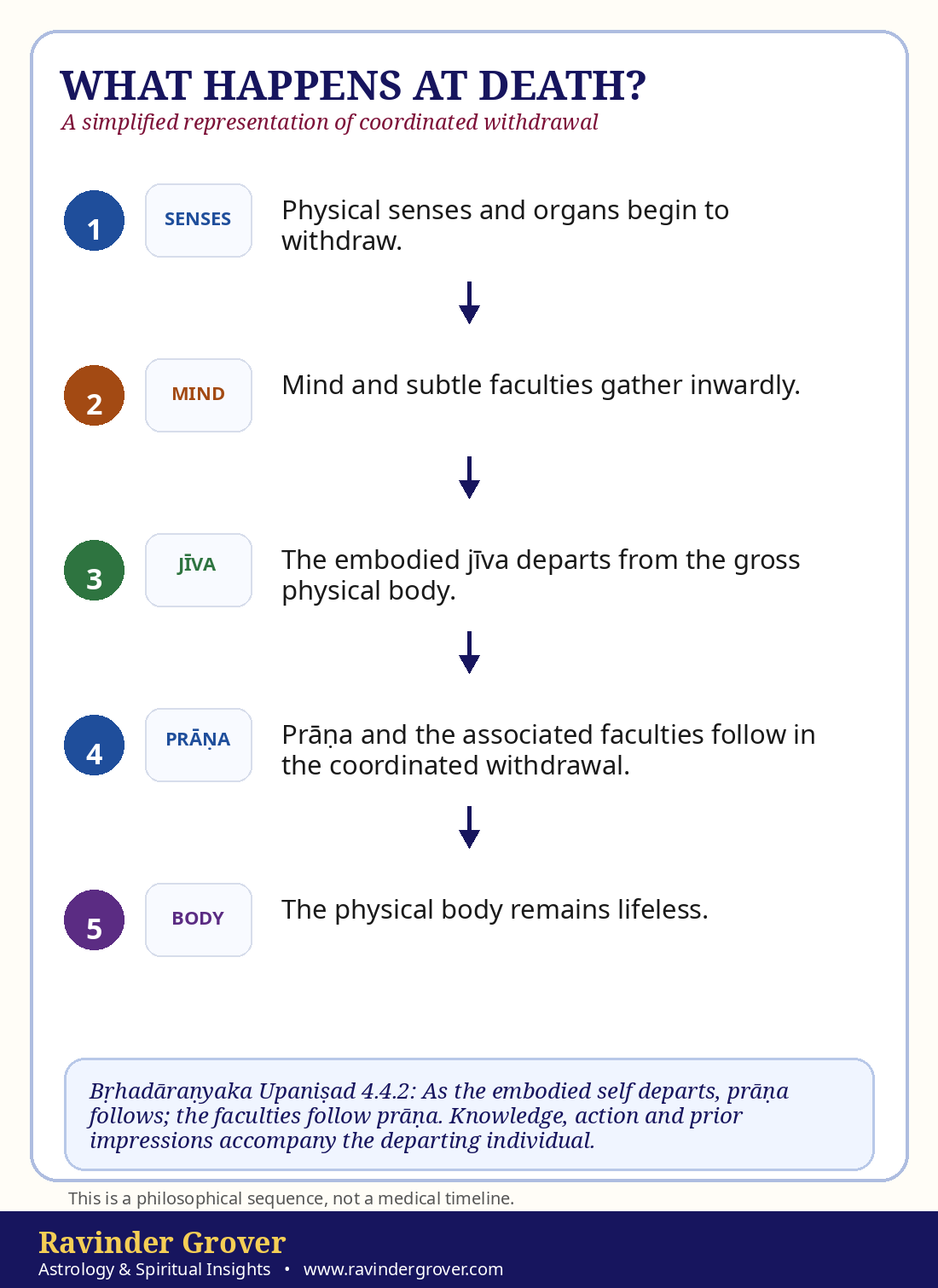
At death, the physical body loses its ability to function, while the subtle faculties undergo a process of withdrawal.
तमुत्क्रामन्तं प्राणोऽनूत्क्रामति ।
प्राणमनूत्क्रामन्तं सर्वे प्राणा अनूत्क्रामन्ति ।
सविज्ञानो भवति, सविज्ञानमेवान्ववक्रामति ।
तं विद्याकर्मणी समन्वारभेते पूर्वप्रज्ञा च ॥ ४.४.२ ॥
Literal translation: As the individual self departs, prāṇa follows. As prāṇa departs, all the prāṇas or faculties follow. The departing individual proceeds with particular consciousness; knowledge, action and previous impressions accompany it. (Bṛhadāraṇyaka Upaniṣad 4.4.2)
This verse does not necessarily describe several independent entities leaving at widely separated moments. It describes an ordered, coordinated withdrawal:
Physical organs lose their functions
↓
The powers of the senses withdraw
↓
Mind and subtle faculties gather inwardly
↓
The embodied jīva departs
↓
Prāṇa follows the departing jīva
↓
The organs or faculties follow prāṇa
↓
The physical body remains lifeless
Accordingly, this article’s formulation is accurate:
“The jīva departs from the gross physical body with its subtle faculties and karmic impressions; prāṇa participates in the coordinated withdrawal.”
Sri Sathya Sai Baba provides a closely related description of this withdrawal:
“…the words enter the mind, the mind enters the life force (prana), and the life force merges in the Atma.”
(Sri Sathya Sai Baba, Sathya Sai Vāhinī, Chapter VIII, “Bondage,” subsection “Solar and Lunar Paths of Liberation,” official SSSBPT interactive PDF, p. 34.)
He then separately discusses the onwards movement of the jīvātma, the embodied soul. Correctly presented:
Sri Sathya Sai Baba describes death as an inward withdrawal of expression into mind, mind into prāṇa, and prāṇa into its Ātmic source. He then refers to the onward journey of the embodied soul, or jīvātma. This statement should not be interpreted as saying that the universal, all-pervading Ātman physically travels from place to place.
This teaching describes an inward resolution:
Speech and expression
↓
Mind
↓
Prāṇa
↓
Ātmic source
The two perspectives are complementary:
- The Upaniṣadic account explains the order in which the embodied individual, prāṇa, and faculties depart.
- Sri Sathya Sai Baba’s account describes their inward resolution into subtler levels.
11. The Role of Udāna
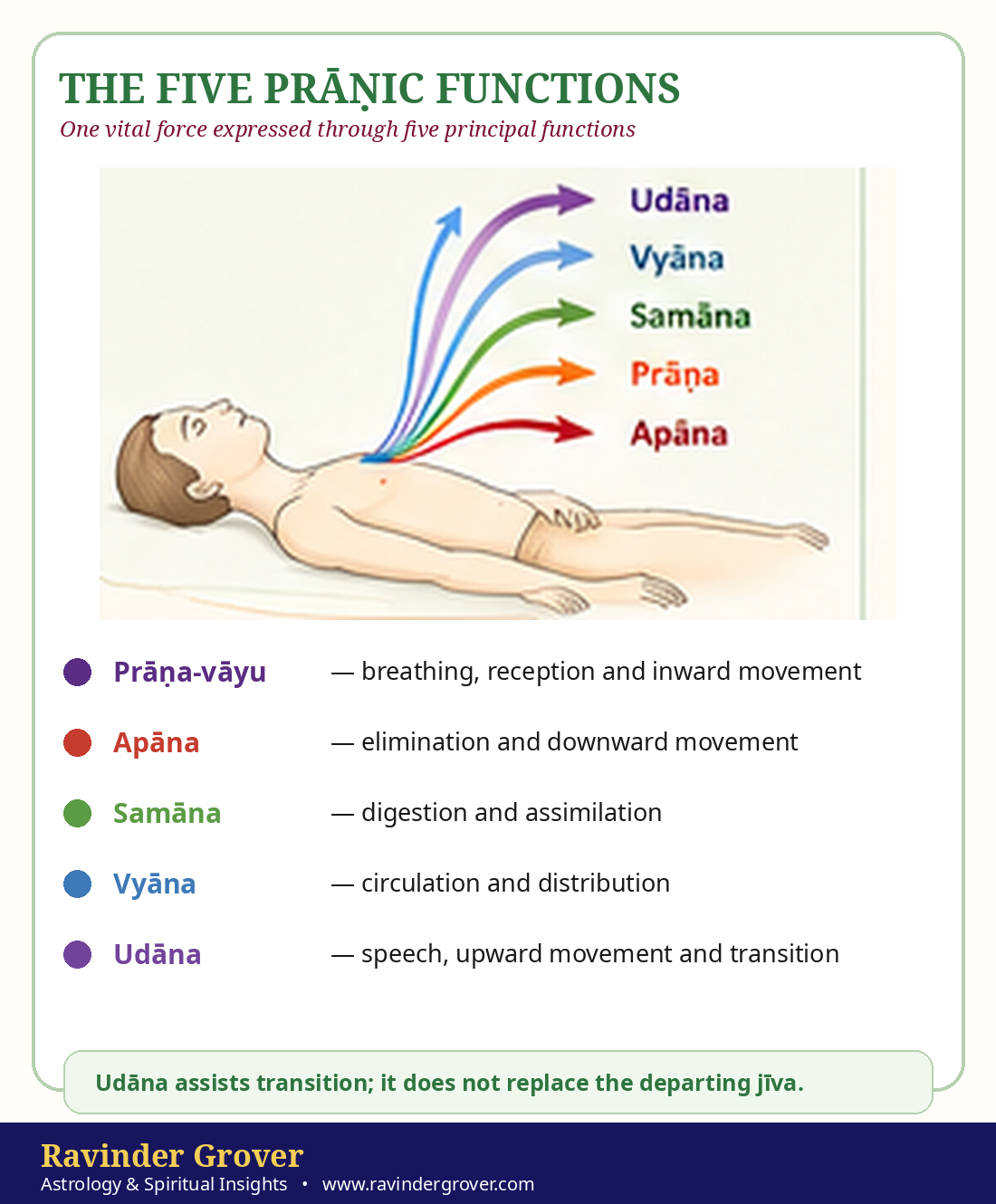
Among the five prāṇic functions, Udāna is associated with upward movement, speech and transition. At death, Udāna is traditionally connected with the jīva’s movement beyond the physical body. However, Udāna is not a separate soul or independent conscious being — it remains a function of prāṇa.
The jīva is the individual associated with:
- The subtle mind
- Karmic impressions
- Tendencies and desires
- Subtle sensory capacities
- The subtle body
“Udāna assists the transition; it does not replace the jīva.”
The Praśna Upaniṣad, Third Question, treats prāṇa as the governing vital principle and explains the functions of its differentiated expressions within the organism.
12. Who Helps Whom?
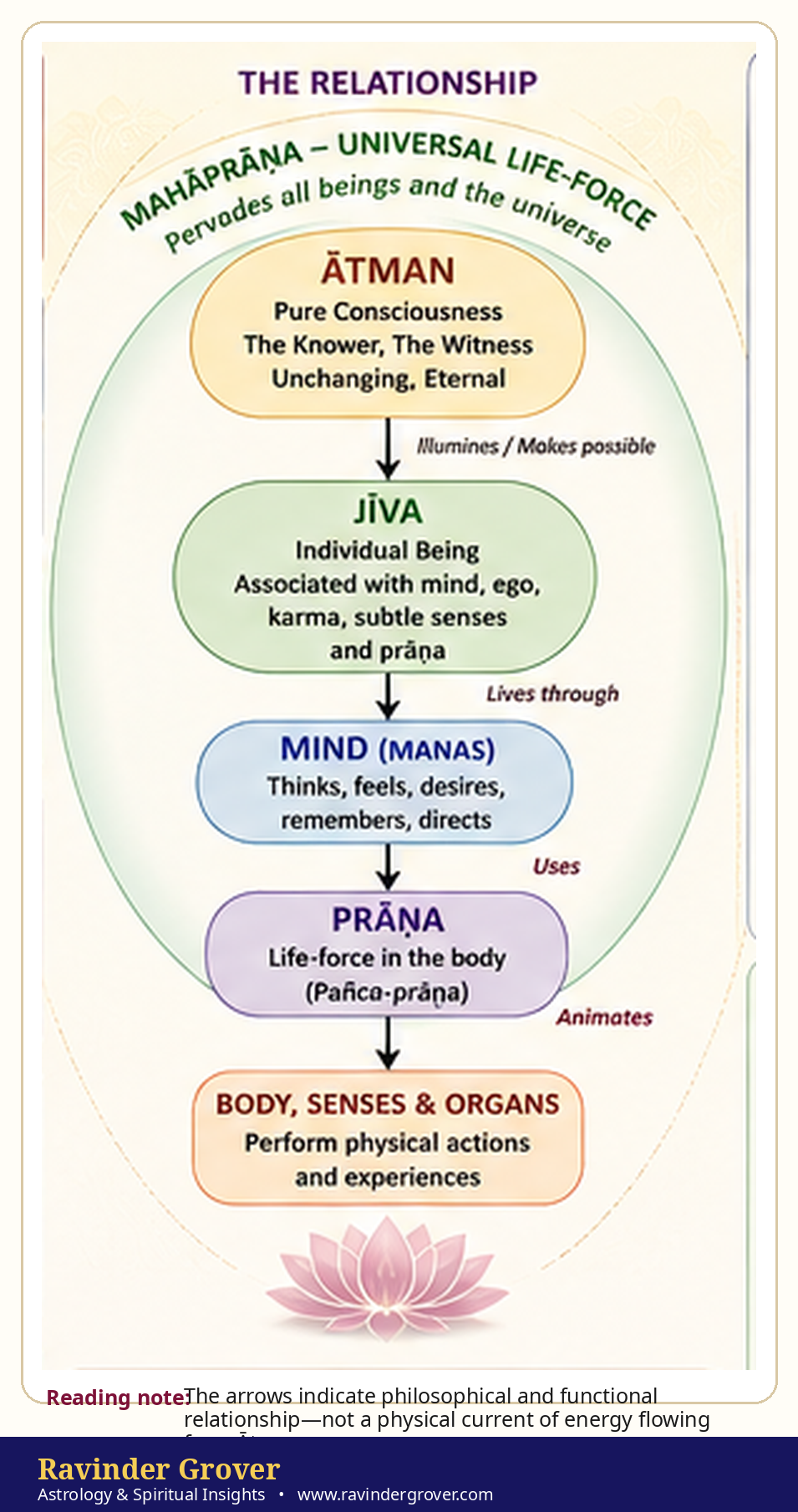
The word “help” can be misleading because these principles do not function as separate individuals assisting one another. A clearer understanding is:
Ātman illumines: it makes conscious knowing possible.
Mahāprāṇa sustains universal life.
Individual prāṇa energises the embodied organism.
Mind thinks, feels, desires and directs attention.
Jīva experiences embodied existence and karma.
The body performs physical actions.
The functional relationship may be represented as follows.
ĀTMAN
Eternal consciousness — the foundation
↓
makes experience consciously knowable
JĪVA
The individual-embodied experiencer
↓
associated with mind, karma and prāṇa
MIND
Thinks, feels, desires and directs
↓
↕
PRĀṆA
Energises mind and physical body
↓
BODY, SENSES AND ORGANS
Perform physical action
Mahāprāṇa may be represented as the universal vital field that nourishes individual prāṇa:
MAHĀPRĀṆA — Universal life-force
individualised expression
↓
PRĀṆA — Vital force functioning in one being
The arrow from Ātman should not be interpreted as a physical energy current. It indicates philosophical dependence and conscious manifestation.
13. A Simple, Child-Friendly Explanation
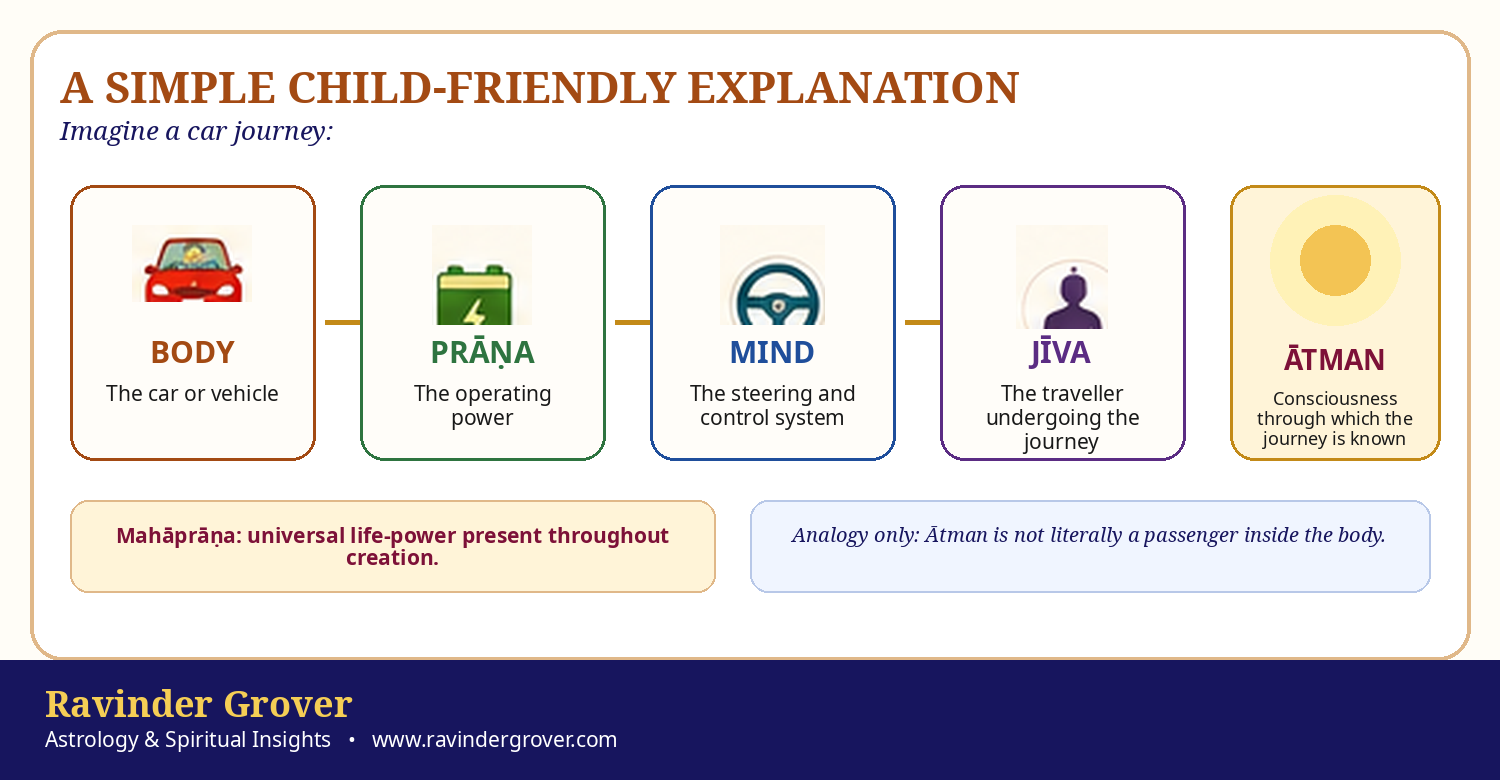
Imagine a car journey:
- The body is like the car.
- Prāṇa is the power that keeps the car running.
- The mind is the steering and control system.
- The intellect helps decide the direction.
- The jīva is the individual traveller on this journey.
- Ātman is the consciousness through which the journey is known.
- Mahāprāṇa is the universal life-power present throughout creation.
When the car becomes unusable, the traveller leaves it; the car remains behind.
The analogy has limits: Ātman is not literally a passenger sitting inside the body. Its purpose is only to distinguish the temporary vehicle, the individual experiencer, the vital power and consciousness.
14. Sri Sathya Sai Baba’s Unifying Teaching
Sri Sathya Sai Baba repeatedly directs attention away from excessive identification with the body and mind and towards the recognition of Ātmic reality. His teachings help us understand that:
- The physical body is temporary.
- Prāṇa supplies vitality.
- The mind shapes our experience.
- The jīva becomes identified with individuality.
- The Ātmic principle is the deeper basis of life.
Baba teaches that the mind connects, or merges, the distant Ātman with the immediate physical body, and that false identification arises when this connection leads a person to believe the temporary body alone is the true Self; spiritual wisdom reverses this process by turning attention inward. He also explains that human life cannot be properly understood at the physical level alone: the jīva’s life-principle has its basis in Ātma-tattva.
In Prasanthi Vāhinī, Baba links the condition of the body with prāṇa, mind and desire, showing that spiritual discipline must include purification and calming of the mind. In Sathya Sai Vāhinī, he describes death as an inward withdrawal of speech into the mind, the mind into prāṇa, and prāṇa into the Ātmic principle, followed by the onwards journey of the jīvātma.
Thus, Baba’s teaching complements the Upaniṣadic vision:
“Know that you are not merely the body, the changing mind or the moving prāṇa. Seek the eternal Ātmic reality that is the foundation of conscious existence.”
15. The Deeper Spiritual Purpose
These distinctions are not merely philosophical. As long as we identify completely with the body and mind, we say:
- “I am old.”
- “I am weak.”
- “I am disturbed.”
- “I am my thoughts.”
- “I am my suffering.”
Spiritual enquiry gradually teaches us to observe instead:
- The body is changing.
- Prāṇa is moving.
- The mind is thinking.
- Emotions are passing.
- The jīva is experiencing.
- But the conscious foundation remains.
This does not mean neglecting the body, mind, family or duties. It means using them as sacred instruments, without mistaking them for the entirety of our being.
Sri Sathya Sai Baba teaches that excessive body-attachment strengthens ego and separation, while recognition of the Ātmic principle develops the awareness of unity.
Final Thought
Ātman is not just another object located somewhere inside the physical body. It is not an organ, a thought, a breath or merely another form of energy. It is the conscious Self, through whose presence every experience is known.
The body performs physical action.
Prāṇa supplies vitality.
The mind thinks, feels and directs.
The jīva experiences embodied life and carries its subtle faculties and karmic impressions.
Ātman is the eternal conscious foundation through whose presence experience becomes knowable.
At death, the most careful formulation is:
“The embodied jīva withdraws from the gross physical body; prāṇa and the subtle faculties participate in the coordinated withdrawal. Pure Ātman, being eternal and all-pervading, neither comes nor goes.”
The memorable sentence may remain, provided it is identified as an original synthesis rather than a scriptural quotation:
“The body acts. Prāṇa energises. Mind thinks. Jīva experiences. Ātman illumines.”
A summary formulated by Ravinder Grover from the teachings of the Bhagavad Gītā, the Upaniṣads, Sri Sathya Sai Baba and Swami Rama.
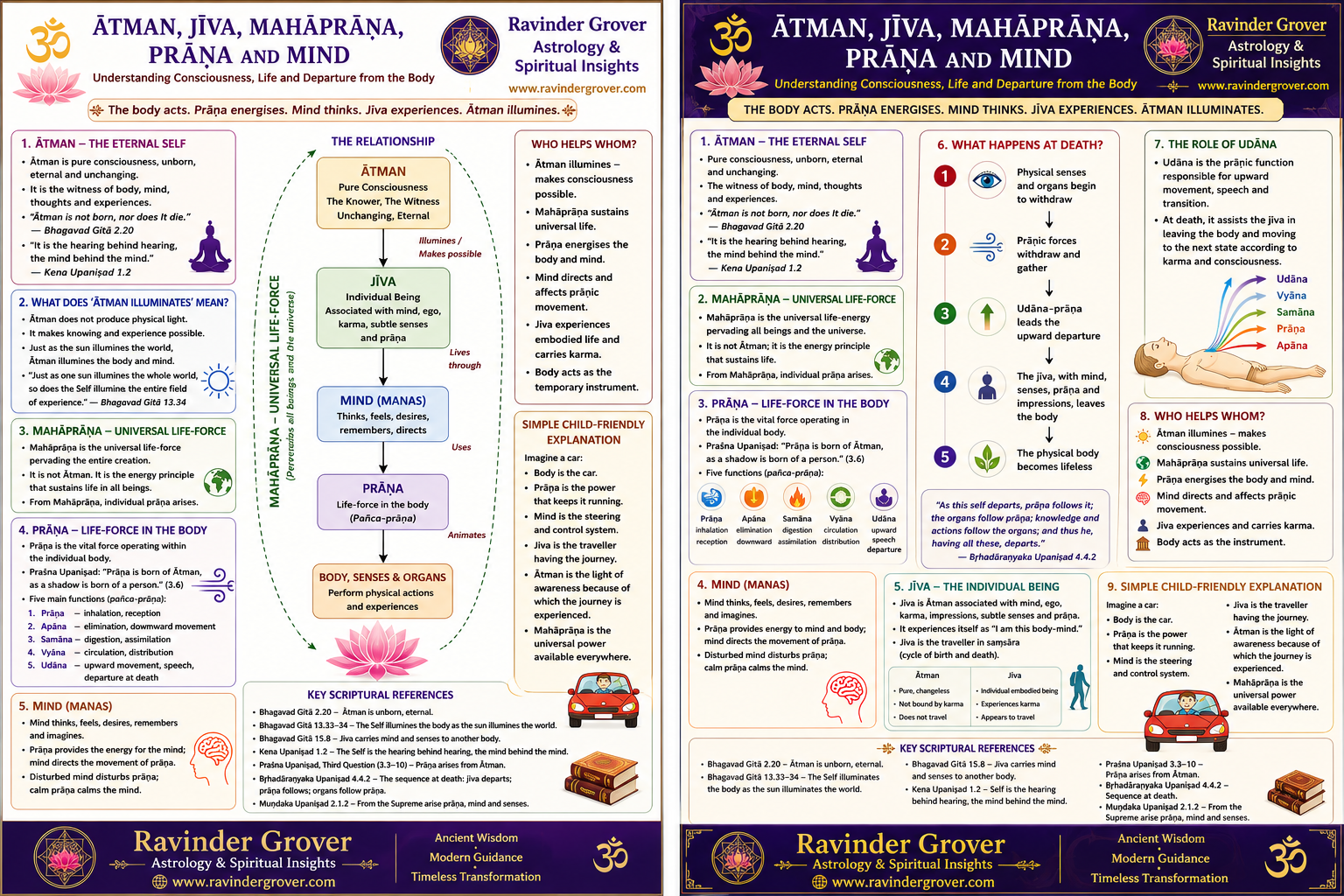
Principal Textual References
Primary scripture
- Bhagavad Gītā 2.20 — Exact Sanskrit and an English rendering are reproduced in Section 1. The Self is unborn, eternal, and survives the body’s destruction.
- Bhagavad Gītā 15.7–8 — Exact Sanskrit and an English rendering are reproduced in Section 9. The jīva is associated with mind and senses and carries these subtle faculties when leaving a body.
- Kena Upaniṣad 1.2 — Exact Sanskrit and an English rendering are reproduced in Section 2: the “ear of the ear”, “mind of the mind” and “prāṇa of prāṇa”.
- Praśna Upaniṣad 3.3 — Exact Sanskrit and an English rendering are reproduced in Section 5. Prāṇa arises from Ātman, depends upon it like a shadow upon a person, and enters the body through mind.
- Praśna Upaniṣad, Third Question — On prāṇa as the governing vital principle and its differentiated functions, including prāṇa, apāna, samāna, vyāna and udāna.
- Bṛhadāraṇyaka Upaniṣad 4.4.2 — The relevant Sanskrit and an English rendering are reproduced in Section 10. Prāṇa and the faculties follow the departing individual; knowledge, action and former impressions accompany it.
Authenticity note: for the Bhagavad Gītā and Upaniṣads, chapter, verse and mantra numbers are the authoritative references. Page numbers vary among Sanskrit editions and English translations.
Sri Sathya Sai Baba
- Sathya Sai Speaks, Vol. 24, Discourse 11, “The Inner Motivator”, Brindavan, 25 May 1991, p. 57 — “But what is the basis for this Jiva Tatwa? It is only the Atma Tatwa.”
- Summer Showers in Brindavan 1991, Discourse 3, “Thath Twam Asi — That Thou Art”, p. 14 — “The characteristic of the mind is to merge the distant Atma with the proximate body.”
- Prasanthi Vāhinī, “Peace, Love, and the Atma,” official interactive PDF, pp. 9–10 — Ātman is distinguished from the vital airs and life-force; the body is related to prāṇa, mind and desire.
- Sathya Sai Vāhinī, Chapter VIII, “Bondage,” subsection “Solar and Lunar Paths of Liberation”, official interactive PDF, p. 34 — On speech entering mind, mind entering life-force, and life-force merging in Ātman at death.
- Summer Showers in Brindavan 1973, Discourse 7, “Turn Your Mind Inward to Atma”, Brindavan, 26 May 1973, pp. 51–52 — On the five vital airs and the reciprocal control of mind and prāṇa.
Swami Rama
- Swami Rama, Meditation and Its Practice, Himalayan Institute Press, 1998 printing, ISBN 0-89389-153-3, Chapter 5, pp. 47–49; Chapter 6, pp. 69–70 — On breath as the bridge between body and mind, the interdependence of breath and mind, prāṇa as vital force, and the mind’s relation to the inner centre of consciousness.
Edition note: page numbers for the modern works above refer to the editions or official PDFs specified. Pagination may differ in another printing, so retain the edition information whenever quoting them.
Ravinder Grover
Astrology & Spiritual Insights
www.ravindergrover.com
© 2026 Ravinder Grover. All Rights Reserved.
This work is protected under copyright and the DMCA. Unauthorised use is prohibited.
Disclaimer: ‘Without Prejudice’. I offer my insight into astrology solely based on my learnings of astrology principles and techniques, some of which I learnt from the Sages of the highest order. These predictions are offered for guidance purposes only. I offer absolutely no guarantee on my calculations and analysis. These predictions are not intended to harm anyone by any means. I expressly disclaim all warranties, whether implied or contingent, for the use of these predictions or for incurring any loss or loss of profit in any manner whatsoever. No notice or advice from anyone will create any liability whatsoever


Leave A Comment