

NAVARATRI 2026 – Nine Nights for Nine Inner Transformations
Sharad Navaratri 2026 (11–20 October 2026) and Vijayadashami 21 October 2026
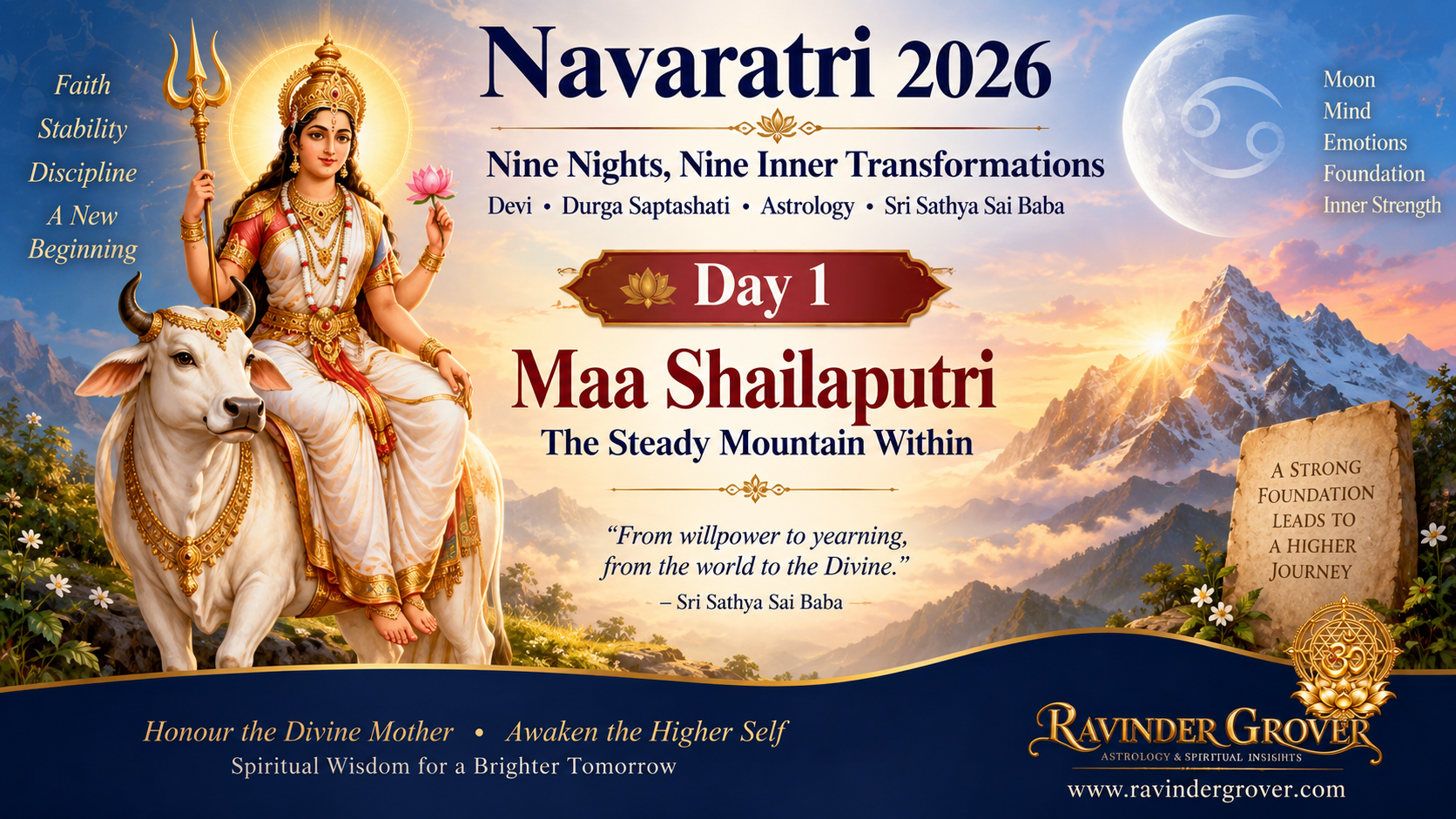
Navaratri 2026 · Day 1 – Maa Shailaputri: The Steady Mountain Within
1. Who Is Maa Shailaputri?
Navaratri opens with Maa Shailaputri, “the daughter of the mountain” (shaila: mountain, putri: daughter). She is the daughter of Himavan, king of the Himalayas, and the rebirth of Sati, who returns as Parvati to unite again with Lord Shiva.
She rides Nandi the bull, holds a trishula in her right hand and a lotus in her left, and wears the crescent moon on her forehead. Each symbol carries a teaching: the mountain suggests stability; the bull, patient strength and dharma; the trident, mastery over the three gunas; and the lotus, purity that remains untouched by its surroundings.
In the order of the Navadurga given in the Devi Kavacham (shlokas 3–5), she comes first: “Prathamam Shailaputri cha…”. Every spiritual journey begins with the same requirement: a firm foundation.
2. The Durga Saptashati Link
The Durga Saptashati (Devi Mahatmya) forms adhyayas 81–93 of the Markandeya Purana. Its first chapter is a fitting reading for Day 1.
King Suratha has lost his kingdom, and the merchant Samadhi has been driven out by his own family. They meet in the ashram of Rishi Medhas and ask a striking question: why do our minds still cling to those who rejected us, even when we know better?
The rishi answers that this is the power of Mahamaya:
| ज्ञानिनामपि चेतांसि देवी भगवती हि सा । बलादाकृष्य मोहाय महामाया प्रयच्छति ॥jñāninām api cetāṃsi devī bhagavatī hi sā | balād ākṛṣya mohāya mahāmāyā prayacchati ||“Even the minds of the wise, the Divine Mother Mahamaya forcibly draws into delusion.”(Devi Mahatmya 1.55; numbering follows the Gita Press edition and may vary slightly in other editions.) |
The same Mother who binds also releases. The chapter then tells of Madhu and Kaitabha, and Brahma’s hymn to Yoganidra. The lesson for Day 1 is simple: before we can climb, we must first recognise how easily the mind is pulled and turn to the Mother for steadiness.
3. The Astrological Link
Sharad Navaratri begins on Ashvina Shukla Pratipada, as the Moon begins to wax after Amavasya. Over the sacred nights the Moon grows in light, and so, ideally, does the mind of the sadhaka. The Purusha Sukta declares, “candramā manaso jātaḥ” — the Moon was born from the mind of the Cosmic Being (Rigveda 10.90.13).
In this series, the astrology lens for Maa Shailaputri is the Moon (Chandra): the mind, emotions, the mother and our inner foundation. A mountain does not move with every wind; the spiritual invitation of Day 1 is to cultivate a mind that does not move with every circumstance.
On Day 1, the Sun is in sidereal Kanya-Virgo, a sign associated with discrimination, service and purification. During the festival, the Sun moves into sidereal Tula-Libra on 17 October 2026, so the series itself crosses a solar threshold — from sorting and refinement toward balance, relationship and right measure.
4. Astrology Message for the Day
Day 1 is ideal for sankalpa — a clear resolve for the sacred period. Those whose charts show more challenging Moon signatures, such as close contact with Saturn, Rahu or Ketu, or a Moon under other forms of pressure, may recognise patterns of restlessness, worry or emotional fluctuation more readily.
Rather than fearing the chart, use the symbolism constructively. Keep regular sleep, make a simple offering according to your tradition, honour your mother or a mother-figure, and sit in silence. Remedies are most meaningful when they change the person, not merely the planet.
Astrology here is used as a reflective spiritual lens, not as a deterministic prediction.
5. A Message for Youngsters
A mountain does not chase every passing cloud. Many young people today feel pulled in every direction by trends, notifications, comparison and pressure. Maa Shailaputri’s message is simple: be rooted before you rise.
Make one small promise for the sacred period and keep it. It might be to wake a little earlier, keep the phone away for the first hour of the morning, or spend ten minutes a day studying without distraction. A promise kept builds more self-respect than a grand promise broken on day two. Strength is not loudness; it is steadiness.
6. Inner Message from Swami, Scripture, and the Sages
Bhagavan Sri Sathya Sai Baba taught that the forms of the Mother are not far away in the temple but within us. In His Dasara discourse at Prasanthi Nilayam on 9 October 1994, Swami declared that “Durga, Lakshmi, and Saraswati dwell in the human heart.” He explained them as three powers in every person: Durga as kriya shakti, the power of action; Lakshmi as ichcha shakti, the power of will; and Saraswati as jnana shakti, the power of wisdom and discrimination. Outer worship, then, should awaken these inner powers.
In His Dasara discourse of 9 October 2008 (Sri Sathya Sai Speaks, Vol. 41, Ch. 16, “All Are One, Be Alike to Everyone”), Swami explained the inner purpose of Dasara as purification of the actions of the dasendriyas — the five senses of perception and the five organs of action.
Swami also reminded devotees that one’s own mother is the living embodiment of Durga, Lakshmi and Saraswati: she gives strength, provides for us, and wishes us to grow in learning. This is especially meaningful for Day 1, whose astrology lens is the Moon, the traditional karaka of the mother. Begin Navaratri by honouring the Mother at home. (Dasara discourse, 14 October 1988; Sri Sathya Sai Speaks, Vol. 21, “The Mother Divine”)
The Bhagavad Gita is equally honest about the mind. Arjuna says it is restless, turbulent and difficult to restrain (Bhagavad Gita 6.34). Sri Krishna replies that it is brought under control by abhyasa — steady practice — and vairagya — detachment (Bhagavad Gita 6.35). Navaratri is an opportunity to practise both.
The Kena Upanishad gives a beautiful link to the Daughter of the Mountain. When the devas could not understand the mysterious Yaksha, there appeared before Indra “umāṃ haimavatīm” — Uma, daughter of Himavat — who revealed that the victory belonged to Brahman (Kena Upanishad 3.12). The Mother of Day 1 therefore also points us toward the first glimpse of Truth.
7. What Everyone Should Understand
• Navaratri is not only a sequence of rituals; it is an inner journey from steadiness at the beginning toward fulfilment and freedom.
• Fasting is a tool for restraint and alertness, not a test of endurance. Follow what your health allows; a simple sattvic diet is a valid observance.
• The Devi is worshipped outside so that She may be recognised inside — as the shakti that sustains our breathing, thinking, choosing and serving.
• Ghatasthapana (installing the kalash) can be contemplated as the body becoming a vessel of divine presence. What we place into that vessel through thought, food, speech and action matters.
8. Practical Orientation for Day 1
• Sankalpa: Sit quietly and state in your own words what you wish to cultivate during Navaratri.
• Ghatasthapana or a simple lamp: If a full kalash sthapana is not possible, light a ghee or oil lamp before an image of the Mother at the same time each day.
• Chanting: Repeat the Day 1 mantra 108 times, or read Chapter 1 of the Durga Saptashati, or at least the Devi Kavacham.
| DAY 1 MANTRA & DHYANA SHLOKA
ॐ देवी शैलपुत्र्यै नमः. Om Devi Shailaputryai Namah Salutations to Devi Shailaputri.
वन्दे वाञ्छितलाभाय चन्द्रार्धकृतशेखराम् । वृषारूढां शूलधरां शैलपुत्रीं यशस्विनीम् ॥ vande vāñchitalābhāya candrārdhakṛtaśekharām | vṛṣārūḍhāṃ śūladharāṃ śailaputrīṃ yaśasvinīm || I bow to the glorious Shailaputri, who wears the crescent moon, rides the bull, and holds the trident, for the fulfilment of my sincere wishes. |
• Stillness: Sit silently for ten minutes with attention on the breath, allowing the mind to settle like a mountain lake.
• Seva: Do one act of care for your mother, an elder woman, or someone who needs support.
Closing Prayer
| सर्वमङ्गलमाङ्गल्ये शिवे सर्वार्थसाधिके । शरण्ये त्र्यम्बके गौरि नारायणि नमोऽस्तु ते ॥sarvamaṅgalamāṅgalye śive sarvārthasādhike | śaraṇye tryambake gauri nārāyaṇi namo’stu te || “O Divine Mother, You are the most auspicious among all that is auspicious. You are the source of welfare and the fulfiller of all worthy aims. O Gauri, three-eyed and compassionate refuge of all, O Narayani, I bow to You.” Devi Mahatmya 11.10 |
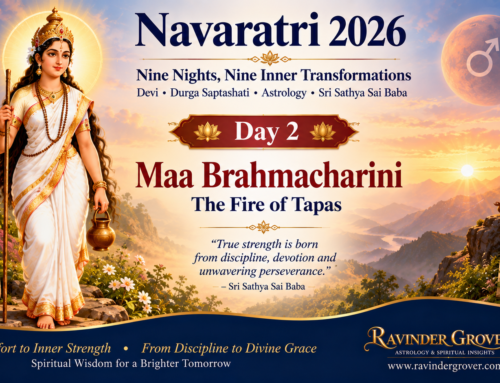
Tomorrow: Day 2 — Maa Brahmacharini, the power of tapas and self-discipline.
Ravinder Grover
Astrology & Spiritual Insights
www.ravindergrover.com
📲 Join my WhatsApp Channel for regular updates:
https://whatsapp.com/channel/0029Vai6rQz6rsQyMHx7nZ1z
| Disclaimer: Without prejudice: I offer my insights into astrology solely on the basis of my study of astrological principles and techniques, including teachings received from respected sages and teachers. Astrological observations in this article are offered for guidance and spiritual reflection only. They are not guarantees of outcomes and are not intended to cause harm. No liability is accepted for decisions, losses or loss of profit arising from the use of these observations. |

Leave A Comment