

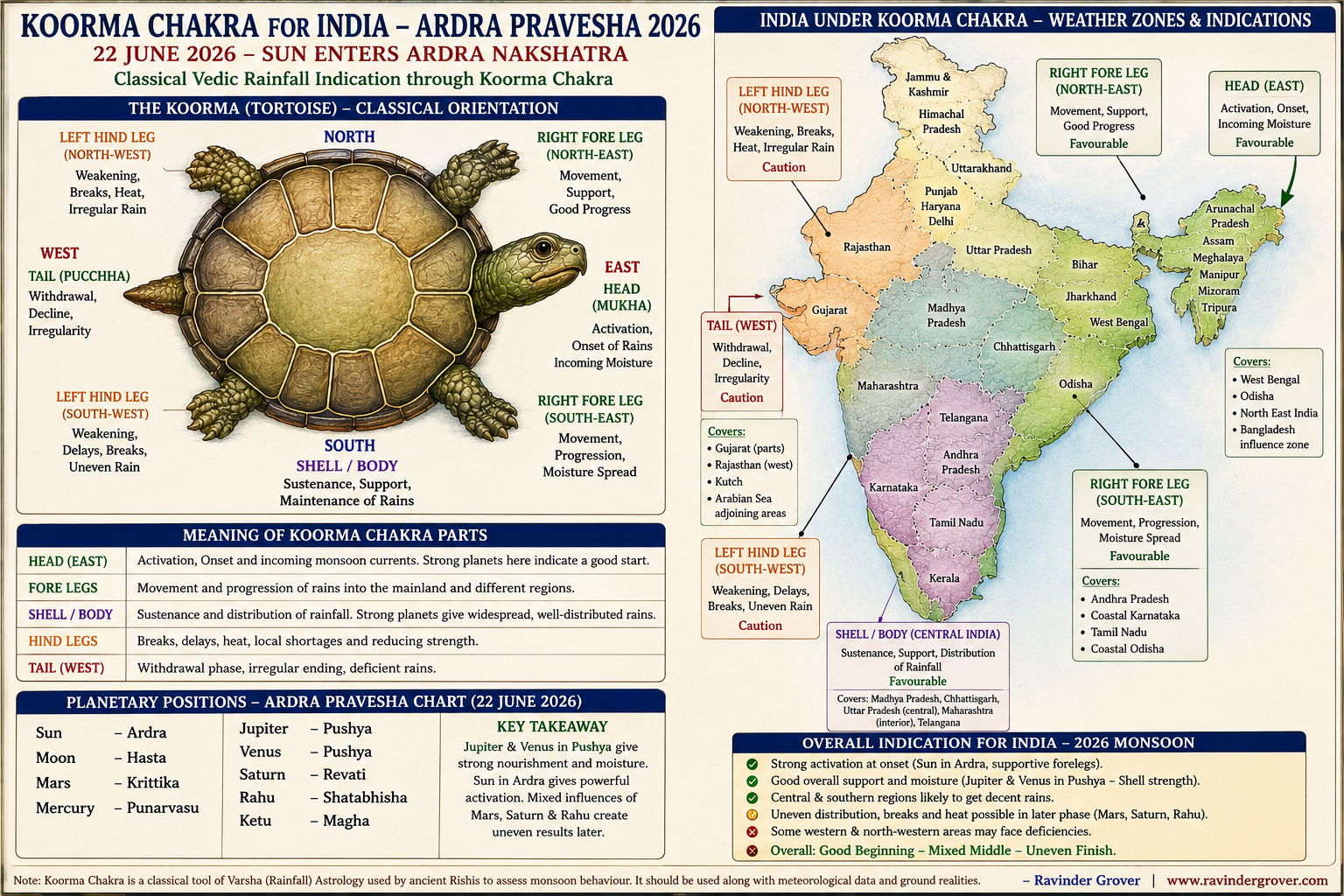
India’s 2026 Monsoon Forecast: Ārdrā Praveśa & Kūrma Chakra
India’s South-west Monsoon is far more than a weather event. It is the lifeline of agriculture, water reservoirs, food security, and rural livelihoods. A good monsoon supports crops, stabilises prices, replenishes groundwater, and uplifts millions. A weak or uneven monsoon can do the opposite.
Modern meteorology relies on ocean temperatures, atmospheric pressure systems, ENSO cycles, and climate models. Ancient India, however, developed its own fascinating system of Medinī Jyotiṣa (mundane astrology) and Varṣa Jyotiṣa (rainfall astrology) to understand weather patterns.
One of the most important traditional tools is Ārdrā Praveśa—the moment when the Sun enters Ārdrā Nakshatra. Another is Kūrma Chakra, the symbolic tortoise diagram used to understand rainfall activation, movement, sustenance, and withdrawal.
When we examine the 2026 monsoon through this classical lens, the message appears to be:
A strong beginning, respectable support in many regions, but uneven distribution later.
Why Ārdrā Praveśa Matters
In traditional weather astrology, the annual rainfall chart is often judged from the moment the Sun enters Ārdrā Nakshatra.
Ārdrā is ruled by Rudra, the force associated with storms, thunder, winds, atmospheric disturbance, and intense weather activation.
Ancient astrologers examined this ingress to judge:
- monsoon onset
- rainfall strength
- regional distribution
- drought tendencies
- flood possibilities
- seasonal progression
For 2026, the Sun enters Ārdrā on 22 June 2026, giving us the annual weather horoscope.
Planetary Nakshatras in the 2026 Ārdrā Praveśa Chart
Key placements are:
- Sun — Ārdrā
- Moon — Hasta
- Mars — Krittika
- Mercury — Punarvasu
- Jupiter — Pushya
- Venus — Pushya
- Saturn — Revati
- Rahu — Shatabhisha
- Ketu — Magha
This combination creates a rich and nuanced rainfall signature.
The Strong Positive Signals
Sun in Ārdrā – Monsoon Activation
The Sun in Ārdrā is a powerful trigger.
This supports:
- storm activation
- wind movement
- atmospheric disturbance
- energetic onset of rain-bearing systems
This is usually considered supportive for a healthy monsoon beginning.
Mercury in Punarvasu – Movement and Replenishment
Mercury governs movement, transport, and atmospheric dynamics.
Punarvasu symbolises restoration and renewal.
This combination supports:
- inland movement of moisture
- replenishment of rain systems
- cloud transport
This is favourable for monsoon progression.
Jupiter and Venus in Pushya – The Great Nourishers
This is the strongest positive feature of the chart.
Pushya is one of the most nourishing nakshatras.
Jupiter represents:
- abundance
- fertility
- expansion
- nourishment
Venus represents:
- moisture
- fertility
- fluid support
Together, they suggest:
- strong moisture support
- agricultural nourishment
- sustained rainfall in several regions
This argues against a severe nationwide monsoon failure.
The Challenging Signals
Moon in Hasta – Uneven Distribution
Hasta introduces movement and fluctuation.
This can create:
- shifting rainfall pockets
- scattered distribution
- uneven district-level outcomes
Meaning some places may receive excellent rain while nearby areas remain comparatively dry.
Mars in Krittika – Heat and Interruptions
Krittika is fiery and drying.
Mars here may create the following:
- heat bursts
- rainfall interruptions
- local weather aggression
- patchy support
Saturn in Revati – Delay and Weakening
Saturn tends to slow and obstruct.
This suggests:
- reduced continuity later
- delayed replenishment
- breaks in rhythm
Rahu in Shatabhisha – Unpredictability
Rahu adds surprise and instability.
Possible effects:
- erratic rainfall
- sudden heavy rain
- unusual local storm events
- regional extremes
Understanding Kūrma Chakra
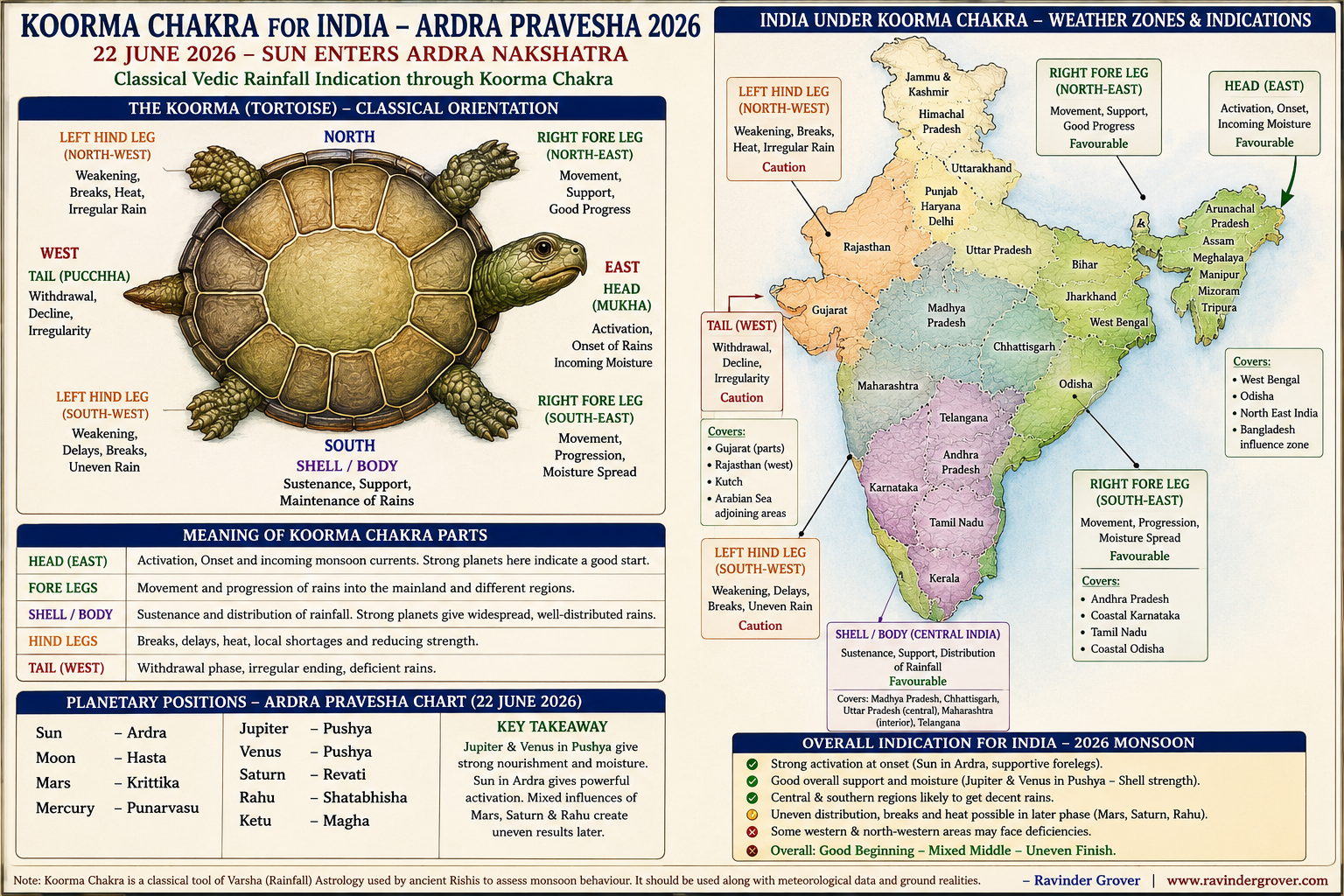 Ancient astro-meteorology also uses Kūrma Chakra, the symbolic tortoise.
Different parts of the tortoise represent different weather functions:
- Head (Mukha) → activation and onset
- Forelegs → movement and progression
- Shell / Body → sustained support and nourishment
- Hind legs → weakening and interruptions
- Tail → withdrawal and irregularity
Classically, this is directional and symbolic. When applied to modern India, it is best understood as an indicative interpretive framework rather than an exact political-state mapping.
Indicative Regional Rainfall Outlook
Strong Activation / Early Onset Regions
These regions may experience energetic monsoon activation:
- West Bengal
- Odisha
- Assam
- Arunachal Pradesh
- Meghalaya
- Nagaland
- Manipur
- Mizoram
- Tripura
- Sikkim
Interpretation:
Strong onset support, active cloud systems, thunderstorm potential.
Good Progression / Moisture Movement Regions
These regions may benefit from inland movement of monsoon systems:
- Uttar Pradesh
- Bihar
- Jharkhand
- Madhya Pradesh
- Chhattisgarh
Interpretation:
Good progression, though local variability remains possible.
Sustained Support Regions
These areas may receive generally supportive rainfall:
- Chhattisgarh
- central Madhya Pradesh
- Telangana
- Andhra Pradesh
- parts of Maharashtra
- Kerala
Interpretation:
Respectable moisture support and agricultural benefit.
Variable Distribution Regions
Rainfall may be active but inconsistent.
- Delhi
- Haryana
- Punjab
- Uttarakhand
- western Uttar Pradesh
Interpretation:
Neighbouring districts may experience noticeably different outcomes.
More Vulnerable / Interruption Regions
Potential heat stress or rainfall breaks:
- Rajasthan
- Gujarat
- Kutch
- western Madhya Pradesh
Interpretation:
Greater caution regarding rainfall continuity.
Practical Seasonal Outlook
Phase 1: June to Mid-July
Likely supportive.
Expect:
- active onset
- encouraging rainfall
- positive agricultural sentiment
- stronger eastern and central activation
Phase 2: Late July to August
Mixed.
Possible:
- interruptions
- uneven distribution
- heat breaks
- local extremes
Phase 3: September
Likely irregular.
Withdrawal may be uneven rather than smooth.
Practical Regional Summary
More Supportive
- Kerala
- Andhra Pradesh
- Telangana
- Chhattisgarh
- West Bengal
- North-East India
- central Madhya Pradesh
Mixed / Uneven
- Maharashtra
- Karnataka
- Odisha
- Uttar Pradesh
- Bihar
- Jharkhand
- Tamil Nadu
- Punjab
- Haryana
- Delhi
More Challenging
- Rajasthan
- Gujarat
- Kutch
- western dry belts
Final Classical Verdict
The ancient message appears remarkably clear:
- Ārdrā activates
- Punarvasu progresses
- Pushya nourishes
- Hasta scatters
- Krittika interrupts
- Revati delays
- Shatabhisha destabilises
In simple language: Good beginning. Mixed middle. Uneven finish.
As the ancient sky-watchers may well have said:
“The clouds shall gather with promise—but not every field shall receive them equally.”
Ravinder Grover
Mundane Astrology Research – Global Reset Series
🌐 www.ravindergrover.com
📲 Join my WhatsApp Channel for regular updates:
https://whatsapp.com/channel/0029Vai6rQz6rsQyMHx7nZ1z
© 2025 Ravinder Grover. All Rights Reserved.
This work is protected under copyright and DMCA. Unauthorized use is prohibited
Disclaimer: ‘Without Prejudice.’ I offer my insight into astrology solely based on my learnings of astrology principles and techniques, some of which I learnt from the Sages of the highest order. These predictions are offered for guidance purposes only. I offer absolutely no guarantee on my calculations and analysis. These predictions are not intended to harm anyone by any means. I expressly disclaim all warranties, implied or contingent, for making use of these predictions or for incurring any loss or loss of profit in any manner whatsoever. No notice or advice from anyone will create any liability whatsoever



Leave A Comment