

MAHĀŚIVARĀTRI 2026
The Śiva Liṅga, Sri Rudram, and Becoming the Inner Axis in a Time of Cosmic Recalibration
Introduction: When Darkness Reveals Light
When the moon almost disappears from the sky, something profound becomes possible. In the deepest darkness, the subtlest light becomes visible.
Mahāśivarātri is that night. But what is it that truly awakens on this night?
Mahāśivarātri—the “Great Night of Śiva”—falls on the fourteenth lunar day of the waning moon, when the moon is nearly absent from the sky. In spiritual symbolism, the moon represents the mind. As it wanes, emotional turbulence softens, ego-identification weakens, and inner quietude becomes accessible.
Thus, Mahāśivarātri is not merely a ritual observance; it is a cosmically aligned opening of consciousness.
Darkness here does not signify negativity; it signifies inwardness—the silence from which awareness arises and to which it ultimately returns.
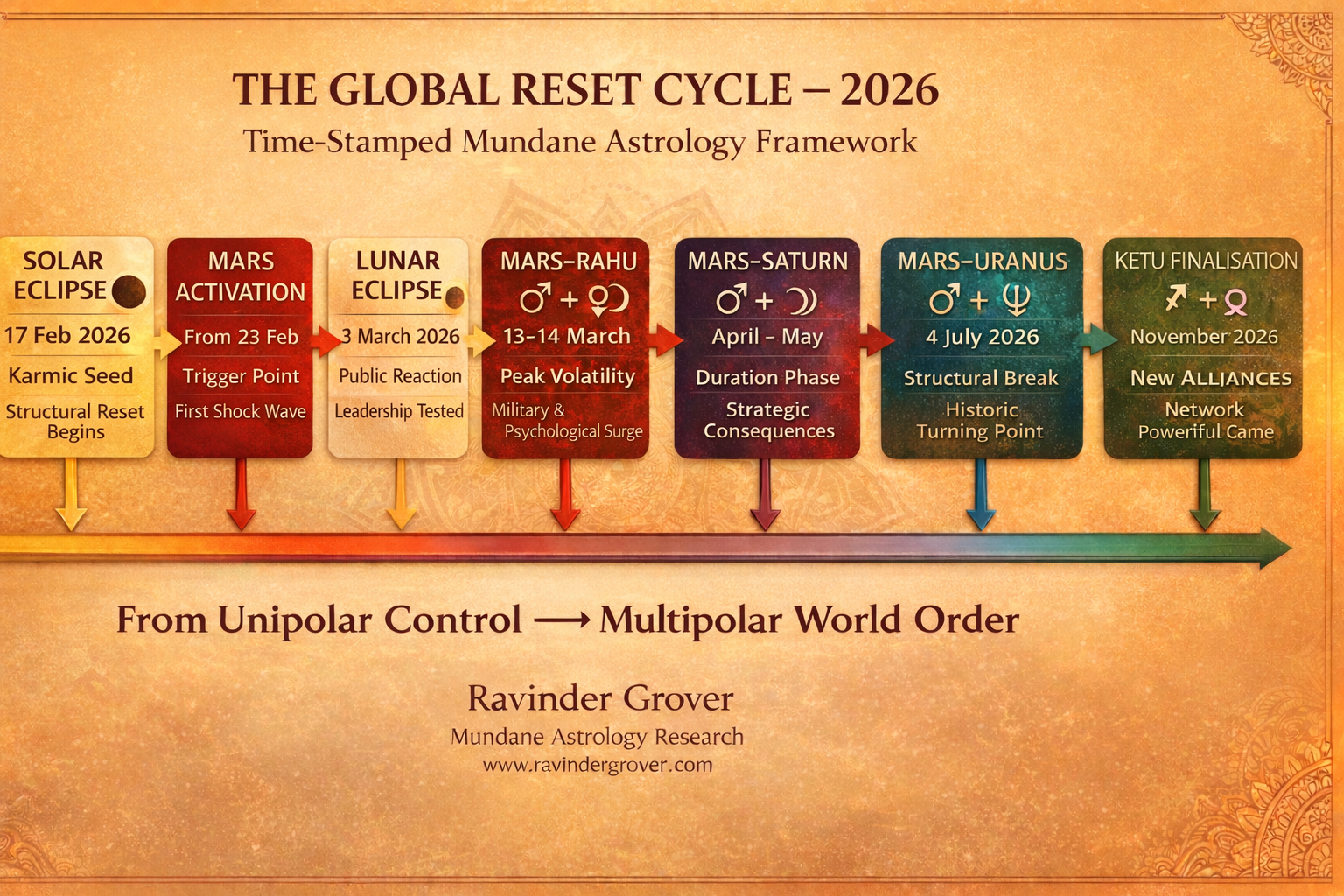
In 2026, this sacred observance arrives during a period marked by significant planetary convergence—notably the Saturn–Neptune conjunction in Pisces and eclipse activity along the Aquarius–Leo axis. Symbolically, such alignments reflect periods when collective structures are questioned, long-held assumptions are reassessed, and emotional undercurrents intensify.
Whenever outer systems shift, inner steadiness becomes essential. Mahāśivarātri trains that steadiness.
The Meaning of the Śiva Liṅga
As Explained by Sri Sathya Sai Baba
Sri Sathya Sai Baba offered one of the clearest explanations of the Śiva Liṅga in modern spiritual discourse.
He explained that:
- “Li” means dissolve
- “Gam” means merge
Thus, ‘Liṅga’ means: “That into which all dissolves and from which all emerges’.
The Liṅga is not merely a stone object, nor a sectarian emblem. It represents:
- The origin of creation
- The sustenance of creation
- The dissolution of creation
- The formless Absolute
It has no limbs, no facial features, and no anthropomorphic limitation. This is deliberate. The Divine cannot be confined within personality or form.
The Liṅga is not merely an object of worship; it is a revelation of ontology — a statement about the nature of reality itself. It points to the formless Brahman of the Upanishads—that which is beyond name, beyond form, and beyond limitation.
It is metaphysics expressed through simplicity.
Liṅgodbhava: The Infinite Pillar of Light
The Purāṇas describe a boundless column of light that appeared before Brahmā and Viṣṇu. Neither could find its beginning nor its end. This episode, known as Liṅgodbhava, encodes a profound truth: the ego cannot measure infinity, and the intellect cannot grasp the Absolute.
The Liṅga symbolises vertical infinity piercing the horizontal flow of time — still light amidst moving shadows. Time unfolds through birth, growth, decay, and dissolution. The Liṅga stands beyond sequence. Mahāśivarātri commemorates this recognition: within the human being exists a dimension untouched by time.
Sri Sathya Sai Baba explained that the word Liṅga means “that in which all forms merge” and “that from which all forms emerge.” It is the sign of the formless, attributeless Reality — the Divine beyond name and form. (Ref: Mahāśivarātri Discourse, 24 February 1981; 20 February 1985)
Unlike anthropomorphic representations, the Liṅga does not confine God to human features. Its smooth, uncarved form directs the mind toward the Infinite. Swami taught that its oval shape signifies the cosmic totality, while its vertical axis represents the ascent of consciousness from the finite to the Absolute. (Ref: Mahāśivarātri Discourse, 16 February 1977; 21 February 1993)
He repeatedly reminded devotees that the true Liṅga is not external. It is within the heart. The Lingodbhava observed on Mahāśivarātri symbolises the emergence of divine awareness from within the individual. (Ref: Mahāśivarātri Discourse, 28 February 1968; 4 March 2002)
Swami declared: “The Linga is the symbol of the Formless and the Absolute. It is the sign of the Divine Principle that pervades everything.” Thus, the Liṅga represents:
-
The beginningless and endless Reality
-
The unity of creation and dissolution
-
The axis of inner awakening
-
The silent centre beyond time
Mahāśivarātri is therefore not merely ritual remembrance. It is the invitation to discover the luminous axis within — the still awareness that neither arises nor dissolves. When that inner Liṅga is realised, time loses its tyranny, and consciousness rests in the Eternal.
The Liṅga as Cosmic Axis
Across cultures, metaphysical traditions speak of a central axis—an unmoving center around which all motion occurs.
In Vedic cosmology, this is Mount Meru. The Śiva Liṅga represents this axis.
- Planets revolve.
- Civilizations evolve.
- Time cycles unfold.
Yet the axis remains steady.
Motion depends upon a center. Without an unmoving center, rotation collapses into chaos. Stability is not the absence of motion; it is the presence of an unmoving core.
In periods of planetary recalibration—such as 2026—this symbolism becomes deeply relevant. When horizontal systems fluctuate, vertical alignment must strengthen.
Mahāśivarātri invites vertical anchoring.
The Yogic Dimension: The Spine as Inner Meru
The human body mirrors cosmic structure.
- The spine represents Mount Meru.
- The chakras align along this vertical axis.
The Liṅga’s vertical form is not accidental; it is instruction.
Awareness must rise.
- The circular base represents Prakṛti — the field of manifestation.
- The vertical axis represents Purusha — pure consciousness.
Śiva and Śakti are inseparable. Consciousness and energy are one.
Mahāśivarātri is the night when this inner union can be consciously experienced.
Sit upright. Spine steady. Breathe quietly.
Let awareness become the pillar.
Sri Rudram: The Vibrational Axis and the Role of the Rudras
If the Liṅga is the cosmic axis, Sri Rudram is its vibration. Found in the Krishna Yajur Veda, it unfolds in two sacred movements:
• Namakam — salutations that dissolve ego
• Chamakam — invocations that refine aspiration
Each “Namah’ in Namakam bends the ego inward and each “Cha me” in Chamakam lifts aspiration upward. Namakam softens identity; Chamakam invokes strength, clarity, discipline, and illumination. Thus, Rudram becomes spiritual reconstruction — dissolving lower tendencies while awakening higher purpose.
Sri Sathya Sai Baba explained that the Eleven Rudras are not distant deities but the eleven faculties within the human system — the five organs of perception, the five organs of action, and the mind. Their role is governance and purification. When uncontrolled, these faculties pull awareness outward. The eyes chase form, the ears seek distraction, speech becomes impulsive, actions turn reactive, and the mind wanders restlessly. This outward dissipation creates sorrow — hence the name “Rudra,” from the root meaning “to weep.”
Yet Rudra does not exist to create suffering. Rudra exists to remove its causes.
Swami connected the Rudra principle with the threefold human afflictions:
- Adhibhautika — physical and external disturbances arising from the body and environment.
- Adhyātmika — internal and mental disturbances caused by desire, anger, ego, and restless thought.
- Adhidaivika — subtle and karmic influences beyond immediate perception.
Rudra energy purifies all three.
- By disciplining the senses, adhibhautika imbalance reduces.
- By steadying the mind, adhyātmika suffering dissolves.
- By invoking sacred sound through Sri Rudram, adhidaivika disturbances are harmonised.
Sri Sathya Sai Baba also emphasised during the Ati Rudra Maha Yajna that sacred sound purifies the five elements and restores balance in the subtle environment. Rudram restores alignment — within the individual and in the collective field.
When the eleven faculties are governed:
• The senses become instruments of discrimination
• Speech becomes truthful and compassionate
• Actions align with dharma
• The mind becomes steady
Then agitation transforms into auspiciousness. Rudra reveals Himself as Śiva — the benevolent inner Self.
Thus, chanting Sri Rudram is not mere recitation. It is inner alignment. True Rudra worship is self-control. Real abhiṣeka is purification of conduct.
Mahāśivarātri becomes meaningful when the eleven Rudras within are brought under awareness and aligned with dharma. In that mastery, the inner axis stands steady — and consciousness rises beyond sorrow.
The Panchākshari Mantra
ॐ नमः शिवाय (Om Namaḥ Śivāya)
This five-syllable mantra corresponds to the five elements.
Chanting it harmonises breath, speech, and awareness.
In times of emotional volatility — symbolically reflected by Pisces and Neptune — sacred vibration stabilises the inner field. Sound restores centre.
Mahākāla and the 2026 Astrological Climate
Śiva is Mahākāla — Lord of Time.
Astrology studies time cycles; Śiva represents awareness beyond cycles.
The Saturn–Neptune conjunction in Pisces symbolically reflects:
- Saturn — structure, karma, discipline
- Neptune — dissolution, transcendence, illusion
- Pisces — cosmic waters, collective emotion
When slow-moving planetary cycles converge, history often enters periods of reassessment and structural renewal.
Eclipses along the Aquarius–Leo axis highlight collective systems and leadership identity.
These alignments do not demand fear; they invite awareness. Recalibration may create uncertainty, but uncertainty can also awaken introspection.
Mahāśivarātri reminds us:
You are not merely subject to time; you are the witness of time
Dissolution: Threat or Liberation?
Śiva destroys — but what? Not the universe. He destroys:
- Ego
- Attachment
- Illusion
- False security
If ego clings, dissolution feels frightening. If awareness expands, dissolution becomes liberation.
Mahāśivarātri is conscious dissolution.
- Before life compels surrender, choose surrender.
- Before structures dissolve around you, dissolve ego within you.
In conscious surrender lies freedom.
Abhiṣeka: Ritual as Inner Transformation
External Abhiṣeka (ritual bathing of the Liṅga) symbolises internal cleansing.
- Water — purity of thought
- Milk — compassion
- Honey — sweetness of speech
Sri Sathya Sai Baba repeatedly emphasised that ritual without character refinement is hollow.
The true Liṅga is the heart.
When the heart becomes pure, every breath becomes worship.
The true abhiṣeka is transformation of conduct.
Practical Spiritual Discipline for Mahāśivarātri 2026
- Observe simplicity or partial fasting
- Maintain silence for some time
- Chant Om Namaḥ Śivāya
- Recite or listen to Sri Rudram
- Sit with spine erect — awareness as pillar of light
- Reflect on ego-patterns that must dissolve
- Strengthen truth, righteousness, and compassion
Let Astrology become awareness, not anxiety.
Let Mahāśivarātri become transformation, not tradition.
Let this night not pass as a ritual memory, but as an inner turning.
Conclusion: Becoming the Axis
Mahāśivarātri 2026 is not a night of fear. It is a night of alignment.
- The Liṅga teaches vertical infinity.
- Rudram teaches vibrational purification.
- Astrology teaches timing.
When cycles intensify, anchor deeper.
When illusions dissolve, awaken awareness.
When structures recalibrate, strengthen character.
When the outer sky trembles, become the inner sky.
When cycles intensify, they become stillness itself.
Become the unmoving centre.
Become the witnessing awareness.
Become the Liṅga.
.
© 2025 Ravinder Grover. All Rights Reserved.
This work is protected under copyright and DMCA. Unauthorized use is prohibited
Ravinder Grover
Disclaimer
The astrological insights shared in this article are based on traditional principles and personal study. They are offered for educational and reflective purposes only. Astrology describes tendencies, not certainties. No guarantee is made regarding outcomes, and readers are advised to exercise independent judgement in all financial, professional, or personal decisions.

Leave A Comment