

The Aquarius Eclipse of 2026 and the Structural Reordering of Global Power
A Mundane Astrological Study (2026–2027)
Ravinder Grover
Vedic · KP · Karmic · Mundane Astrology Researcher
Abstract
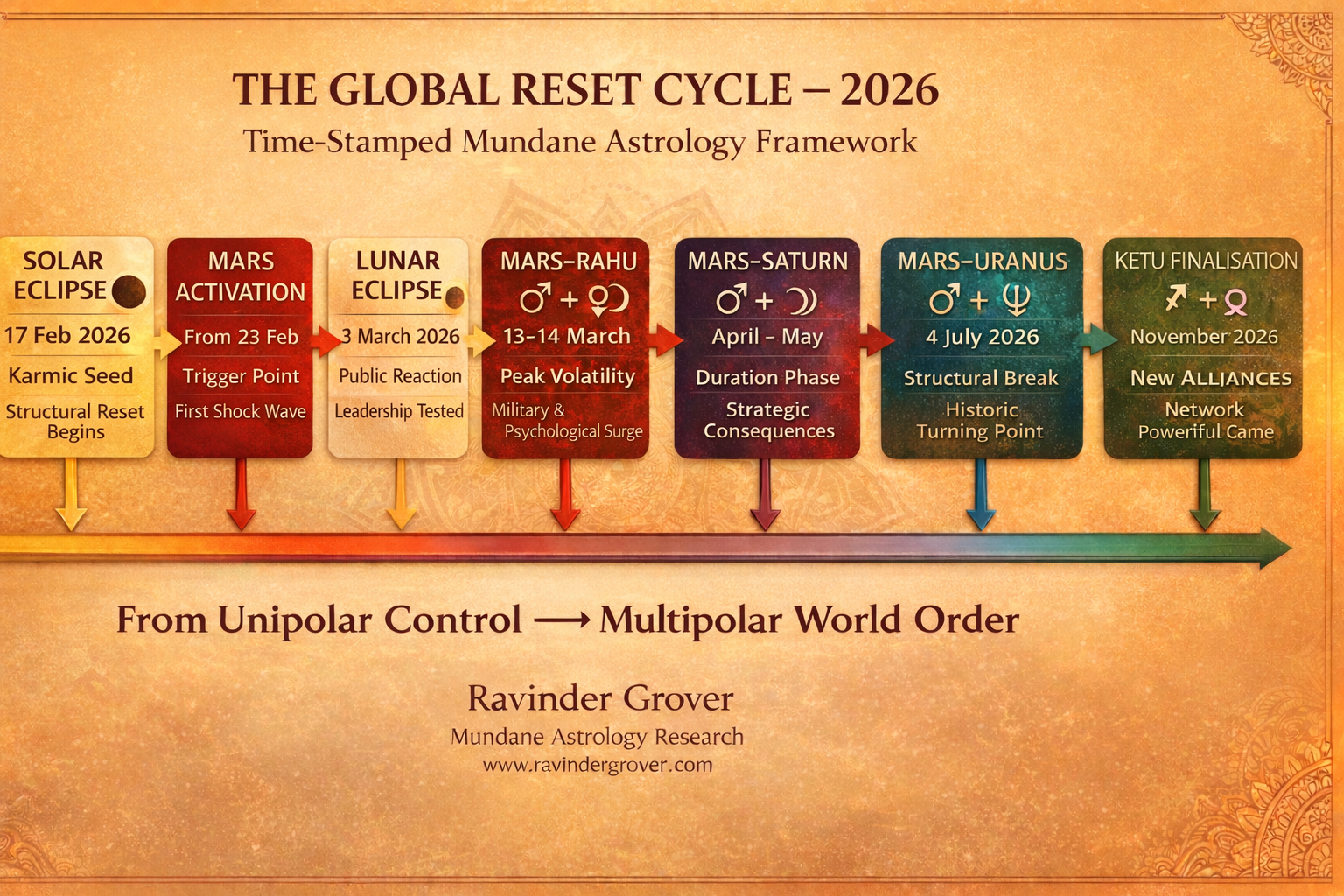
The solar eclipse of 17 February 2026 at 4° Aquarius (Dhanishtha Nakshatra) marks the beginning of a major geopolitical restructuring cycle. This paper examines the eclipse through the classical mundane framework of sign, nakshatra, dispositorship, outer-planet background, and national chart interaction. The study demonstrates that the period 2026–2027 corresponds not to a phase of global collapse but to a systemic reorganisation of power characterised by the transition from unipolarity to a network-based multipolar order. Particular emphasis is placed on the synchronised rise of India as a central stabilising force within this emerging structure.
1. Introduction: Eclipses as Historical Time Markers
In mundane astrology, eclipses do not merely indicate events.
They open historical chapters.
Their impact becomes decisive when:
-
they occur in fixed signs → long-duration structural effects
-
they are placed in Mars-ruled nakshatras → material execution
-
they are rapidly activated by transiting Mars → event manifestation
The eclipse of 17 February 2026 fulfills all three conditions.
It must therefore be treated as
a world-system reset point.
2. Astronomical and Sidereal Framework
Date: 17 February 2026
Position: 4° Aquarius (sidereal)
Nakshatra: Dhanishtha
Nakshatra Lord: Mars
Sign Lord: Saturn
This produces a combined planetary governance:
Saturn → structural karma
Mars → execution of change
Historically, Saturn–Mars cycles coincide with:
-
geopolitical realignment
-
redistribution of power
-
institutional restructuring
-
strategic conflict followed by system redesign
3. Mundane Significance of Aquarius
In mundane astrology Aquarius governs:
-
multilateral alliances
-
treaty frameworks
-
global governance architecture
-
technological civilisation
-
transnational economic systems
An eclipse in this sign indicates:
-
exhaustion of an existing world order
-
redesign of institutional networks
-
redistribution of influence across multiple centres
This is the classical signature of the end of a unipolar era.
4. Dhanishtha Nakshatra as an Execution Field
Dhanishtha is not symbolic.
Its core attributes include:
-
synchronised action
-
control and redistribution of resources
-
rhythm change in power structures
-
military-economic coordination
When activated in mundane charts, it produces:
-
implementation of structural change
-
decisive geopolitical timing
-
rapid realignment following a latent phase
5. The Trigger Mechanism: Mars as Event Deliverer
The eclipse itself plants the karmic seed.
Materialisation begins when Mars:
-
enters Aquarius (23 February 2026)
-
crosses the eclipse degree (late February–early March 2026)
This produces the first visible manifestations:
-
diplomatic escalation
-
military signalling
-
market volatility
-
strategic policy shifts
6. The Mars–Uranus Conjunction of 4 July 2026
This is the principal rupture point of the cycle.
Mars–Uranus combinations in mundane history correlate with:
-
revolutionary geopolitical developments
-
technological power breakthroughs
-
sudden alliance restructuring
-
irreversible strategic shifts
Its occurrence in the 250th year of American independence marks:
a civilisational reset in the global leadership model.
7. Outer-Planet Background: The Epochal Engine
No eclipse becomes epochal without outer-planet support.
Pluto in Aquarius
Transfer of power from centralised empires to network systems.
Uranus in Taurus
Disruption of:
-
financial models
-
resource control
-
food and currency structures
Neptune in late Pisces
Dissolution of the post-Cold-War ideological framework.
Together these signify:
the end of the unipolar world.
8. Rahu Cycles and Historical Parallels
Major global restructuring phases correspond to Rahu return cycles:
| Period | Historical Expression |
|---|---|
| 1917–18 | Emergence of new ideological world systems |
| 1947 | Decolonisation – birth of new nations including India |
| 1989 | Collapse of the bipolar order |
| 2008 | Global financial reset |
| 2026 | Beginning of the network-based world order |
India’s independence itself occurred in a Rahu-driven global reset.
The 2026 cycle represents the next octave of the same karmic pattern.
9. National Chart Interaction
9.1 United States
This cycle activates:
-
institutional transformation zones
-
financial restructuring sectors
-
alliance redefinition houses
The United States transitions from:
sole superpower → system architect.
9.2 China
Activation indicates:
-
inward consolidation
-
technological depth strategy
-
long-term systemic positioning
Not expansion—but structural embedding.
9.3 India
The eclipse activates India’s:
-
global diplomacy axis
-
long-term destiny houses
-
Saturn-linked growth sectors
India is a civilisation aligned with Saturnian time cycles.
In a Saturn-governed restructuring era:
resonance produces rise.
10. Functional Expression of India’s Emergence
10.1 Geopolitical
-
balancing power between blocs
-
strategic autonomy model
-
diplomatic bridge nation
10.2 Economic–Technological
Alignment with the Aquarian Age through:
-
digital infrastructure
-
space systems
-
demographic scale
-
network economy
10.3 Civilisational
A non-expansionist influence model rooted in continuity and pluralism.
This is historically unprecedented in modern power transitions.
11. Regional Activation: Mars in Aquarius
Aquarius governs cross-border systems:
-
water treaties
-
migration flows
-
intelligence networks
-
strategic corridors
Therefore the cycle produces:
-
treaty renegotiations
-
heightened diplomatic activity
-
controlled tension phases
Not necessarily war—but sustained activation.
12. The Ketu Phase – November 2026
Mars–Ketu contact represents:
-
separation from obsolete alliances
-
removal of outdated leadership
-
irreversible karmic outcomes
This closes the first phase of the cycle.
13. The Emerging World Structure (By 2027)
The end state of the cycle:
-
multipolar power grid
-
fluid alliance systems
-
technology as the primary influence currency
-
corridor-based geopolitics
India becomes a central stabilising node in this system.
14. Conclusion
The eclipse of February 2026 does not indicate global instability in the conventional sense.
It marks:
-
the structural redesign of the world order
-
the transformation of American leadership
-
the consolidation of Chinese systemic power
-
the rise of India as a civilisational and geopolitical anchor
This is not a short-term event cycle. It is a transition between historical epochs.
Disclaimer
Without prejudice. These observations are based on established principles of mundane astrology and are offered for academic and research purposes only.

Leave A Comment