

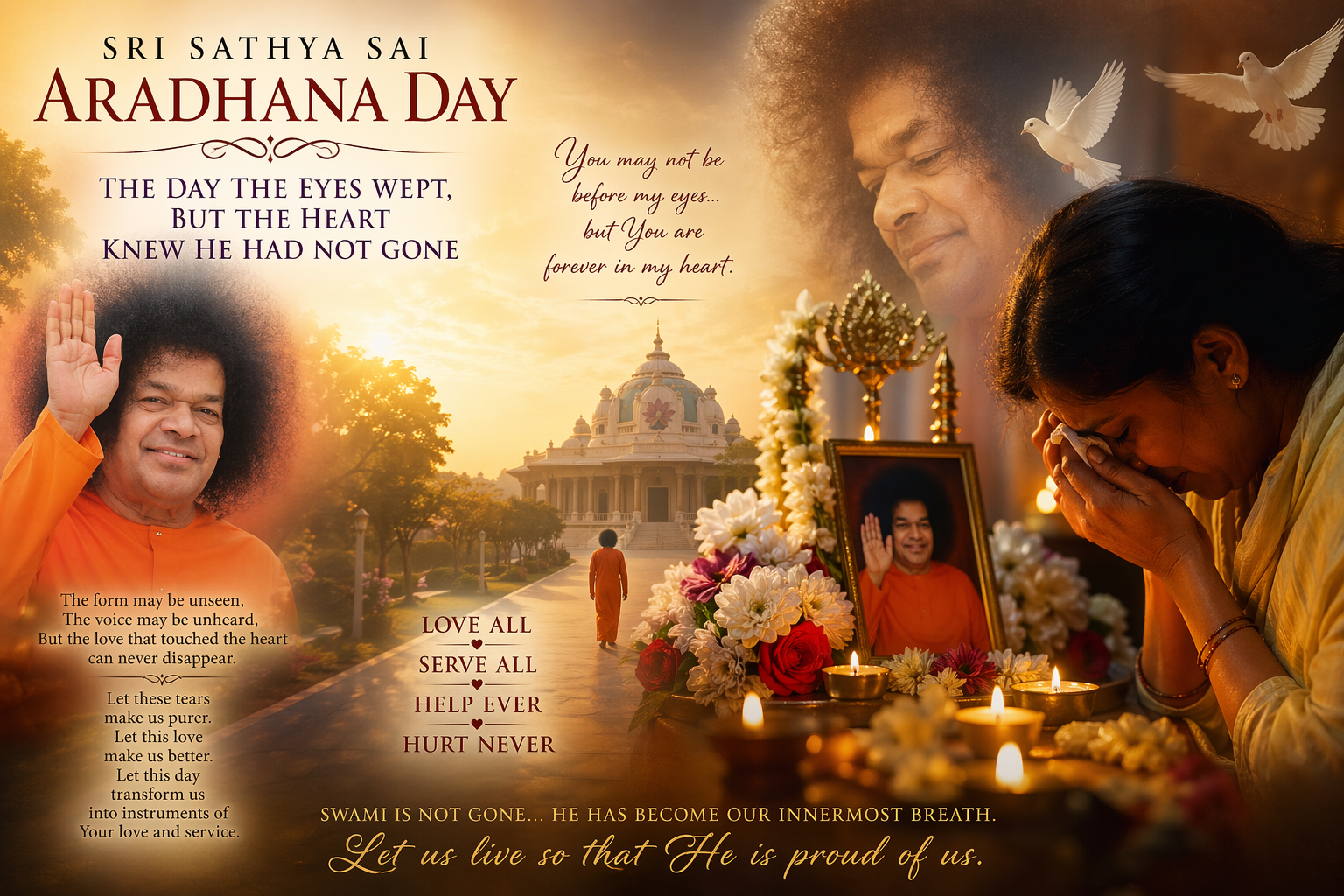
Sri Sathya Sai Aradhana Day
The Day the Eyes Wept, Yet the Heart Knew He Had Not Gone
There are some days which do not merely appear on the calendar. They rise from the silent chambers of memory, touch the deepest fibres of the heart, and leave the soul trembling with sweetness and pain together. For the devotees of Bhagawan Sri Sathya Sai Baba, Aradhana Day is such a day. It is not merely a date to be remembered. It is a sacred wound wrapped in worship, a tear illumined by gratitude, and a silence filled with His invisible Presence.
This is the holy day on which devotees lovingly recall Bhagawan’s Mahasamadhi—the day when He withdrew from the physical frame. But to describe it merely as a departure is to say too little. For the devotee, Aradhana Day is a day of adoration, reverence, gratitude, prayer, introspection, and renewed dedication. It is the day on which love remembers, faith deepens, and the heart once again bows low at His Lotus Feet.
The very word Aradhana is fragrant with devotion. It means loving worship, heartfelt adoration, reverent remembrance, and the offering of oneself in humility and gratitude. Therefore, this day is not meant to remain merely a day of sorrow, though sorrow has its rightful place in love. Tears may come, and they come naturally. But they must not end in helpless grief. They must ripen into prayer. They must blossom into resolve. They must become an offering to Swami in the form of a purer heart, a nobler life, and a steadier effort to live what He taught.
The Pain of Loving Remembrance
And yet, who can deny the pain of this day?
How can the eyes not search for that orange robe?
How can the heart not long for that tender, reassuring smile?
How can memory not return to the darshan line, the bhajan hall, the veranda, the raised hand in blessing, the sweetness of one glance that could calm months of anxiety and dissolve years of hidden unrest?
For many, Swami was not merely a spiritual teacher. He was mother, father, guru, protector, friend, refuge, and God made near enough to be loved without fear. To stand before Him was to feel wholly seen. To receive His glance was to feel sheltered without deserving it. To remember Him was to know that however troubled life might be, it still had a centre, a light, and a sanctuary.
That is why Aradhana Day enters the heart with such depth.
The world may say, “He left the body.” But the heart asks in wonder, “How can the One who entered my prayer, my breath, my tears, and my conscience ever leave me?”
That is the sacred mystery of Aradhana Day.
The pain is real, because love is real.
The longing is real, because His nearness was real.
The tears are real, because the sweetness of His visible form was real.
Yet if this day remains only in sorrow, then perhaps we have not fully understood what Swami, in His infinite compassion, came to teach us.
From the Form to the Formless
Again and again, Swami reminded devotees that He was not the body. The form was sacred indeed. It was grace made visible, compassion made tangible, divinity made approachable. Through that form, countless men and women learnt how to love God without fear, how to trust, how to surrender, and how to hope again. Yet the Divine who shone through that form was never confined to one body, one place, one chair, one gesture, or one brief span of earthly time. The form was precious beyond words, but it was not the whole Truth.
That is why Aradhana Day is not only about absence. It is about awakening.
It is the day when the devotee is gently, painfully, and lovingly led from the darshan of the form to the darshan of the formless.
When Swami was physically present, devotees longed for outward darshan—a glimpse, a smile, a word, a sign, a touch, or simply the blessing of sitting in His presence. But after Mahasamadhi, the devotee is called to discover a still deeper darshan: the darshan of Swami in the heart, in the silent voice of conscience, in the prompting to love, in the call to serve, in the strength that unexpectedly rises during difficulty, in the tears that come in prayer, and in the quiet assurance from within: “Why fear when I am here?”
This is the journey from form to formlessness.
It does not mean that the devotee loves the form any less. Never. That beloved form remains forever precious. The heart still remembers the robe, the smile, the eyes, the movements, the sweetness of visible nearness. But slowly, through devotion and grace, one begins to understand that the Lord once adored before the eyes must now be discovered more deeply within. The Feet once sought outwardly must now be found inwardly—in truthfulness, purity, humility, compassion, self-control, service, and surrender.
When Memory Becomes Presence
This is why Aradhana Day carries such a tide of emotion. The heart remembers. Every devotee carries within an unseen garland of sacred moments: a first darshan, a prayer answered, a burden quietly lifted, a fear soothed, a glance never forgotten, a bhajan that melted the heart, a silence in which one knew without proof, “He heard me.”
On this day, these no longer remain mere memories. They become living presences. They rise like waves from the inner sea. They return like fragrance from a long-cherished flower. They reopen the secret shrine of the heart.
A photograph becomes almost too alive to look at calmly.
A bhajan line trembles on the lips and catches in the throat.
A familiar image suddenly fills the eyes with tears.
A small remembrance becomes an ocean.
And then the heart realizes: this is not mere sadness. This is love remembering its Source.
What Should We Do on Aradhana Day?
Yet even here, Swami’s teaching stands before us as a lamp in the dusk.
What should we do on Aradhana Day?
We should remember Him with love.
We should sit in prayer.
We should sing bhajans with feeling.
We should read and reflect upon His teachings.
We should spend some time in silence.
We should examine our life honestly.
We should ask forgiveness for our failings.
We should offer gratitude for His unseen grace.
We should perform some act of selfless service.
And we should renew our resolve to live what He taught.
For Swami would never want this day to remain merely emotional. He would want it to become transformative.
He would want us to ask:
Have I become more loving?
Have I become more truthful?
Have I reduced anger?
Have I become less selfish?
Do I speak more gently?
Do I serve anyone beyond myself?
Do I remember God in the midst of daily life?
Do I see the Divine in others?
Am I sincerely trying to become an instrument of His love?
That is true Aradhana.
The Highest Worship
Flowers are beautiful.
Bhajans are sacred.
Tears are natural.
Memories are precious.
But the highest Aradhana is this: to become a better human being because we loved Swami.
If our speech becomes softer, that is Aradhana.
If our heart becomes more compassionate, that is Aradhana.
If we forgive someone, that is Aradhana.
If we restrain anger, that is Aradhana.
If we serve quietly, that is Aradhana.
If we choose truth over convenience, that is Aradhana.
If we lessen ego and increase love, that is Aradhana.
If we become even a little closer to what Swami wanted us to be, that is Aradhana.
This sacred day also places before us a tender but searching question: do we merely miss Swami, or do we live Swami?
It is easy to say, “Swami, I miss You.”
It is harder to pray, “Swami, transform me.”
It is easy to weep before His photograph.
It is harder to allow those tears to wash away pride, selfishness, harshness, and indifference.
It is easy to remember His form.
It is harder to live His message.
And yet, that is exactly what He asks of us.
Becoming His Instrument
Swami’s real legacy does not lie only in memories, stories, or even the visible institutions and noble works associated with His earthly life. His deepest legacy lies in the heart transformed by His love—a restless heart made peaceful, a selfish heart made serviceful, a wounded heart made strong, a proud heart made humble, a cold heart made compassionate. When an ordinary human life becomes sanctified through daily conduct, then His mission continues to shine.
That is why Aradhana Day is both tender and demanding.
It does not allow us merely to weep. It asks us to rise.
It asks us to become His instruments.
And what does that mean?
It means that when someone is in pain, we do not turn away.
It means that when harsh words rise to the lips, we remember His gentleness.
It means that when selfishness asks only for comfort, we choose service.
It means that when another heart is lonely, burdened, or afraid, we become—in whatever small measure we can—a reminder that Swami still loves, still protects, still consoles, and still guides.
If one hungry person is fed through our hands, He is there.
If one grieving heart is comforted through our words, He is there.
If one harsh reaction is restrained because we remembered Him, He is there.
If one act of kindness is done without pride, He is there.
If one life is touched by compassion because we wished to please Him, He is there.
Once, we waited for Him outside.
Now He asks to work through us.
Once, we longed to receive from Him.
Now He asks us to give in His Name.
Once, we prayed, “Swami, bless me.”
Now the deeper prayer becomes, “Swami, make me worthy to serve as Your instrument.”
The Mystery of the Avatar
Aradhana Day also bears a profound connection with the mystery of the Avatar. The passing of an ordinary person is remembered as death. The departure of a saint may be reverently described as Mahasamadhi. But in the case of an Avatar, devotees do not see an end. They see the withdrawal of a Divine Mission from visible form into invisible presence.
The Avatar comes in form, but is never confined by form. Therefore, when the visible form is withdrawn, the Presence does not cease. It becomes more inward, more subtle, more universal, and in a sacred sense, even more intimate.
Thus Aradhana Day is not merely the remembrance of a holy loss. It is a call.
A call to move from visible nearness to inner faith.
A call to move from emotion to character.
A call to move from tears to service.
A call to move from devotion in feeling to devotion in living.
A Prayer at His Lotus Feet
And so, on this sacred day, the devotee does not only say, “Swami, we miss You.”
The devotee also prays:
Swami, if these eyes cannot behold You as before,
let this heart feel You more deeply.
If these hands cannot touch Your Lotus Feet,
let these hands become instruments of Your love.
If these ears cannot hear Your voice outwardly,
let my conscience hear You within.
If this heart still cries for Your visible form,
let that cry purify me, soften me, and make me truer.
Do not allow my devotion to remain only emotion.
Turn it into character.
Turn it into compassion.
Turn it into courage.
Turn it into selfless service.
Turn my life into an offering at Your Lotus Feet.
For this is the deepest truth of Aradhana Day:
The chair may be empty,
but the heart need not be.
The form may be unseen,
but the Presence is not absent.
The voice may no longer fall upon the ear,
but it still speaks through silence, conscience, grace, and love.
And so on this day the eyes may indeed weep. They must, for love cannot do otherwise. But deeper than tears there is gratitude. Deeper than longing there is faith. Deeper than pain there is the quiet certainty that the Lord once loved in visible form has not gone anywhere. He has become more inward, more subtle, more all-pervading, and more intimate than before.
Therefore, with folded hands, moist eyes, and a heart too full for ordinary speech, the devotee can only pray:
Beloved Swami,
the eyes still search for You.
The heart still cries for You.
Yet deeper than our tears is our gratitude,
and deeper than our longing is our faith.
You have not gone.
You live in our prayer,
in our conscience,
in our service,
in our love,
and in every sincere effort to become better because of You.
Let this Aradhana not remain only remembrance.
Let it become transformation.
Let it become surrender.
Let it become service.
Let it become life at Your Lotus Feet.
In loving remembrance at His Lotus Feet,
Ravinder Grover
© 2025 Ravinder Grover. All Rights Reserved.
This work is protected under copyright and DMCA. Unauthorized use is prohibited
Disclaimer: ‘Without Prejudice.’ I offer my insight into astrology solely based on my learnings of astrology principles and techniques, some of which I learnt from the Sages of the highest order. These predictions are offered for guidance purposes only. I offer absolutely no guarantee on my calculations and analysis. These predictions are not intended to harm anyone by any means. I expressly disclaim all warranties, implied or contingent, for making use of these predictions or for incurring any loss or loss of profit in any manner whatsoever. No notice or advice from anyone will create any liability whatsoever


Leave A Comment