

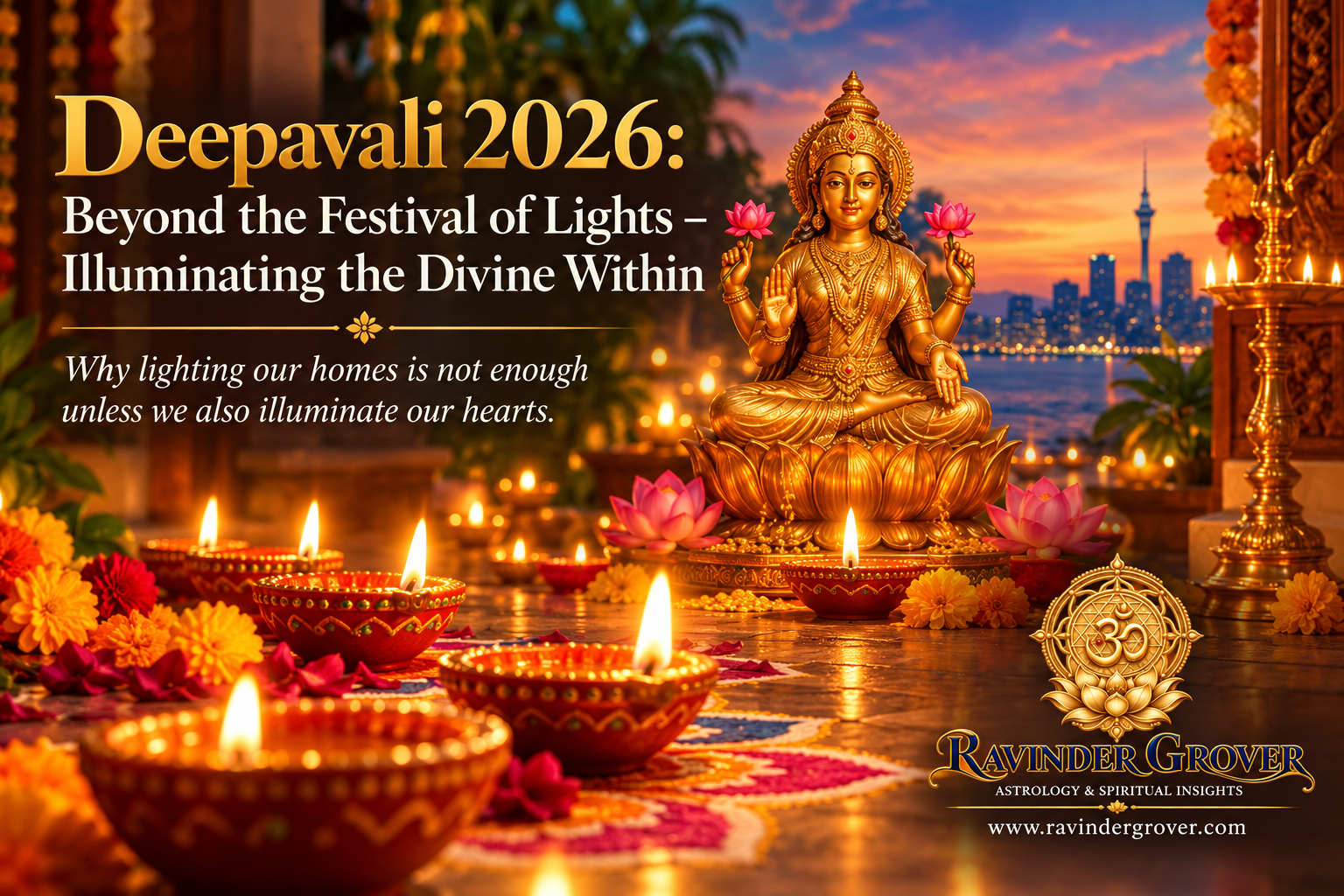
Deepavali 2026: Beyond the Festival of Lights — Awakening the Divine Light Within
From the wisdom of the Upanishads and the blessings of Maa Mahalakshmi to the teachings of Bhagawan Sri Sathya Sai Baba: rediscovering the deeper purpose of Deepavali.
1. Deepavali: Sunday, 8 November 2026
Every year, as Deepavali approaches, millions of homes are cleaned, decorated and illuminated with lamps. Families prepare sweets, wear new clothes, exchange gifts and offer prayers to Maa Lakshmi for happiness, prosperity and wellbeing. There is joy, excitement and a sense of renewal everywhere. Yet amid all these preparations, have we ever paused to ask a simple question?
We make every effort to remove darkness from our homes, but what about the darkness that may still remain within our hearts?
We illuminate our surroundings with hundreds of lamps, yet allow anger, jealousy, greed, attachment and resentment to linger within us. We welcome Maa Lakshmi into our homes, but do we create the conditions in which peace, purity, truth and harmony can flourish there?
Perhaps the deeper meaning of Deepavali lies not merely in lighting a lamp but in understanding what that lamp represents. Deepavali is an invitation to move from ignorance to wisdom, from selfishness to selflessness, from attachment to discrimination, and ultimately from the limited awareness of the individual self towards the Divine Light within.
2. Many Traditions, One Universal Message
The word Deepavali comes from two Sanskrit words: Deepa, meaning lamp, and Avali, meaning a row. It is the festival of rows of lights, and it is associated with several sacred narratives, each carrying a deeper spiritual lesson.
In the popular Ramayana tradition, Deepavali commemorates the joyous return of Lord Rama, Maa Sita and Lakshmana to Ayodhya after fourteen years of exile and the defeat of Ravana. The people of Ayodhya welcomed their beloved Lord by illuminating the entire city.
Rama’s return may also be understood symbolically. Ayodhya represents the inner kingdom of the human heart, and Rama represents righteousness and Divine consciousness. Ravana, despite his great learning and accomplishments, shows how ego, uncontrolled desire and attachment can lead to destruction. Rama’s victory is therefore not merely the defeat of an external enemy; it reflects the continuous struggle between our higher aspirations and our lower tendencies.
Another tradition celebrates Lord Krishna’s victory over Narakasura, a symbol of arrogance, oppression and unrighteousness, in which Satyabhama plays a significant role (Srimad Bhagavatam, Skandha 10, Adhyaya 59). In many parts of India, Deepavali is especially associated with the worship of Maa Lakshmi, while other traditions honour Maa Kali, Lord Ganesha, King Bali and Lord Vamana.
These traditions differ in their stories and observances, but one message unites them:
Darkness cannot be overcome merely by condemning it. We must bring in the light — and that light must first be awakened within ourselves.
3. From Darkness to Light: The Wisdom of the Upanishads
The spiritual essence of Deepavali finds its most profound expression in the Pavamana prayer of the Brihadaranyaka Upanishad (Adhyaya 1, Brahmana 3, Mantra 28):
असतो मा सद्गमय।
तमसो मा ज्योतिर्गमय।
मृत्योर्मामृतं गमय॥
Asato mā sadgamaya
Tamaso mā jyotirgamaya
Mṛtyor mā amṛtaṃ gamaya
Meaning: Lead me from the unreal to the Real. Lead me from darkness to Light. Lead me from mortality to Immortality.
These are not merely words to be recited at a religious gathering. They express one of humanity’s deepest spiritual aspirations. The darkness referred to here is not simply the absence of sunlight. It is Avidya: ignorance of our true nature.
A person may possess wealth, education, social standing and worldly success, yet remain troubled by fear, jealousy, insecurity or dissatisfaction. Another, with few material possessions, may live in profound contentment, compassion and inner peace. Spiritual illumination is not measured by external achievements; it is reflected in the transformation of consciousness.
When discrimination replaces confusion, when compassion overcomes selfishness, and when truth guides our actions, the journey from darkness towards light has already begun. Deepavali offers us an opportunity to examine where we stand on this journey.
4. Maa Lakshmi: Is Prosperity Only About Wealth?
For many families, Lakshmi Puja is the central observance of Deepavali. Homes and workplaces are decorated, accounts are reviewed, offerings are prepared and prayers are made for prosperity. There is nothing wrong in seeking material wellbeing.
Sanatana Dharma recognises Artha, the pursuit of material resources, as one of the four Purusharthas or aims of human life, alongside Dharma, Kama and Moksha. But Artha must always be guided by Dharma. Wealth gained through dishonesty, exploitation or injustice may increase our possessions without ever bringing lasting peace.
What is the value of prosperity if it comes at the expense of peace, relationships, character or conscience?
The Sri Suktam, the revered Vedic hymn to Sri Mahalakshmi, describes prosperity through rich imagery of abundance, nourishment, fertility and radiance. Its opening verse (Sri Suktam, Verse 1) is:
हिरण्यवर्णां हरिणीं सुवर्णरजतस्रजाम्।
चन्द्रां हिरण्मयीं लक्ष्मीं जातवेदो म आवह॥
Hiraṇyavarṇāṃ hariṇīṃ suvarṇarajatasrajām,
Candrāṃ hiraṇmayīṃ lakṣmīṃ jātavedo ma āvaha.
Meaning: O Jatavedas, sacred Fire, bring to me Lakshmi, radiant and golden-hued, adorned with garlands of gold and silver, shining with the splendour of the moon.
The hymn certainly honours material prosperity, but its imagery also points to the wider conditions that sustain a fulfilling life. Traditionally, Lakshmi’s grace extends far beyond money, to nourishment, courage, knowledge, family wellbeing and success through righteous effort.
A home with ample money but constant conflict is not truly prosperous. A family with every luxury but lacking affection, respect and understanding may still feel impoverished. A person who has amassed great wealth but lives in perpetual fear of losing it may never know contentment. True prosperity becomes meaningful when wealth is accompanied by wisdom, gratitude, generosity and inner harmony.
So this Deepavali, let us ask: When we invite Maa Lakshmi into our homes, are we also ready to welcome the values that make prosperity a blessing rather than a burden?
5. The Astrological Significance of Deepavali: Light Amid Darkness
Deepavali holds a distinctive place in the Hindu lunisolar calendar. The principal Lakshmi Puja is traditionally observed on the Amavasya (new moon) of Kartika, according to the regional calendar followed.
Amavasya marks the conjunction of the Sun and Moon, when the Moon is not visible in the night sky. In Vedic astrology, the Sun signifies the Atma, vitality, authority and consciousness, while the Moon signifies the mind, emotions and our inner experiences. Their conjunction offers a meaningful symbol for spiritual reflection: when the outer light of the Moon is absent, the devotee is invited to turn towards another source of light — the light of spiritual awareness.
This symbolism should not be mistaken for a claim that Amavasya is inherently inauspicious, or that those born under it must face difficulties. Astrological interpretation always requires context, and no single planetary position determines the whole of a human life.
The deeper message of Deepavali’s Amavasya is conscious illumination. On the darkest night, even a small lamp becomes visible. Likewise, in times of uncertainty, confusion or emotional struggle, a sincere prayer, a moment of self-examination or an act of kindness can become the beginning of positive transformation.
Deepavali 2026 and Lakshmi Puja in New Zealand
In 2026, Deepavali falls on Sunday, 8 November. According to the Drik Panchang calculation for Auckland, the Lakshmi Puja muhurta is approximately 8:36 pm to 10:02 pm NZDT, with Amavasya beginning at about 6:57 pm on 8 November and ending at about 8:01 pm on 9 November.
These are Auckland local times, not Indian Standard Time. Devotees should follow their own family tradition, local panchang and customary method of determining the muhurta.
An auspicious muhurta is meant to support sincere worship, never to become a source of fear or anxiety. No planetary configuration should distract us from the central purpose of the festival: the cultivation of purity, wisdom, gratitude and Divine Love.
6. Sri Sathya Sai Baba: The Lamp That Must Be Lit Within
Bhagawan Sri Sathya Sai Baba gave a particularly profound interpretation of Deepavali. In His Divine Discourse of 5 November 1991, Light the Lamp Within, Swami explained that external lamps can dispel physical darkness, but cannot remove the ignorance that resides in the human mind.
He compared the spiritual life to an ordinary oil lamp. To light a lamp, we need a container, oil, a wick and something to kindle the flame. Swami related each of these to the inner journey:
- The heart is the container.
- The mind is the wick.
- Love is the oil.
- Vairagya (detachment, or sacrifice) is what kindles the flame.
When these come together, the light of the Atma, the Divine Self, shines forth. The heart must become a vessel able to hold Divine Love. The mind must be disciplined, so that it becomes an instrument of illumination rather than an endless source of distraction. Love must be continually replenished through compassion, service and understanding. And detachment must free us from excessive attachment to selfish desires and passing experiences.
Swami’s teaching also reminds us of the six inner enemies, the Arishadvargas:
- Kama: uncontrolled desire
- Krodha: anger
- Lobha: greed
- Moha: delusion or attachment
- Mada: pride or arrogance
- Matsarya: jealousy
These cannot be removed simply by decorating our homes or performing elaborate rituals. They require awareness, discipline, humility and sincere spiritual practice.
What use is a beautifully illuminated home if its members cannot speak peacefully to one another? What purpose does worship serve if we continue to hurt others through harsh words, dishonesty or selfish conduct? Rituals gain their true significance when they inspire a change in our behaviour. The lamp of Deepavali is not only something to place before the altar; it is something we must learn to kindle within our hearts.
7. Cleaning the House — But What About the Mind?
Deepavali preparations often begin weeks before the festival. Cupboards are cleaned, unwanted things are discarded, rooms are rearranged and homes are decorated, so that the festival may be welcomed in a clean and pleasant space.
This custom also offers a valuable opportunity for introspection. We carefully remove the dust that has gathered in our homes, but how often do we examine the resentment, bitterness, jealousy or prejudice that may have gathered in our minds?
Some of us carry painful memories for years. An argument, an insult, a misunderstanding or an unfulfilled expectation can continue to colour our thoughts long after the event itself has passed. We may have forgotten the exact words spoken, yet the emotional burden remains. Deepavali invites us to ask whether some of that burden can finally be released.
Forgiveness does not mean approving of wrongdoing or abandoning necessary boundaries. It means loosening the hold that bitterness has gained over our inner life. In the same way, cleaning the mind does not mean suppressing every difficult emotion. It means understanding our responses and gradually cultivating greater patience, compassion and discrimination.
Just as a clean home becomes more welcoming, a purified mind becomes more receptive to peace and Divine Grace.
8. The Five Days of Deepavali: Five Lessons for Life
In many traditions, Deepavali is celebrated over several days. The names, order and dates of these observances vary with region and family custom, but each can be seen as an opportunity for inner growth.
Dhanteras — Wealth with Wisdom. Dhanteras invites reflection on health, wellbeing, resources and responsible prosperity. The lesson is not simply to acquire more, but to use wisely what we already have.
Naraka Chaturdashi — Overcoming Inner Negativity. Remembering the defeat of Narakasura encourages us to recognise and overcome our own destructive tendencies. Which habits, attitudes or attachments keep us from expressing our higher nature?
Lakshmi Puja — Inviting Sacred Prosperity. The worship of Maa Lakshmi reminds us that wealth must be accompanied by gratitude, purity and righteousness. Prosperity becomes truly meaningful when it benefits others as well as ourselves.
Govardhan Puja — Gratitude and Protection. Lord Krishna’s lifting of Govardhan Hill (Srimad Bhagavatam, Skandha 10, Adhyaya 25) speaks of Divine protection, humility, care for nature and our dependence upon it. It also teaches that strength finds its noblest expression in protecting the vulnerable.
Bhai Dooj — Relationships as Sacred Responsibilities. Celebrating the bond between siblings reminds us that love must be expressed through care, respect, forgiveness and responsibility. Relationships cannot thrive on occasional ceremonies alone; they need constant attention and understanding.
Taken together, these observances are far more than a festive calendar. They remind us of the value of health, self-discipline, righteous prosperity, gratitude and loving relationships.
9. Deepavali and Karma: Every Action Leaves an Impression
The philosophy of Karma offers another important perspective on Deepavali. According to Hindu spiritual thought, our actions, intentions and attitudes leave impressions (samskaras) that shape our future conduct.
Every thought we repeatedly entertain strengthens a particular direction of the mind. Anger, constantly indulged, becomes habitual. Likewise, generosity, compassion and self-discipline grow stronger through repeated practice.
Deepavali invites us to examine the direction in which our actions are taking us. Are we becoming more patient as we grow older? Are we learning from our experiences, or merely repeating the same patterns? Are our relationships becoming more harmonious? Are we accumulating only possessions, or wisdom as well?
The Bhagavad Gita (Chapter 2, Shloka 47) teaches us to perform our duty without attachment to its results:
Karmaṇy evādhikāras te mā phaleṣu kadācana
Meaning: You have a right to perform your actions, but never to their fruits.
This principle is deeply relevant to Deepavali. We cannot always control the circumstances of our lives, but we can grow in awareness of how we respond to them. The conquest of the inner Ravana or Narakasura is not achieved in one dramatic moment. It is a gradual process of choosing truth over convenience, compassion over anger and Dharma over selfishness.
Every such choice lights another lamp within.
10. Deepavali in Today’s World: Celebration or Competition?
Deepavali has increasingly become an occasion for elaborate decorations, expensive gifts, entertainment and social media displays. Celebration is natural, and there is nothing wrong with enjoying the festival. Difficulties arise, however, when joy is replaced by comparison. Whose house is decorated most beautifully? Who has bought the most expensive gifts? Who is hosting the grandest celebration, or sharing the most impressive photographs?
When outward appearance becomes the measure of celebration, we risk losing sight of the values that give the festival its meaning. Deepavali should never place unnecessary financial pressure on families, nor leave those with limited means feeling excluded or inadequate. A simple earthen lamp lit with sincerity holds greater spiritual value than an extravagant display driven by pride.
The festival is also an opportunity to act with sensitivity towards the environment, animals, the elderly and all those affected by excessive noise or pollution.
In a multicultural country such as New Zealand, Deepavali has become an important way of sharing Indian culture, traditions and spiritual values with the wider community. It can serve as a bridge between generations and between cultures. Yet the most meaningful contribution we can make is not simply to explain how the festival is celebrated, but to demonstrate through our conduct the values it represents. Truthfulness, kindness, mutual respect, service and responsible living are understood across every culture and faith.
The light of Deepavali becomes universal when it is shared without distinction.
11. A Message for the Young: Be the Light You Wish to See
For younger generations, Deepavali is a chance to celebrate cultural identity, family traditions and spiritual heritage. Its message also speaks directly to the challenges of modern life.
Today’s young people live in a world of constant information, digital communication, competition and rapidly changing expectations. They have extraordinary opportunities, but also face distraction, pressure, uncertainty and comparison. The symbolism of Deepavali offers practical guidance:
- The lamp of knowledge encourages us to seek understanding rather than accept everything we see online.
- The lamp of discrimination helps us distinguish genuine achievement from superficial popularity.
- The lamp of compassion asks us to consider how our words and actions affect others.
- The lamp of discipline encourages habits that strengthen character.
- The lamp of gratitude reminds us never to take for granted the love, support and sacrifices of parents, teachers and others.
Spirituality does not ask young people to withdraw from the modern world. It asks them to bring integrity, compassion and awareness into whatever they undertake, whether studying, working, creating, serving or pursuing personal ambitions.
The real measure of success is not only what we achieve, but the kind of human beings we become while achieving it.
12. Five Lamps We Can Light Within Ourselves
As we prepare to celebrate Deepavali 2026, perhaps we can make a few simple commitments.
The first lamp — Truth. Let us become more truthful in thought, word and deed, even when honesty requires courage.
The second lamp — Love. Let us express genuine affection and concern for our family, our friends and those who may be struggling.
The third lamp — Forgiveness. Let us release unnecessary resentment and work towards peace wherever reconciliation is possible and appropriate.
The fourth lamp — Selfless Service. Let us share something of what we have — our time, knowledge, resources or compassion — with someone in need.
The fifth lamp — Gratitude. Let us recognise the countless blessings we so often take for granted: life itself, family, health, opportunities, nature and the guidance of the Divine.
These five lamps need no elaborate decorations and no expensive preparations. They can be lit anywhere, by anyone, at any time. And unlike physical lamps, which eventually burn out, the light of righteous living continues to shine in our lives and in the lives of those around us.
12. Inner Reflection: Has Deepavali Changed Anything Within Us?
When the celebrations are over, the decorations are packed away and the lamps have gone out, what remains?
Have we become more understanding? Have we tried to heal a strained relationship? Have we helped someone who was lonely or in need? Have we examined a habit that needs correcting? Have we become more conscious of the Divine Presence within ourselves and in others?
These may be more meaningful questions than how many lamps we lit or how elaborate our celebrations were. The purpose of a spiritual festival should extend well beyond the day itself; otherwise we risk repeating beautiful traditions year after year without allowing them to transform our lives.
Deepavali gives us an annual opportunity to renew our commitment to Dharma, compassion, wisdom and selfless love. The external lamp is temporary. The inner journey is lifelong.
13. Conclusion: Let the Light Remain After Deepavali
As we celebrate Deepavali 2026, let us welcome the joy of the festival with gratitude. Let us decorate our homes, light the traditional diyas, share sweets, offer our prayers to Maa Lakshmi and spend meaningful time with our loved ones.
But let us also remember that the deeper purpose of Deepavali is not fulfilled by outward celebration alone. The Upanishads call us to move from darkness towards Light. The worship of Maa Mahalakshmi reminds us that genuine prosperity must be guided by Dharma. Bhagawan Sri Sathya Sai Baba urges us to kindle the lamp of Divine Love within our hearts. And the law of Karma reminds us that every sincere effort towards right living contributes to our spiritual evolution.
Perhaps the most meaningful offering we can make this Deepavali is a sincere commitment to become a better human being:
A little more patient.
A little less judgemental.
A little more forgiving.
A little more generous.
A little more conscious of the Divine in everyone.
For ultimately, Deepavali is not fulfilled when a thousand lamps illuminate our homes. Its deeper purpose is fulfilled when even one lamp of Divine Love begins to shine within our hearts, and its light reaches another human being.
May Maa Mahalakshmi bless every home with righteous prosperity, good health, harmony and contentment. May the Divine Light of wisdom dispel ignorance, fear and negativity. And may we all become instruments of love, peace and selfless service.
Wishing everyone a blessed, peaceful and spiritually illuminating Deepavali 2026.
References and Further Reading
- Brihadaranyaka Upanishad, Adhyaya 1, Brahmana 3, Mantra 28: the Pavamana prayer, from darkness to Light.
- Sri Suktam, Verse 1: the opening invocation of Sri Mahalakshmi.
- Valmiki Ramayana, Yuddha Kanda: Lord Rama’s victory and return to Ayodhya. The association of His return with Deepavali belongs to later festival tradition.
- Srimad Bhagavatam, Skandha 10, Adhyaya 59: Lord Krishna’s victory over Narakasura.
- Srimad Bhagavatam, Skandha 10, Adhyaya 25: Lord Krishna lifts Govardhan Hill.
- Bhagavad Gita, Chapter 2, Shloka 47: Karma Yoga, action without attachment to results.
- Bhagawan Sri Sathya Sai Baba, Divine Discourse, 5 November 1991, Light the Lamp Within.
- Drik Panchang, Auckland, New Zealand: Deepavali and Lakshmi Puja timings for 8 November 2026.
Ravinder Grover
Astrology & Spiritual Insights
📲 Join my WhatsApp Channel for regular updates:
https://whatsapp.com/channel/0029Vai6rQz6rsQyMHx7nZ1z
© 2026 Ravinder Grover. All Rights Reserved.
This work is protected under copyright and DMCA. Unauthorised use is prohibited.
Disclaimer: ‘Without Prejudice’. I offer my insight into astrology solely based on my learnings of astrology principles and techniques, some of which I learnt from the Sages of the highest order. These predictions are offered for guidance purposes only. I offer absolutely no guarantee for my calculations and analysis. These predictions are not intended to cause harm to anyone in any way. I expressly disclaim all warranties, whether implied or contingent, for making use of these predictions or for incurring any loss or loss of profit in any manner whatsoever. No notice or advice from anyone will create any liability whatsoever

Leave A Comment