

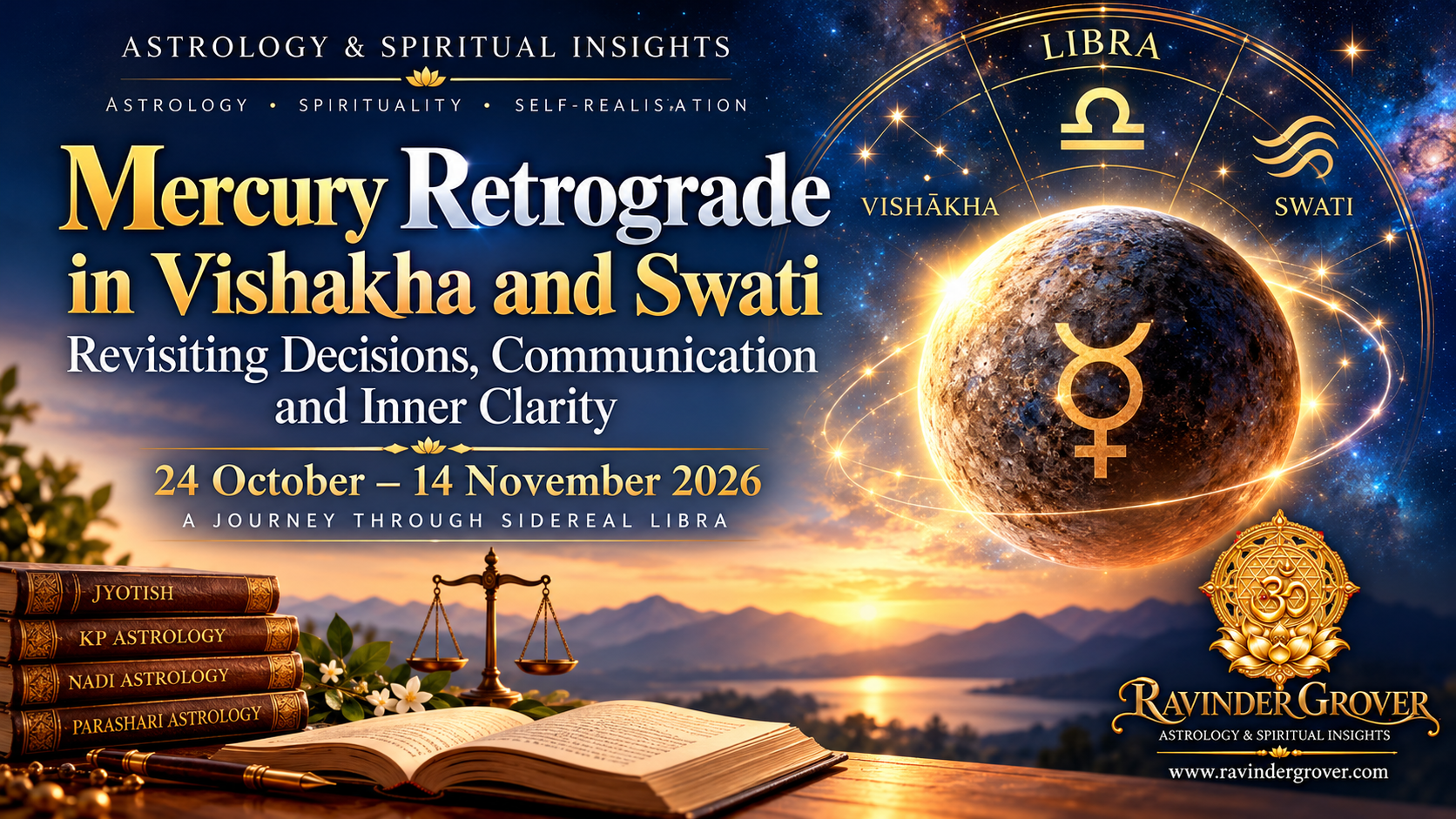
Mercury Retrograde in Vishakha and Swati: Revisiting Decisions, Communication and Inner Clarity
24 October 2026 – 14 November 2026 | A Journey Through Sidereal Libra
When the planet of communication appears to move backwards, perhaps the deeper invitation is not to stop moving forward but to reconsider the direction in which we are moving.
From 24 October to 14 November 2026, Mercury (Budha), the planet traditionally associated with intelligence, speech, analysis, commerce, learning and communication, undergoes its final retrograde cycle of 2026.
In sidereal Vedic astrology, Mercury begins its retrograde journey in Vishakha Nakshatra, ruled by Jupiter, and moves backwards into Swati Nakshatra, ruled by Rahu. Both nakshatras fall within Libra, the sign of relationships, negotiation, fairness and balance.
This movement offers a meaningful symbolic framework for examining how our words, choices, expectations and relationships influence our lives.
Mercury retrograde is not necessarily a period of misfortune. In Jyotish, it can also represent an opportunity for introspection, revision, recovery and renewed understanding.
1. The Astronomical Reality — Why Does Mercury Appear to Move Backwards?
Mercury does not physically reverse its orbit around the Sun.
Retrograde motion is an apparent movement observed from Earth, arising from the changing relative positions and orbital motions of Earth and Mercury.
During this period, Mercury appears to move westward against the background of distant stars, although it continues its normal orbital journey around the Sun.
In traditional astrology, this apparent reversal acquires symbolic importance.
Mercury governs buddhi — the discriminating intellect — and is associated with the processes through which we receive information, interpret experiences and communicate our understanding.
When Mercury becomes vakri (retrograde), Jyotish practitioners examine whether these functions may require re-examination.
The important distinction is that astronomical retrograde motion is observable, whereas its influence upon human events remains an astrological interpretation rather than an established scientific cause.
2. Important Dates and Sidereal Planetary Positions
The following times are expressed in New Zealand Daylight Time (NZDT).
| Event | Date | Astrological significance |
|---|---|---|
| Pre-retrograde shadow begins | 4 October 2026 | Themes that may later be revisited |
| Mercury stations retrograde | 24 October, approximately 8:13 pm | Vishakha, approximately 26°45′ Libra |
| Mercury revisits Swati | During the retrograde | Reconsidering independence, flexibility and communication |
| Mercury stations direct | 14 November, approximately 4:56 am | Swati, approximately 10°48′ Libra |
| Post-retrograde shadow ends | 30 November 2026 | Completion of the broader review cycle |
The sidereal positions use the Lahiri ayanamsa. Different ayanamsas, including KP conventions, can produce small differences in longitude and nakshatra-transition timing.
The shadow period refers to Mercury traversing the same zodiacal degrees before and after the retrograde movement. It should not be interpreted as a separate astronomical retrograde event.
3. Vishakha Nakshatra — The Determination to Achieve
Nakshatra: Vishakha
Range: 20° Libra – 3°20′ Scorpio
Ruling planet: Jupiter
Presiding deities: Indra and Agni
Key themes: Determination, ambition, purpose and transformation
Mercury commences its retrograde motion in the Libra portion of Vishakha Nakshatra.
Vishakha represents focused aspiration and the desire to reach an objective. Its symbolism includes determination, discipline and the pursuit of success.
Yet the pursuit of an objective can become problematic when achievement is valued more highly than wisdom, relationships or righteousness.
Mercury’s retrograde movement in Vishakha invites several questions:
- Am I pursuing a goal because it is meaningful, or merely because I have invested so much effort in it?
- Have ambition and impatience influenced my decisions?
- Have I confused winning an argument with discovering the truth?
- Do my plans support both material progress and spiritual development?
The deeper lesson of Vishakha is that determination must be guided by discrimination.
A strong intellect without ethical direction may achieve temporary success but fail to produce inner peace.
Jupiter’s influence
Because Vishakha is ruled by Jupiter, its themes connect Mercury’s analytical intelligence with Jupiter’s traditional association with wisdom, principles and higher knowledge.
The distinction between information and wisdom becomes particularly relevant.
Information tells us what is possible. Wisdom helps us understand what is appropriate.
Inner reflection: Before making an important decision, ask whether it serves only an immediate desire or also contributes to lasting wellbeing.
4. Swati Nakshatra — Freedom, Flexibility and the Power of Communication
Nakshatra: Swati
Range: 6°40′ – 20° Libra
Ruling planet: Rahu
Presiding deity: Vayu, the wind deity
Key themes: Independence, movement, adaptability and learning
As Mercury moves backwards through Libra, it re-enters Swati Nakshatra.
Swati is symbolically associated with movement and independence. Like the wind, it suggests flexibility, freedom and the capacity to respond to changing circumstances.
Yet excessive movement can become instability.
Freedom without responsibility can become restlessness.
Communication without sensitivity can become misunderstanding.
With Rahu governing Swati, the symbolic emphasis may shift towards technology, global connectivity, unconventional thinking, rapidly circulating information and a desire for independence.
In contemporary life, these themes can be explored through digital communication, social media, online transactions, emerging technologies and the speed with which opinions are formed and distributed.
Mercury retrograde in Swati therefore offers a valuable reminder:
Not every message requires an immediate reply, not every opportunity demands immediate action, and not every disagreement requires victory.
The Vishakha–Swati transition
The movement from Jupiter-ruled Vishakha into Rahu-ruled Swati presents an interesting philosophical contrast.
Vishakha asks: What am I trying to achieve?
Swati asks: Am I free to reconsider how I achieve it?
Together, these nakshatras encourage purposeful action without rigid attachment.
5. Mercury Retrograde Through the Parashari Perspective
In classical Parashari astrology, Mercury is associated with intellect, calculation, speech, education, trade, interpretation and communication.
However, the outcomes of any Mercury transit cannot be assessed from retrograde motion alone.
An individual analysis should consider:
Natal placement: Mercury’s sign, house, dignity, conjunctions and planetary influences.
Functional lordship: The houses ruled by Mercury for the particular ascendant.
Dasha and antardasha: Whether Mercury or related planets are active in the native’s planetary periods.
Transit relationships: Mercury’s movement relative to natal planets, important houses and sensitive degrees.
Planetary strength: Relevant considerations of combustion, planetary association, retrogression and other classical measures.
A retrograde planet is not automatically weak or harmful. Some classical methods assign distinctive strength to retrograde planets, although strength and favourable results are not the same thing.
A strong planet can still produce difficult results when its functional role or house connections are challenging.
Thus, a responsible astrologer should avoid declaring that Mercury retrograde will necessarily cause losses, disputes, technical failures or relationship difficulties.
The full horoscope must be considered.
6. The KP Astrology Perspective — Results Through Significators and Sub-Lords
Krishnamurti Paddhati (KP) provides a more specific framework for examining whether a particular event may materialise.
The mere fact that Mercury is retrograde is insufficient to predict an outcome.
KP analysis requires examination of Mercury’s stellar and sub-level significations together with the relevant house relationships and ruling periods.
For example:
| Matter | Houses commonly examined |
|---|---|
| Education and learning | 4, 9 and 11 |
| Communication and documents | 3, with other houses according to the matter |
| Business and professional outcomes | 2, 6, 7, 10 and 11, as applicable |
| Marriage and relationships | 2, 7 and 11 |
| Employment | 2, 6, 10 and 11 |
| Financial transactions | 2, 6 and 11, together with relevant contextual houses |
The actual judgment depends upon the applicable cusp, its sub-lord, planetary significators and the operating dasha–bhukti–antara periods.
In horary astrology, the question must also be examined through the properly erected chart and its ruling planets.
An important methodological caution
Mercury’s passage through Vishakha and Swati means the planetary star-lord changes during this retrograde journey.
However, it would be incorrect to assign one KP sub-lord to the entire period.
The sub-lord changes according to Mercury’s exact sidereal longitude. Consequently, meaningful KP analysis requires a correctly calculated ephemeris and the chosen ayanamsa.
Predictions concerning contracts, career changes, relationships or financial transactions should therefore be based on a specific chart rather than on the general retrograde alone.
7. The Nadi Perspective — Planetary Connections and Unfinished Themes
Nadi astrology often places emphasis on planetary connections, sign relationships, progression patterns and sequences through which events are interpreted.
Within such traditions, retrograde Mercury may symbolically invite reconsideration of matters already under development.
These might include unfinished studies, interrupted communication, delayed agreements, professional relationships or decisions that require additional understanding.
The proximity and relationships of Mercury to other planets must be carefully assessed using actual planetary positions rather than assumed combinations.
In karmic interpretation, the opportunity to revisit a matter should not automatically be described as proof of a specific past-life debt.
A more thoughtful approach is to ask what can be learned from recurring behaviour in the present life.
The highest purpose of karmic understanding is transformation, not fatalism.
8. Possible Personal Implications
The following represent traditional astrological themes for reflection, not inevitable predictions.
Communication and relationships
Misunderstandings can arise when assumptions replace careful listening.
This period offers an opportunity to clarify expectations, revisit unfinished conversations and reconsider the tone of our speech.
Avoid interpreting every delayed response as rejection or every disagreement as hostility.
Career and business
Review proposals, correspondence, financial estimates and professional commitments.
An existing project may benefit from correcting errors, improving systems or renegotiating unclear responsibilities.
There is no universal astrological requirement to stop all new work.
Education and intellectual pursuits
Revisiting older material, correcting misunderstandings, completing unfinished studies and refining teaching resources may be particularly meaningful uses of this period.
Technology and digital communication
Maintain backups, verify important information, check recipients before sending sensitive messages and ensure that critical systems have tested recovery procedures.
These are sensible practices at any time, not evidence that Mercury causes technical problems.
Emotional wellbeing
The mind may become preoccupied with unresolved questions when we consciously focus on reviewing the past.
Rather than allowing reflection to become rumination, use it to identify one practical improvement and then move forward.
9. Possible Global and Mundane Astrological Themes
In mundane astrology, Mercury traditionally signifies communication networks, trade, commercial exchanges, information, negotiations, transportation and administration.
The Libra emphasis introduces themes of diplomatic balance, partnership, legal negotiation and competing interests.
Vishakha may symbolically highlight competing ambitions, while Swati may direct attention towards independence, international exchange and rapidly circulating information.
Astrologers may therefore observe developments involving:
- Diplomatic negotiations and international agreements.
- Commercial communications and trade discussions.
- Technology, media and information management.
- Public debates around fairness, representation and regulation.
- Revisions of previously announced policies or agreements.
These are areas of astrological interest rather than reliable forecasts of particular global events.
Claims about wars, disasters, financial crises or political upheavals would require independent evidence and substantially more detailed mundane chart analysis.
10. Sri Sathya Sai Baba’s Teachings — The Discipline of Speech and Thought
The spiritual importance of Mercury can be understood through the relationship between thought, speech and action.
Sri Sathya Sai Baba consistently emphasised truth, right conduct, peace, love and non-violence as foundations of human life.
His teachings invite us to recognise that speech is not merely a means of communicating information. It also reveals the quality of our inner life.
We may possess knowledge yet lack understanding.
We may speak accurately yet without compassion.
We may defend our position yet fail to recognise another person’s pain.
The spiritual discipline is therefore not merely to speak more carefully, but to purify the intention behind speech.
The Bhagavad Gita provides a particularly relevant teaching:
अनुद्वेगकरं वाक्यं सत्यं प्रियहितं च यत्।
स्वाध्यायाभ्यसनं चैव वाङ्मयं तप उच्यते॥
Anudvegakaraṁ vākyaṁ satyaṁ priya-hitaṁ ca yat,
Svādhyāyābhyasanaṁ caiva vāṅmayaṁ tapa ucyate.
Meaning: Speech that does not cause unnecessary agitation, that is truthful, pleasant and beneficial, together with the practice of sacred study, constitutes austerity of speech.
— Bhagavad Gita 17.15
This teaching transcends planetary movements.
Before speaking, writing or posting a message, we might ask:
Is it true? Is it necessary? Is it kind? Is it beneficial?
Such self-examination transforms ordinary communication into spiritual practice.
11. Practical Sadhana During Mercury Retrograde
No elaborate ritual is necessary to benefit from a period of reflection.
The following practices can be undertaken according to personal faith and inclination.
Budha mantra
ॐ बुं बुधाय नमः॥
Om Buṁ Budhāya Namaḥ.
Meaning: Salutations to Budha, traditionally associated with intelligence, discrimination and communication.
Devotees who follow planetary mantra traditions may choose to recite this mantra 11, 21 or 108 times on Wednesdays.
Mantra practice should be undertaken with reverence and sincerity rather than fear of planetary consequences.
Five practical disciplines
1. Observe silence: Spend a few minutes each day in quiet reflection before beginning important activities.
2. Review unfinished responsibilities: Complete pending correspondence, correct avoidable mistakes and attend to neglected commitments.
3. Practise mindful speech: Avoid unnecessary criticism, gossip and impulsive digital communication.
4. Reconcile where possible: Make sincere efforts to resolve misunderstandings while respecting appropriate personal boundaries.
5. Strengthen discrimination: Verify information before accepting it, forwarding it or acting upon it.
The purpose of these disciplines is to cultivate clarity irrespective of the planetary cycle.
12. Message for Youngsters — Think Before You Click, Speak or Share
Young people live in an environment where information travels almost instantaneously.
Technology provides extraordinary opportunities for learning, collaboration and creativity. Yet speed can sometimes replace reflection.
Mercury retrograde offers a symbolic reminder that intelligence is not measured only by the speed of a response.
It is also reflected in the ability to distinguish fact from opinion, recognise misinformation, acknowledge mistakes and communicate respectfully.
Before posting something online, ask whether it is accurate, fair and necessary.
Before responding to criticism, consider whether the situation requires an immediate answer.
Before abandoning a difficult subject, consider whether another attempt might deepen understanding.
Real intelligence includes the courage to reconsider one’s own conclusions.
13. Inner Reflection — What Is Mercury Asking Us to Reconsider?
Throughout this period, devote a few moments to the following questions:
- Which unfinished responsibility continues to demand my attention?
- Have my words recently created misunderstanding or unnecessary hurt?
- Am I making decisions from clarity, anxiety, ambition or social pressure?
- Which relationship would benefit from more patient listening?
- What knowledge have I acquired but not yet translated into constructive action?
- Am I prepared to revise an opinion when presented with better evidence?
These questions are not predictions.
They are invitations to practise self-awareness.
14. The Deeper Spiritual Message — From Intellect to Wisdom
Mercury’s apparent backward movement provides a useful metaphor for the spiritual journey.
Ordinary intelligence often seeks to move forward continuously — acquiring more information, achieving more results and pursuing new experiences.
Wisdom sometimes requires us to revisit what we thought we had already understood.
We may have learned the value of patience but still respond with irritation.
We may understand the importance of truth yet hesitate to acknowledge our mistakes.
We may speak about universal love while remaining unwilling to forgive.
The journey from Vishakha to Swati can therefore be contemplated as a movement from determination towards flexibility, and from attachment to a particular outcome towards a more balanced understanding.
Spiritual growth is not always measured by how far we have travelled.
Sometimes it is measured by how deeply we have understood the lessons already placed before us.
Conclusion — When Mercury Appears to Move Backwards, Let Awareness Move Forward
From 24 October to 14 November 2026, Mercury’s retrograde journey through sidereal Libra, from Vishakha into Swati, offers a valuable period for examining the relationship between intelligence, speech, intention and action.
Astrologically, the cycle highlights themes of communication, negotiation, reconsideration, learning and balance.
Spiritually, it invites a deeper discipline: to speak truthfully, listen compassionately, act thoughtfully and remain open to correction.
We need not fear the apparent backward movement of a planet.
Instead, we can use the period as a reminder to review what needs improvement, complete what remains unfinished and move forward with greater understanding.
Let Mercury’s retrograde journey remind us that clarity does not always come from doing more. Sometimes it comes from understanding better.
May our thoughts be pure, our words be truthful, and our actions be guided by love.
References and Methodological Notes
- Bhagavad Gita, Chapter 17, Verse 15 — austerity of speech.
- Brihat Parashara Hora Shastra — traditional principles of planetary nature, house lordship, planetary strength and dasha interpretation.
- Krishnamurti Paddhati — house significations, stellar relationships and sub-lord principles.
- Traditional nakshatra framework — Vishakha, Swati, their ruling planets and presiding deities.
- Astronomical and ephemeris references — Mercury’s October–November 2026 station dates and apparent retrograde motion.
Calculation note: Dates and approximate times are based on published ephemerides. Sidereal positions are stated using Lahiri ayanamsa. Precise KP sub-lord transitions, aspects and individual predictions require separately calculated charts.
Ravinder Grover
Astrology & Spiritual Insights
📲 Join my WhatsApp Channel for regular updates:
https://whatsapp.com/channel/0029Vai6rQz6rsQyMHx7nZ1z
© 2026 Ravinder Grover. All Rights Reserved.
This work is protected under copyright and DMCA. Unauthorised use is prohibited.
Disclaimer: ‘Without Prejudice’. I offer my insight into astrology solely based on my learnings of astrology principles and techniques, some of which I learnt from the Sages of the highest order. These predictions are offered for guidance purposes only. I offer absolutely no guarantee for my calculations and analysis. These predictions are not intended to cause harm to anyone in any way. I expressly disclaim all warranties, whether implied or contingent, for making use of these predictions or for incurring any loss or loss of profit in any manner whatsoever. No notice or advice from anyone will create any liability whatsoever

Leave A Comment