

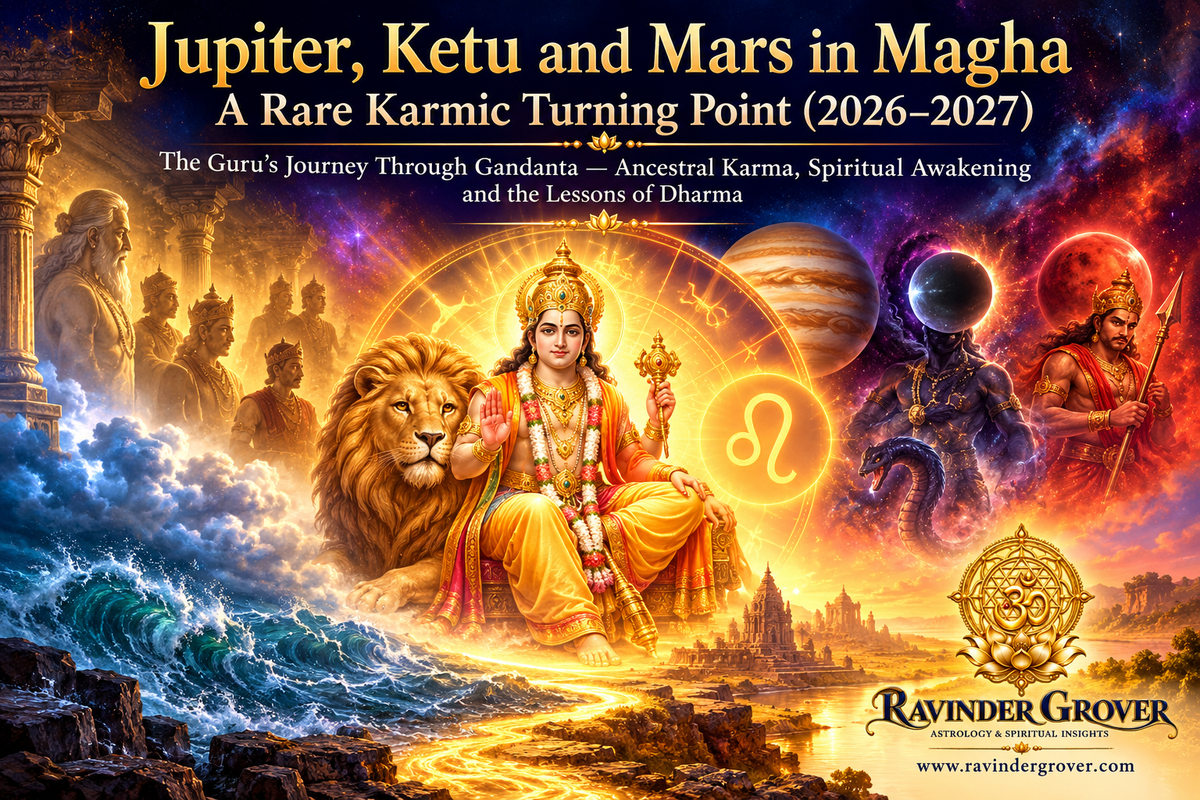
Guru at the Threshold: Jupiter, Ketu and the Karmic Knot of Gandanta
Wisdom, Ancestors and Inner Transformation | October 2026 – July 2027
As October 2026 draws to a close, an unusual combination is taking shape in the sidereal zodiac. Jupiter (Guru), the planet of wisdom and dharma, moves out of Cancer, where he is exalted, and enters Leo, the royal sign of the Sun. Ketu, the shadowy graha of detachment and moksha, is already in Magha nakshatra. Mars will soon join them. All three will activate the delicate junction between Cancer and Leo, the Gandanta.
Does this mean we should be afraid? Certainly not. Astrology is not given to us to create fear. It is a sacred language that encourages us to understand time, examine our own actions and live with greater awareness. When Guru meets Ketu, the question is not simply what we may lose, but what we may learn to release.
1. Jupiter at the Threshold: What Is Gandanta?
Gandanta literally points to a knot at the junction of water and fire. The Ashlesha–Magha junction extends from Cancer 26°40′ to Leo 3°20′. Its most sensitive central span is often taken as Cancer 29°20′ to Leo 0°40′. Ashlesha speaks of attachments, entanglements and unfinished emotional patterns; Magha reminds us of our ancestors, duties, lineage and the rightful use of authority.
Jupiter crosses this threshold slowly, then returns through it because of retrograde motion. Using the Lahiri ayanamsa and the timings in my New Zealand transit calculations, Guru is within the broader Gandanta from 9 October 2026 to 20 February 2027, with another passage beginning 5 June 2027 and concluding 14 July 2027. The deepest part is activated around 26 October–6 November 2026, again from 19 to 30 January 2027, and finally from 22 to 30 June 2027.
It is worth remembering that Jupiter has not lost his wisdom because he is in Gandanta. The final pada of Ashlesha falls in Pisces navamsha, a sign belonging to Guru. Even in a difficult passage, the capacity for discrimination, prayer and inner guidance remains available. The remedy is not haste, but patience.
Jupiter is not the only graha passing through this sensitive region. Using the same broad Gandanta definition, Ketu is also close to the Cancer–Leo junction during the latter part of 2026, while Mars moves through the closing degrees of Cancer in November. The source calculations place Ketu in this zone approximately from 3 October 2026 to early February 2027, and Mars from about 5 to 19 November 2026. These are extended proximity windows, not three planets at precisely the same degree throughout.
Why is this important? Guru urges us to find meaning; Ketu exposes our attachments; and Mars brings the urge to act. Where water meets fire, feelings and decisions may not move at the same speed. I would regard it as a reminder to pause before reacting. Gandanta should never be treated as a verdict of inevitable loss or calamity; its expression depends on the entire horoscope.
2. Jupiter’s Journey: A First Visit, a Return and a New Beginning
| Auckland date and time | Transit |
| 31 October 2026, 7:32 pm NZDT | Jupiter enters Leo |
| 12 November 2026, 9:29 am NZDT | Jupiter–Ketu exact conjunction |
| 6 December 2026, 6:02 am NZDT | Ketu leaves Leo and enters Cancer (Ashlesha); Rahu enters Capricorn |
| 13 December 2026, 1:30 pm NZDT | Jupiter stations retrograde at Leo 2°47′, still within the Gandanta |
| 25 January 2027, 9:01 am NZDT | Jupiter returns to Cancer |
| 2 March 2027, 12:04 am NZDT | Second Jupiter–Ketu conjunction, now in Ashlesha (Cancer) |
| 13 April 2027, 2:42 pm NZST | Jupiter stations direct in Cancer |
| 20 April 2027, 12:46 pm NZST | Third and final Jupiter–Ketu conjunction, in Ashlesha (Cancer) |
| 26 June 2027, 11:48 am NZST | Jupiter re-enters Leo |
| 14 July 2027, 1:44 pm NZST | Jupiter clears the Gandanta |
This first stay in Leo is a preview, not the full story. Guru turns retrograde at only 2°47′ Leo, so throughout this first visit he never leaves the Gandanta, and he then returns to Cancer. Ketu also moves back into Cancer on 6 December 2026, which means Guru and Ketu meet twice more in 2027, this time in Ashlesha rather than Magha. The more sustained Leo transit begins only in June 2027. Whatever themes arise in late 2026 may therefore need to be reconsidered, and perhaps released, before they can mature.
3. Magha: The Throne of the Ancestors
Magha occupies the first 13°20′ of Leo. It is ruled by Ketu and traditionally associated with the Pitris, our ancestral lineage. Its symbol is the royal throne. Yet the throne is not merely a symbol of personal power. It asks whether the person who sits upon it is worthy of the responsibility.
We inherit much more than family names and property. We inherit habits, values, blessings, unresolved patterns and sometimes burdens that were never openly discussed. Magha invites us to honour what is noble in our inheritance, while having the courage to end what is harmful or no longer meaningful.
Jupiter represents the Guru, scriptures, higher knowledge and moral discernment. Ketu represents renunciation and the movement from attachment towards liberation. Together in Magha, they can focus our attention on the difference between outward status and inner authority. A person may occupy a high position and still lack wisdom. Another may possess very little and yet live with great dignity.
Some modern astrologers call this combination Ganapati or Parampara Yoga, connecting it with removal of obstacles and the transmission of spiritual traditions. Such labels are not universally standard classical yoga definitions; the more reliable interpretation comes from the individual grahas, nakshatra, house, lordships and dasha operating in a birth chart.
There is also a subtler aspect of Magha that deserves reflection: Pitru Rina, our sense of gratitude and responsibility towards those who came before us. Not every family inheritance is material. Some people receive love, wisdom and a strong sense of duty; others inherit silence, mistrust or unresolved disagreements. The purpose of spiritual understanding is not to blame our ancestors for every difficulty. It is to appreciate their sacrifices, learn from their mistakes and avoid passing the same pain to the next generation.
A simple remembrance of departed parents or elders, feeding someone in need, speaking respectfully to the living, or offering prayers according to one’s own tradition may be more meaningful than a complicated ritual performed without sincerity. This is how ancestral reverence can become everyday dharma.
Jupiter and Ketu also bring together two seemingly different movements: jnana, the search for true knowledge, and vairagya, freedom from compulsive attachment. In a favourable horoscope this may deepen study, meditation or devotion to a Guru. In another horoscope it may require us to question beliefs we have accepted without reflection. Liberation is not rejection of our duties; it is performing them without unnecessary ego.
4. When Mars Joins Guru and Ketu
The exact contacts are important. Jupiter conjoins Ketu on 12 November 2026 at approximately 9:29 am NZDT; Mars enters Leo on 13 November and conjoins Ketu on 15 November at 1:30 pm NZDT; Mars then conjoins Jupiter on 16 November at 7:23 pm NZDT. These are exact meetings, not the beginning and end of the whole period of influence.
Guru expands, Ketu separates and Mars acts. Used wisely, the combination can give courage to remove an unhealthy attachment, renew a neglected spiritual practice or take responsibility for an overdue decision. Used without discrimination, the same combination can encourage impatience, heated arguments or the feeling that every problem needs an immediate solution.
In worldly affairs, Leo concerns leaders, institutions, reputation and public responsibility. This transit can be read symbolically as a time to question whether authority is being exercised for service or for self-importance. It would, however, be wrong to claim that particular wars, storms or political upheavals must occur because three planets occupy a sign. Astrology suggests themes; it does not establish physical causation or guarantee events.
The three grahas do not form one exact triple conjunction at one instant. Jupiter–Ketu is exact on 12 November; Mars–Ketu on 15 November; Mars–Jupiter on 16 November, according to the Auckland calculations used here. Mars, Jupiter and Ketu occupy the early degrees of Leo together for a wider interval, until Ketu moves back into Cancer in early December under the mean-node convention. Readers should distinguish these exact contacts from the longer background influence.
In mundane Jyotish, Magha and Leo naturally invite us to examine the conduct of rulers, the credibility of institutions and the preservation of cultural traditions. We may ask whether power is guided by duty or pride. Historical comparisons can be thought-provoking, but the proposed matches in 1635 CE, 129 CE and around 690 BCE need independent ephemeris and historical verification; I have deliberately not treated them as proof that particular events must recur.
5. At the Same Time: The Sun, Mars and Venus in Debilitation
The broader planetary background deserves attention. The Sun is in Libra, its sign of debilitation, from 18 October to 17 November 2026. Mars remains debilitated in Cancer until 13 November, and retrograde Venus returns to its debilitation sign, Virgo, on 6 November and stays there until 23 November. Thus approximately 6–13 November brings a brief overlap when all three are in their signs of debilitation.
The word neecha should not frighten us. A debilitated planet does not mean that life has come to a standstill. It suggests an area in which greater effort, humility and understanding may be needed. The Sun may ask us to examine ego and leadership; Mars, anger and the proper direction of energy; Venus, relationships, expectations and criticism. A weakness recognised and worked upon can become a source of strength.
Mercury’s retrograde phase in Libra, from 24 October to 14 November 2026, is another reminder to read carefully, listen twice and avoid unnecessary assumptions. These are sensible habits in every season, regardless of planetary positions.
The finer detail is equally instructive. The Sun reaches the traditional deepest debilitation point, 10° Libra, around 28 October 2026. Its transit through Swati brings a Rahu-ruled backdrop, followed by Vishakha, Jupiter’s nakshatra, in early November. The position of the Sun in the navamsha and its relationship with Venus must also be examined before a simple judgement of weakness is made.
Mars reaches the traditional debilitation degree, 28° Cancer, around 8 November 2026, while passing through Ashlesha and Gandanta. Its temporary exalted navamsha placement in late October is a reminder that a planet cannot be assessed from the rashi alone. Venus returns to Virgo on 6 November, stations direct around 14 November near 28° Virgo, and leaves Virgo around 23 November, according to the transit schedule in the source document. The often-repeated phrase “three debilitated planets” applies to the short overlap of 6–13 November, not to the entire Jupiter–Ketu period.
Neecha Bhanga must be judged carefully. A dignified dispositor, the position of the lord of the exaltation sign, angular relationships and the strength of the divisional charts can alter the practical outcome. One should not automatically declare a cancellation of debilitation merely because a planet shares a sign with another graha. A thoughtful reading combines dignity, bhava, nakshatra, aspects and the active dasha.
6. What Can This Mean in an Individual Horoscope?
In Leo, Jupiter activates the natural fifth sign of the Kala Purusha—intelligence, children, learning, creativity, mantra and purva punya. Yet no general transit works equally for every person. The house occupied from the ascendant and Moon, the houses owned by Jupiter, the relevant nakshatras and, above all, the running dasha and bhukti change the result considerably.
For example, Jupiter in the fifth from Aries may emphasise education, children and creative expression; in the ninth from Sagittarius, higher learning, dharma and the Guru; in the twelfth from Virgo, expenses, retreats and spiritual reflection. These are only broad indications, not predictions. In KP astrology, the significations of the relevant cusps, sub-lords and planetary periods must be examined before a specific event can be judged.
For quick reference, the following are broad house themes when Jupiter transits Leo. Read first from the Lagna, then consider the Moon. These are not individual predictions:
Aries — 5th house: education, children, mantra, creativity and purva punya. Use inspiration constructively rather than seeking applause.
Taurus — 4th house: home, mother, property and emotional security. Peace in the home deserves as much attention as material progress.
Gemini — 3rd house: courage, communication, siblings and writing. Be firm in what you say, but not harsh.
Cancer — 2nd house: family responsibilities, speech, food habits and resources. Let wisdom guide what is spoken and spent.
Leo — 1st house: personal direction, values and confidence. With Ketu and Mars involved, avoid turning conviction into impatience.
Virgo — 12th house: expenditure, retreat, foreign connections, sleep and charity. Solitude can be productive when it leads to greater understanding.
Libra — 11th house: friendships, associations, gains and aspirations. Choose company that supports your higher values.
Scorpio — 10th house: work, reputation and responsibilities. Growth is useful only if it is matched by integrity.
Sagittarius — 9th house: dharma, teachers, pilgrimage and higher knowledge. Continue learning rather than assuming you know enough.
Capricorn — 8th house: shared finances, research, hidden questions and inner change. Avoid unnecessary risk and superficial conclusions.
Aquarius — 7th house: partnership, agreements and dealing with others. Listen as carefully as you speak.
Pisces — 6th house: service, routines, competition and the handling of difficulties. Turn knowledge into practical discipline.
The sustained Leo passage begins again on 26 June 2027. Jupiter emerges from the Gandanta around 14 July, enters Purva Phalguni around 31 August, Uttara Phalguni around 5 November and Virgo around 27 November 2027 under the calculations in the source document. This makes late 2026 an opening chapter, while the middle of 2027 brings a fuller opportunity to work with the lessons of Leo.
7. The Spiritual Lesson: Release Without Rejecting
Ketu does not always take away something valuable. Sometimes Ketu shows us that what we have been holding tightly is no longer helping our growth. Guru asks us to understand the lesson rather than become bitter about the experience. Mars supplies the courage to act, but must remain guided by discrimination.
Honouring the ancestors does not mean repeating every old practice blindly. True respect means preserving truth, gratitude, service and integrity, while allowing harmful habits to end with us. That, to my mind, is the deeper teaching of Magha.
As Sri Krishna teaches in the Bhagavad Gita, Chapter 2, Shloka 48, “Samatvam yoga uchyate”—evenness of mind is yoga. In times of transition, balance is not passivity. It is the ability to do our duty without losing our inner peace.
8. A Few Simple Upayas
Offer gratitude to parents, elders and teachers. Remember departed ancestors through sincere prayer, charity or appropriate family traditions of tarpana. Recite the Guru mantra—Om Graam Greem Graum Sah Gurave Namah—or Vishnu Sahasranama, if it is part of your practice. Hanuman Chalisa, Surya Namaskar, seva and a few minutes of daily silence are also meaningful ways of bringing discipline into life.
Above all, speak gently, keep promises, avoid impulsive judgements and help someone who cannot repay you. A remedy has little meaning if our conduct remains unchanged. No spiritual practice should replace necessary medical care or practical responsibilities.
For Guru, I would give importance to gratitude towards teachers, thoughtful study, charity and the recitation of “Om Gram Greem Graum Sah Gurave Namah” (ॐ ग्रां ग्रीं ग्रौं सः गुरवे नमः), meaning a reverential salutation to Guru, the principle of wisdom and guidance. Vishnu Sahasranama is another established devotional practice.
For Surya, one may offer water to the rising Sun or recite Aditya Hridayam. For Mars, Hanuman Chalisa and disciplined, compassionate action are meaningful. For Venus, respect, gentleness and the correction of needless criticism are better remedies than merely collecting objects. In remembrance of the Pitris, one may offer prayers, give food or undertake tarpana where it belongs to one’s family tradition.
These upayas are spiritual disciplines, not guarantees of specific worldly results. Eating moderately, resting adequately, taking medical advice when needed and discharging family duties are equally important. Above all, the greatest upaya is a change in our conduct.
9. A Closing Reflection
Jupiter’s journey from Cancer into Leo is more than a change of sign. The Guru leaves the shelter of the mother and approaches the throne of responsibility. Ketu asks us to loosen the grip of ego and attachments. Magha reminds us that we stand upon the foundation laid by those who came before us. Mars challenges us to use our energy constructively.
The real question is not whether the planets will make our lives difficult. It is whether we are willing to learn from the time through which we are passing. We cannot always choose the circumstances, but we can choose our response. Let us welcome this period with patience, humility, prayer and awareness. When wisdom guides action, even a karmic knot can become an opening towards greater clarity.
Timing note: All dates and times are for Auckland, calculated with the KP ayanamsa and the mean lunar node. With the true node, Ketu leaves Leo about ten days earlier (26 November 2026) and the Jupiter–Ketu conjunction falls on the evening of 12 November. Small differences of minutes or hours are normal between software and ephemeris settings.
Ravinder Grover
Astrology & Spiritual Insights
📲 Join my WhatsApp Channel for regular updates:
https://whatsapp.com/channel/0029Vai6rQz6rsQyMHx7nZ1z
© 2026 Ravinder Grover. All Rights Reserved.
This work is protected under copyright and DMCA. Unauthorised use is prohibited.
Disclaimer: ‘Without Prejudice’. I offer my insight into astrology solely based on my learnings of astrology principles and techniques, some of which I learnt from the Sages of the highest order. These predictions are offered for guidance purposes only. I offer absolutely no guarantee for my calculations and analysis. These predictions are not intended to cause harm to anyone in any way. I expressly disclaim all warranties, whether implied or contingent, for making use of these predictions or for incurring any loss or loss of profit in any manner whatsoever. No notice or advice from anyone will create any liability whatsoever


Leave A Comment