

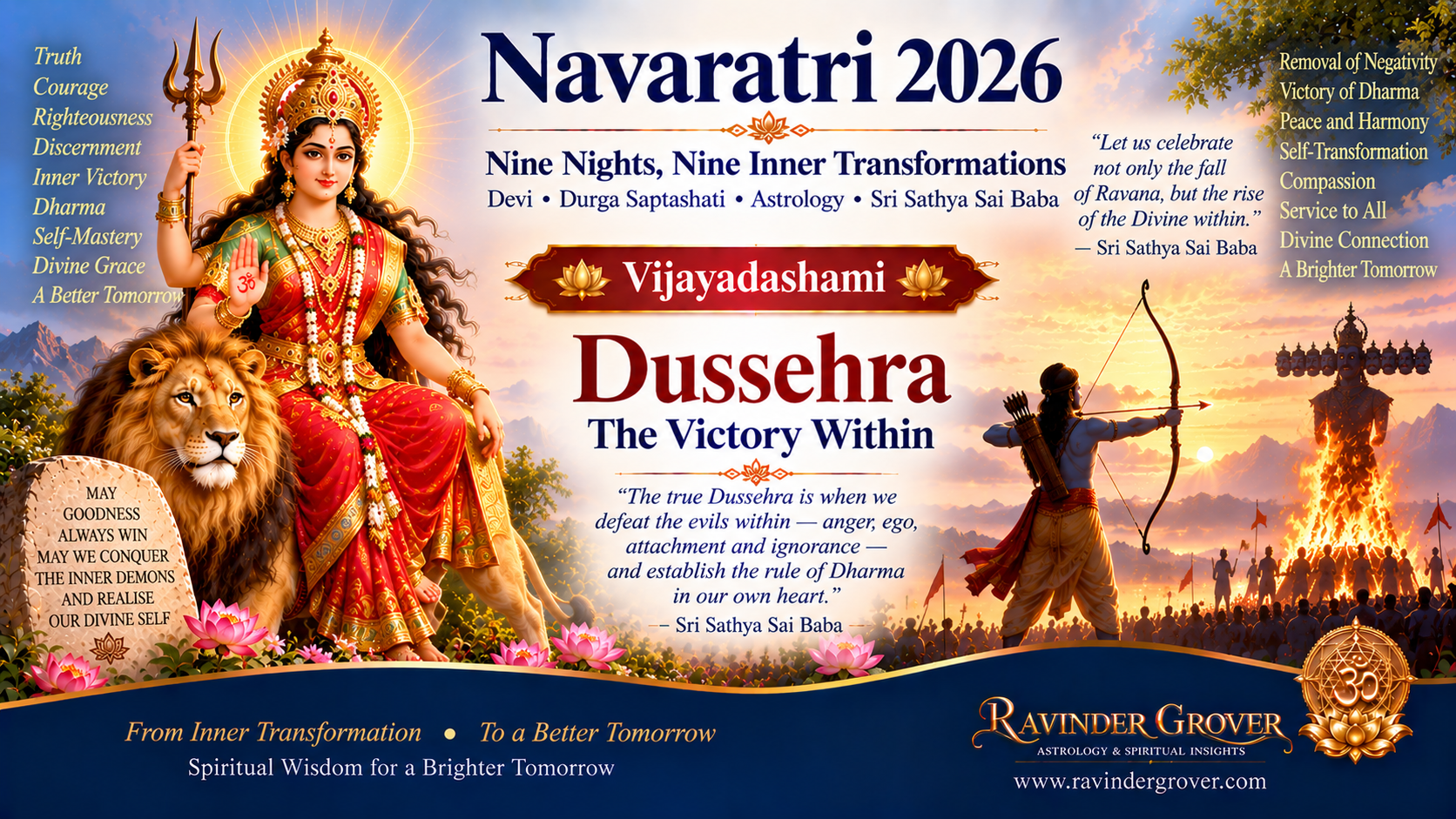
NAVARATRI 2026 – Nine Nights for Nine Inner Transformations
Sharad Navaratri 2026 (11–19 October 2026) and Vijayadashami 20 October 2026
Navaratri 2026 · Vijayadashami – Dussehra: The Victory Within
1. What Is Vijayadashami?
After nine nights of worship comes the tenth day, Vijayadashami, “the tenth day of victory”, also called Dussehra or Dasara. It celebrates two great victories: the Devi’s triumph over Mahishasura and the demons, and Lord Rama’s victory over Ravana.
The word Dasara is commonly explained as dasha (ten) and hara (removal): the removal of the ten. Ravana had ten heads; we have ten senses, and the ten inner enemies Swami named on Day 2. Vijayadashami asks whether, after nine days of sadhana, any of those heads have fallen.
Across India the day is marked in different ways: the burning of Ravana effigies in the north, the immersion of Durga images in Bengal, the worship of weapons and the Shami tree, and Vidyarambham, when small children are initiated into writing their first letters.
2. The Durga Saptashati Link
The Durga Saptashati is the story of a journey that matches the nine days. It begins with a king and a merchant who have lost everything and are still bound by attachment (Chapter 1), moves through the defeat of Madhu and Kaitabha (tamas), Mahishasura (rajas), and Shumbha and Nishumbha (the subtle ego), and ends with both seekers receiving the Mother’s grace (Chapter 13).
In Chapter 12 the Devi herself promises that those who hear or recite her glories with devotion will be freed from fear and difficulty. Vijayadashami is the day to complete the recitation, or simply to read Chapter 12 with gratitude.
3. The Astrological Link
Vijayadashami is counted among the sade-teen muhurta, the three and a half most auspicious days of the year, when new undertakings may be begun without consulting a separate muhurta. The afternoon period known as Vijaya Muhurta is traditionally regarded as especially favourable for beginnings.
Around this time the Sun moves from sidereal Kanya into Tula, its sign of debilitation. As the outer Sun weakens, the inner Sun lit during Navaratri must carry us. Lord Rama himself, before the final battle, was taught the Aditya Hridayam, a hymn to the Sun, by the sage Agastya (Valmiki Ramayana, Yuddha Kanda, sarga 105).
[Sarga number differs between recensions; please check against your edition]4. Astrology Message for the Day
This is an excellent day to begin something you have been postponing: study, a business step, a spiritual practice, or a creative project. In the astrological tradition, an undertaking begun on Vijayadashami carries the blessing of victory.
Whatever your chart shows, remember that the grahas are instruments of karma, and karma is shaped by our choices. The real Vijaya is victory over our own tendencies. A chart describes the battlefield; it does not decide the outcome.
5. A Message for Youngsters
Every year we watch Ravana burn. This year, burn your own. On Day 2 you were asked to choose one of the ten inner demons. Write it on a slip of paper, and today, with a prayer, let it go into the fire or tear it up. Then write one quality you want to grow in its place, and keep it where you can see it.
Rama won not because he was stronger than Ravana but because he stood with dharma, kept his word, and had friends who believed in him. Choose your friends and your values carefully. They are your army.
6. Inner Message from Swami, Scripture, and the Sages
Bhagavan Sri Sathya Sai Baba, in His Dasara discourse of 18 October 1991, asked each of us to examine whether the Divine Mother has destroyed the ten demons within during the ten days of the festival, and said that each person must decide for themselves whether they are a Ravana or a Rama according to their qualities.
On Vijayadasami in 2007, Swami declared that “the Vijayadasami Day is one to begin a new life.” [Discourse of 21 October 2007; likely Sri Sathya Sai Speaks, Vol. 40, Ch. 18; please verify]
In that Vijayadasami discourse, “Make Sathya and Dharma Your Steadfast Companions” (Sri Sathya Sai Speaks, Vol. 40, Ch. 18), Swami also cautioned that japa bears fruit only when the mind is fixed on the Name: the mala may turn in the hand while the mind does not turn toward God. The festival is real only when the inner life changes.
It was on Vijayadasami, 17 October 1953, that Swami gave His first public discourse, “Worship in the Mind” (Sri Sathya Sai Speaks, Vol. 1, Discourse 2). The title itself is the essence of Navaratri.
The Bhagavad Gita ends with Sanjaya’s declaration: wherever there is Krishna, the Lord of Yoga, and Arjuna, the archer, there will surely be fortune, victory (vijaya), prosperity, and righteousness (Bhagavad Gita 18.78). Victory belongs where the Divine and human effort meet.
7. What Everyone Should Understand
- Burning Ravana’s effigy is symbolic. The real Ravana is within, and the fire is sadhana.
- Vijayadashami is a day for beginnings: Vidyarambham for children, new ventures for adults, and a new life, as Swami said, for all.
- Victory in our tradition is never the victory of one person over another, but of dharma over adharma, light over darkness, and the Self over the ego.
- The nine days are a template. Their real test is the ninety days, and the nine years, that follow.
8. Practical Orientation for Vijayadashami
- Begin something: Start the study, practice, or project you have been postponing, ideally in the Vijaya Muhurta.
- Burn your Ravana: Let go of the one inner demon you identified on Day 2, and write down the quality you will grow instead.
- Reading: Read Chapter 12 of the Durga Saptashati, or Bhagavad Gita 18.78, as a closing prayer.
- Vidyarambham: If there are small children in the family, help them write their first letters, or “Om”, in rice or sand.
- Share the victory: Visit elders, exchange sweets, and seek blessings. In many traditions, Shami or Apta leaves are exchanged as “gold”.
Mantras for Vijayadashami
On Vijayadashami the Mother is worshipped as Aparajita, “the unconquered one”, and in many regions the Shami tree is honoured before the day’s new beginnings.
Aparajita name mantra
ॐ अपराजितायै नमः
Om Aparajitayai Namah
Salutations to the Unconquered Mother. Chant 108 times before beginning anything new today.
Shami prayer
शमी शमयते पापं शमी लोहितकण्टका ।
धारिण्यर्जुनबाणानां रामस्य प्रियवादिनी ॥
śamī śamayate pāpaṃ śamī lohitakaṇṭakā |
dhāriṇyarjunabāṇānāṃ rāmasya priyavādinī ||
The Shami removes sin; the Shami with its reddish thorns held the arrows of Arjuna and spoke kindly to Rama. This traditional verse, recited while worshipping the Shami tree, recalls the Pandavas hiding their weapons in a Shami tree during their year in disguise.
[Both are traditional recitations in common use; like the Navadurga dhyana shlokas, the Shami prayer is not traced to a single scriptural source]You may also recite the Saptashloki Durga (see the introductory post) as a closing offering for the whole Navaratri.
yatra yogeśvaraḥ kṛṣṇo yatra pārtho dhanurdharaḥ |
tatra śrīr vijayo bhūtir dhruvā nītir matir mama ||
(Bhagavad Gita 18.78)
Jai Mata Di · Shubh Vijayadashami
.
Ravinder Grover
Astrology & Spiritual Insights
📲 Join my WhatsApp Channel for regular updates:
https://whatsapp.com/channel/0029Vai6rQz6rsQyMHx7nZ1z
© 2026 Ravinder Grover. All Rights Reserved.
This work is protected under copyright and DMCA. Unauthorised use is prohibited.
Disclaimer: ‘Without Prejudice’. I offer my insight into astrology solely based on my learnings of astrology principles and techniques, some of which I learnt from the Sages of the highest order. These predictions are offered for guidance purposes only. I offer absolutely no guarantee for my calculations and analysis. These predictions are not intended to cause harm to anyone in any way. I expressly disclaim all warranties, whether implied or contingent, for making use of these predictions or for incurring any loss or loss of profit in any manner whatsoever. No notice or advice from anyone will create any liability whatsoever

Leave A Comment