

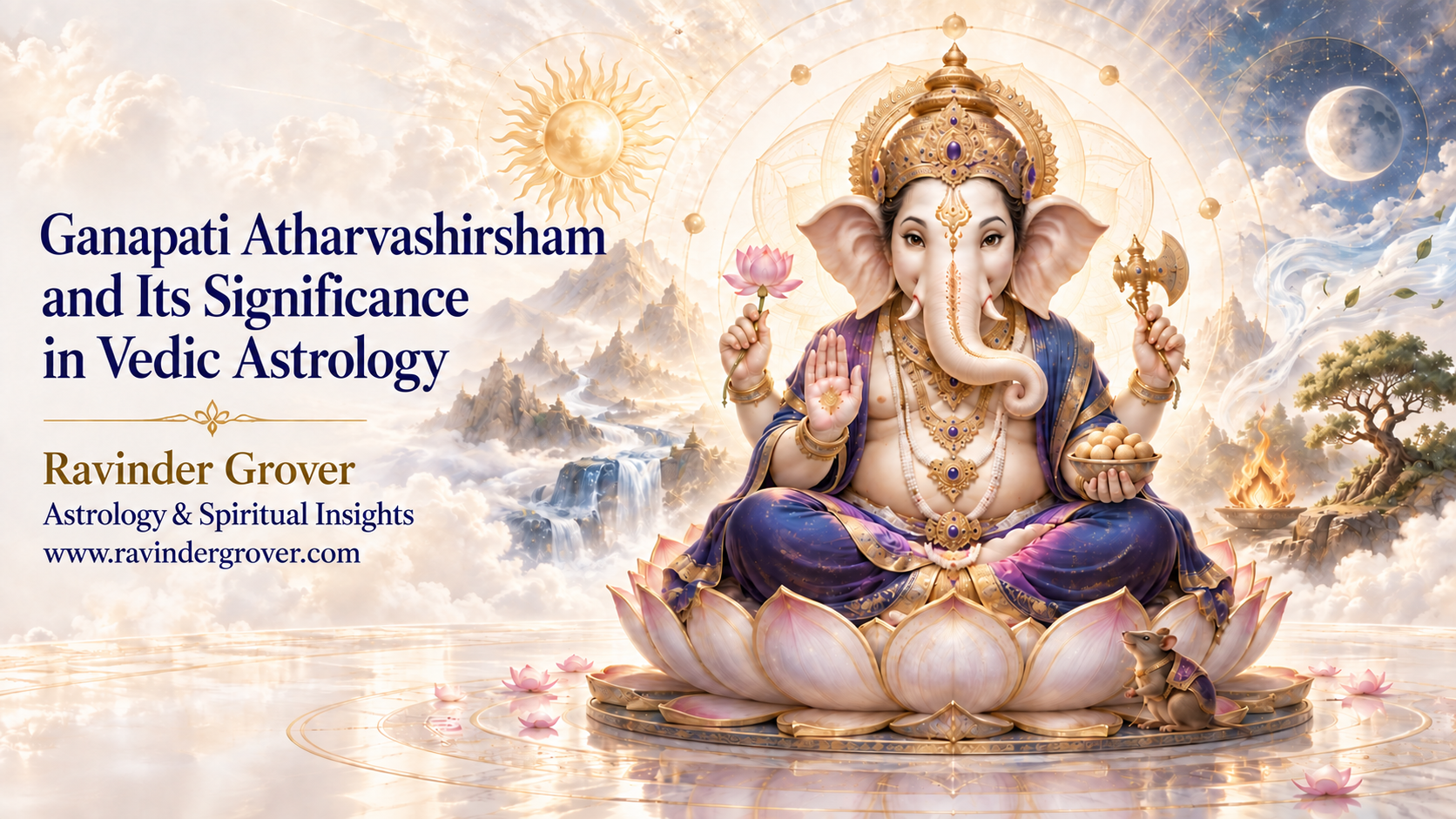
Ganapati Atharvashirsham and Its Significance in Vedic Astrology
Beyond planetary remedies towards wisdom clarity and knowledge of the Self
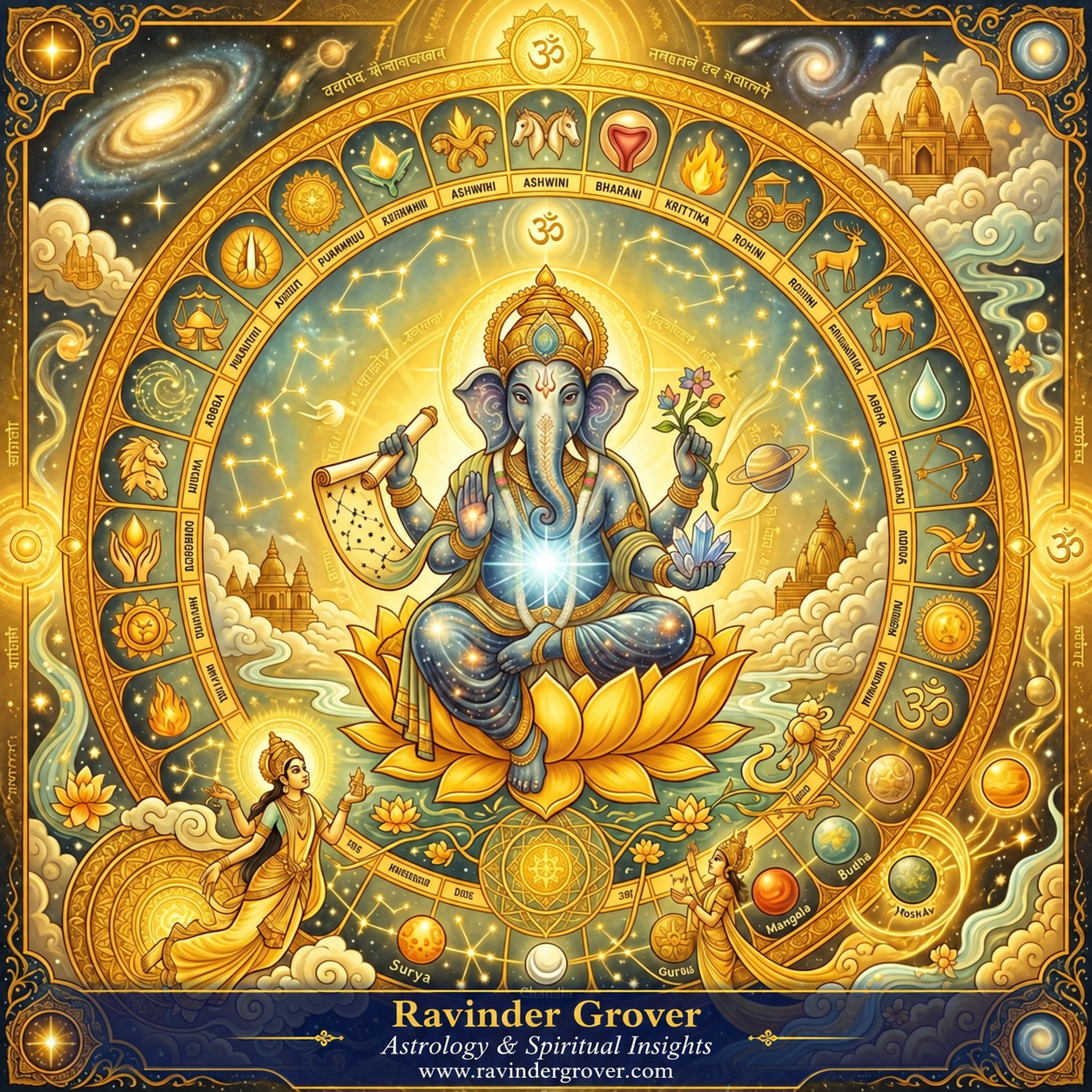
Lord Ganesha is invoked before a journey, a ceremony, a new undertaking, or the study of sacred knowledge. He is loved as Vighnaharta, the remover of obstacles, and honoured as the giver of buddhi, the intelligence that helps us recognise the right path. In Jyotish, His worship is often suggested when Mercury, Ketu, or the Badhaka principle appears to obstruct clarity or progress. These associations are meaningful, but the Ganapati Atharvashirsham carries us much further.
The text does not limit Ganapati to one planet, one difficulty or one desired result. It reveals Him as Brahman, Atman, Om, the five elements, sacred speech, the powers operating through creation, and the consciousness beyond the three divisions of time. Seen through this Upanishadic vision, a remedy is not merely an attempt to change an outer event. It is also a means of restoring clarity within the person who must meet that event.
This article follows the Atharvashirsham as its principal guide. Other scriptural passages are included only where they illuminate its teaching. The central understanding is simple: Jyotish describes the changing patterns of life within time, while Ganapati Tattva awakens the wisdom through which those patterns can be understood and lived correctly.
Ganapati as the ‘reality’ before us
ॐ नमस्ते गणपतये ।
त्वमेव प्रत्यक्षं तत्त्वमसि ।
त्वमेव केवलं कर्तासि । त्वमेव केवलं धर्तासि ।
त्वमेव केवलं हर्तासि । त्वमेव सर्वं खल्विदं ब्रह्मासि ।
त्वं साक्षादात्मासि नित्यम् ॥
— Ganapati Atharvashirsham
Salutations to Ganapati. You alone are the directly perceptible Reality. You alone create, sustain, and dissolve. You are all this as Brahman, and You are directly the eternal Self.
The words “Tvam eva pratyaksham tattvam asi” place a profound truth at the beginning of the teaching. Ganapati is not presented only as a divine form standing outside us. The visible form becomes an entrance into the Reality present throughout existence. Devotion begins with name and form, but contemplation gradually recognises the formless consciousness that makes every experience possible.
The verse then identifies Ganapati with creation, preservation, and dissolution. This gives a wider meaning to the removal of obstacles. We usually think that grace has arrived only when an unwanted difficulty disappears. Yet dissolution also has a sacred place in life. A false expectation, an unsuitable direction or an attachment that has completed its purpose may need to end before a more dharmic possibility can emerge. Ganesha removes what blocks wisdom, not merely whatever causes temporary discomfort.
Ganesha as Brahman and Atman
त्वं वाङ्मयस्त्वं चिन्मयः ।
त्वमानन्दमयस्त्वं ब्रह्ममयः ।
त्वं सच्चिदानन्दाद्वितीयोऽसि ।
त्वं प्रत्यक्षं ब्रह्मासि ।
त्वं ज्ञानमयो विज्ञानमयोऽसि ॥
— Ganapati Atharvashirsham
You are the essence of speech and consciousness, of bliss and Brahman. You are non-dual existence consciousness and bliss. You are knowledge and realised wisdom.
Ganapati is declared to be both Brahman, the all-pervading Reality, and Atman, the eternal Self. The worshipper, the world being experienced, and the Divine presence are therefore not ultimately separate. This does not diminish devotion; it deepens it. The Ganesha before whom we bow also shines as the awareness by which we know that we are bowing.
An astrological chart can describe tendencies, strengths, pressures, and periods of karmic fruition. It cannot define the whole of the Self. The horoscope belongs to the field of changing experience; the Atman is the witness of change. Remembering this distinction protects Jyotish from becoming fatalistic. A difficult combination may describe a genuine challenge, but it does not become the complete identity of the person.
Ganesha as ‘Om’ and the power of the sacred sound
ॐ गं गणपतये नमः ॥
— Ganapati Atharvashirsham
Om Gaṃ Ganapataye Namaḥ. Salutations to Lord Ganapati.
The Atharvashirsham reveals Ganapati through Om and through the bija Gaṃ, commonly written as Gam. It explains the sacred syllable through its consonant, vowel, anusvara, bindu, and nada. Together they form the mantra-body contemplated in Ganeshavidya. A bija is therefore more than an abbreviated name. It concentrates a spiritual principle into sound and gives the mind a subtle form through which to approach it.
The Upanishad also describes Ganesha as Vangmaya and Chinmaya, the essence of speech and the essence of consciousness. Its reference to the four stages of speech is traditionally understood through Para, Pashyanti, Madhyama, and Vaikhari. The audible word is the final expression of a process that begins more deeply as intention, subtle perception, and inner formulation. Correct pronunciation matters, but pronunciation alone cannot complete the practice. The quality of thought, feeling and awareness behind the recitation is equally important.
The declaration “Ritam vachmi, satyam vachmi” gives this teaching its moral force. Ritam is truth aligned with the Divine order; satyam is truth expressed and lived. Taittiriya Upanishad 1.11.1 offers a close parallel in the instruction “Satyam vada, dharmam chara”—speak truth and live in accordance with dharma. Worship of the Lord of speech should therefore refine ordinary conversation as well as sacred chanting. Its fruit becomes visible when words grow more truthful, measured and compassionate.
The Universe and the Five Elements
सर्वं जगदिदं त्वत्तो जायते ।
सर्वं जगदिदं त्वत्तस्तिष्ठति ।
सर्वं जगदिदं त्वयि लयमेष्यति ।
सर्वं जगदिदं त्वयि प्रत्येति ।
त्वं भूमिरापोऽनलोऽनिलो नभः ।
त्वं चत्वारि वाक्पदानि ॥
— Ganapati Atharvashirsham
From You this universe arises, in You it is sustained, into You it dissolves and to You it returns. You are earth, water, fire, air and space, and You are the four stages of speech.
The five elements are not described as substances separate from the Divine. They are expressions of the same Ganapati Tattva. Earth gives solidity and support; water permits flow and adaptation; fire transforms; air moves; and space allows every form and movement to exist. The body, environment and visible universe are woven from these elemental principles.
This teaching prevents spiritual practice from becoming disconnected from life. Care of the body, moderation, breath, surroundings, emotional balance and the use of speech all belong within the field of worship. The sacred is not confined to the altar. The same presence invoked through mantra is recognised in the material and psychological conditions through which daily life unfolds.
Beyond the threefold limits
त्वं गुणत्रयातीतः ।
त्वमवस्थात्रयातीतः ।
त्वं देहत्रयातीतः ।
त्वं कालत्रयातीतः ।
त्वं मूलाधारस्थितोऽसि नित्यम् ।
त्वं शक्तित्रयात्मकः ॥
— Ganapati Atharvashirsham
You are beyond the three gunas, the three states, the three bodies and the three divisions of time. You are eternally established in the Muladhara and embody the three powers.
Sattva, rajas and tamas describe the qualities of prakriti (nature). Waking, dream and deep sleep describe changing states of experience. The gross, subtle and causal bodies describe different layers of embodiment. Past, present and future organise our experience of time. Ganapati is said to be present through all these conditions and yet not confined by any of them.
Jyotisha (Vedic Astrology) studies the patterns of prakriti with remarkable subtlety through grahas, rashis, bhavas, nakshatras, dashas and gochar (transits). The Atharvashirsham adds the essential spiritual perspective: the consciousness that knows these patterns is greater than the patterns themselves. Astrology may show when a season of life is changing; spiritual knowledge prevents that season from becoming a prison for the mind.
The Sun, Moon and the wholeness of the cosmic order
त्वं ब्रह्मा त्वं विष्णुस्त्वं रुद्रस्त्वमिन्द्रस्त्वमग्निस्त्वं वायुस्त्वं सूर्यस्त्वं चन्द्रमास्त्वं ब्रह्म भूर्भुवः स्वरोम् ॥
— Ganapati Atharvashirsham
You are Brahma, Vishnu, Rudra, Indra, Agni and Vayu. You are the Sun and the Moon. You are Brahman and the sacred worlds expressed through Om.
The many divine functions named in this verse are gathered into one spiritual vision. Creation, preservation, transformation, authority, fire, movement, solar illumination and lunar receptivity are not isolated powers competing with one another. They operate within a single cosmic order.
In Jyotish, the Sun may signify purpose, vitality and the organising centre of identity, while the Moon reflects mind, responsiveness and lived experience. Every graha has its particular role. Ganapati, however, is not restricted to one member of that order. He is the intelligence within the whole. A planet may show the channel through which an experience arrives; Ganapati Tattva is present in the cosmic principle, in the experience and in the awareness capable of understanding it.
The Muladhara and the need for a firm foundation
The statement that Ganapati is eternally established in the Muladhara points to the necessity of foundation. In Yoga, Muladhara is associated with rootedness and stability. Spiritually, it reminds us that insight must be supported by a life capable of holding it. A disturbed foundation makes even sincere practice irregular and easily overwhelmed by circumstance.
For this reason, worship and daily order belong together. Regular sleep, appropriate food, care of health, fulfilment of obligations, financial responsibility, respectful relationships and truthful speech create steadiness. They are not separate from a remedy, nor do they replace grace. They prepare the ground upon which prayer, mantra and discrimination can work more deeply.
The Muladhara teaching also brings humility into spiritual life. One need not pursue extraordinary experiences while neglecting what is immediately before us. Ganapati first restores the base: attention, balance and the capacity to act without inner fragmentation. From such a foundation, spiritual growth becomes natural rather than forced.
The place of Jyotisha (Vedic Astrology) in this teaching
Vedic Astrology is a study of kala, the ordered movement of time. Dashas and transits help us recognise when particular karmic tendencies are likely to mature. The Atharvashirsham declares Ganapati to be beyond the three divisions of time. This does not reject astrology. It places astrology within a larger spiritual reality. Time influences circumstances, but the Self by which time is known is not exhausted by those circumstances.
A challenging period can make the mind contract around one prediction or one feared outcome. Recitation of the Atharvashirsham repeatedly expands the field of awareness. It moves from a particular obstacle to universal intelligence, from a single graha to the complete cosmic order, and from anxiety about the future to remembrance of the eternal Self.
Its astrological value may be understood through steadiness, discrimination and perspective. A steadier mind is less likely to turn pressure into uncontrolled reaction. Stronger buddhi can distinguish anxiety from intuition and desire from dharma. A wider perspective allows the meaning of a difficult period to be examined without denying its practical reality.
Mercury, Ketu and the ‘Badhaka‘ (obstacle) principle
Ganesha is naturally associated with intelligence, learning, memory and speech, creating an understandable connection with Mercury. Some Jyotish traditions also connect Him with Ketu, whose separating influence can turn attention away from outer identification and towards subtler knowledge. Ganesha worship is further recommended in some lineages when the Badhaka principle indicates obstruction.
These correspondences can guide a remedy, but they should not define Ganapati. The Atharvashirsham itself identifies Him with Om, Brahman, Atman, the elements, the powers of creation, the Sun, the Moon and the total universe. It does not teach that Ganapati belongs exclusively to Mercury or Ketu. Nor does it prescribe a universal posture or one Badhaka mantra for every ascendant. Such individual recommendations belong to a particular Jyotish tradition and should be given only after the horoscope and the person’s spiritual background have been considered.
The most balanced approach is therefore to use planetary correspondence as an entry point, not as a boundary. A person may begin Ganesha worship because of a Mercury, Ketu or Badhaka concern. The Atharvashirsham then enlarges the purpose of that worship from the removal of one obstruction to the cultivation of wisdom and knowledge of the Self.
Remedies Centered on the Ganapati Atharvashirsham
The following practices bring together the Phalashruti of the Atharvashirsham, established devotional traditions and a few useful ritual ideas commonly recommended for Ganesh Chaturthi. They are best understood as forms of reverence and inner alignment, not as guarantees that karma or practical difficulties will disappear immediately.
Simple Worship at Home
A simple worship space may be prepared with cleanliness and devotion. A lamp, flowers, durva grass and a sattvic offering such as modaka may be placed before Ganesha. Where it suits one’s family tradition, a small image formed from natural clay or turmeric paste can be worshipped temporarily. The significance lies in shraddha, attention and simplicity rather than display. Any temporary image should be treated respectfully and returned to nature in an environmentally responsible manner.
Recitation and Listening
एतदथर्वशीर्षं योऽधीते ।
स ब्रह्मभूयाय कल्पते ।
स सर्वविघ्नैर्न बाध्यते ।
स सर्वतः सुखमेधते ॥
— Ganapati Atharvashirsham Phalashruti
One who studies this Atharvashirsham becomes fit for the realisation of Brahman, is not overpowered by obstacles and grows in well being.
The text may be recited individually, with family or in a devotional gathering. A person who is still learning may listen with attention and gradually learn the pronunciation and Vedic accents from a competent teacher. Group recitation can support concentration and shared devotion, but its value should not be reduced to a claim that a particular number of participants automatically removes karma. The Phalashruti refers separately to imparting the teaching properly to eight worthy recipients; that statement should be respected in its own context rather than converted into a mechanical formula.
Ganapati Abhisheka
अनेन गणपतिमभिषिञ्चति स वाग्मी भवति ॥
— Ganapati Atharvashirsham Phalashruti
One who performs Ganapati abhisheka with this recitation becomes accomplished in speech.
Where abhisheka forms part of one’s tradition, the Atharvashirsham may accompany the offering of water to the murti. The recitation should remain attentive and reverential. The promise of becoming vagmi, accomplished in speech, is consistent with the body of the text, which has already declared Ganapati to be Vangmaya. The outer rite therefore points towards refined expression, understanding and responsible use of words.
Durva Modaka Laja and Sacred Offerings
यो दूर्वाङ्कुरैर्यजति स वैश्रवणोपमो भवति ।
यो लाजैर्यजति स यशोवान् भवति । स मेधावान् भवति ।
यो मोदकसहस्रेण यजति स वाञ्छितफलमवाप्नोति ।
यः साज्यसमिद्भिर्यजति स सर्वं लभते स सर्वं लभते ॥
— Ganapati Atharvashirsham Phalashruti
The Phalashruti praises worship with durva, laja, modakas and ghee offerings, associating them with prosperity, good repute, intelligence and the fulfilment of worthy aspirations.
Durva grass and modaka are among the most familiar offerings to Ganesha, and the Phalashruti gives them a direct textual place. Laja, or parched grain, and offerings made with ghee are also mentioned. These verses may be received with faith without turning devotion into a commercial exchange. The offering symbolises gratitude, surrender and the willingness to place one’s resources and desires before the Divine.
Maha Ganapati Homa
A Maha Ganapati Homa may be undertaken on Ganesh Chaturthi or another suitable occasion when proper arrangements and competent priestly guidance are available. It may also be selected as part of a Jyotish remedy where a practitioner considers Ganesha worship appropriate for Ketu or an obstructive pattern. The homa should not be presented as an instant cancellation of karma. Its deeper purpose is purification of sankalpa, invocation of wisdom and strengthening of the inner capacity to act correctly.
A Personal Jyotish Remedy
A mantra, form of Ganesha or mode of worship may sometimes be chosen after considering the ascendant, planetary condition, dasha and Badhaka indications. Such personalisation can be meaningful when it comes from a recognised lineage or carefully reasoned Jyotish practice. It should not be attributed directly to the Atharvashirsham unless the text actually states it. The universal and safest foundation remains respectful Ganesha worship, recitation or listening, truthful speech and dharmic action.
The Conduct That Follows Worship
The prayer “Ritam vachmi, satyam vachmi” should remain alive after the ritual has ended. A remedy centred on the Lord of wisdom becomes stronger when accompanied by honest communication, completion of genuine responsibilities, reconciliation where harm has been caused, charity according to one’s capacity and care for those in need. These actions do not purchase grace. They allow the intention of worship to enter daily life.
Scriptural Parallels
गणानां त्वा गणपतिं हवामहे
कविं कवीनामुपमश्रवस्तमम् ।
ज्येष्ठराजं ब्रह्मणां ब्रह्मणस्पत
आ नः शृण्वन्नूतिभिः सीद सादनम् ॥
— Rig Veda 2.23.1
We invoke the lord of the hosts, the seer among seers, greatly renowned and foremost among the powers of sacred utterance. Hear us and be present with your protection.
In its original Vedic setting, this celebrated mantra addresses Brahmanaspati. In the later living tradition it became closely associated with Ganapati and is widely used at the beginning of sacred undertakings. The historical distinction should be remembered, while the spiritual parallel remains clear: divine intelligence presides over sacred speech, order and auspicious commencement.
ॐ इत्येतदक्षरमिदं सर्वं तस्योपव्याख्यानं
भूतं भवद् भविष्यदिति सर्वमोङ्कार एव ।
यच्चान्यत् त्रिकालातीतं तदप्योङ्कार एव ॥
— Mandukya Upanishad 1
Om is all this: the past, the present and the future. Whatever is beyond the three divisions of time is also Om.
The Mandukya Upanishad helps us understand why the Atharvashirsham’s identification of Ganapati with Om is so comprehensive. Om includes the whole field of time and also points beyond it. Jyotish examines time and its patterns; contemplation of Om recalls the consciousness that is not confined to those patterns.
सत्यं वद । धर्मं चर ॥
— Taittiriya Upanishad 1.11.1
Speak truth. Live according to dharma.
This concise instruction closely supports “Ritam vachmi, satyam vachmi.” Sacred speech is not fulfilled only by correct recitation. It becomes complete when truth and dharma guide ordinary conduct.
योगस्थः कुरु कर्माणि सङ्गं त्यक्त्वा धनञ्जय ।
सिद्ध्यसिद्ध्योः समो भूत्वा समत्वं योग उच्यते ॥
— Bhagavad Gita 2.48
Established in yoga, perform action without attachment, remaining balanced in success and failure. Such equanimity is called yoga.
The Gita provides the right attitude towards an astrological remedy. Prayer is not a substitute for action, and action need not arise from panic. Worship steadies the mind so that effort can be made with clarity, while the final result is offered to the Divine.
The Prayer Within the Remedy
The Ganapati Atharvashirsham begins with the remover of obstacles but leads towards a much greater revelation. Ganapati is the Reality before us, the Self within us, the sacred sound we utter, the elements that compose the world and the consciousness beyond time. Its purpose cannot be contained within the hope that one difficult period will end.
When a dasha or transit becomes challenging, it is natural to pray for relief. Along with relief, one may pray for a steady mind, clear discrimination, truthful speech and the courage to perform the duty required by the moment. This is where an astrological remedy becomes spiritual practice. The outer situation may change quickly or slowly, but the person meeting it is no longer left without inner direction.
O Ganapati, remove the obstacles that obstruct dharma.
Illuminate the confusion within the mind.
Grant purity of speech, steadiness in action and clarity of discrimination.
Lead us from fear of changing time to knowledge of the eternal Self.
Ganapati Bappa Morya
References
- Ganapati Atharvashirsham, including its Phalashruti.
- Rig Veda 2.23.1.
- Mandukya Upanishad 1.
- Taittiriya Upanishad 1.11.1.
- Bhagavad Gita 2.48.
Ravinder Grover
Astrology & Spiritual Insights
📲 Join my WhatsApp Channel for regular updates:
https://whatsapp.com/channel/0029Vai6rQz6rsQyMHx7nZ1z
© 2026 Ravinder Grover. All Rights Reserved.
This work is protected under copyright and DMCA. Unauthorised use is prohibited.
Disclaimer: ‘Without Prejudice’. I offer my insight into astrology solely based on my learnings of astrology principles and techniques, some of which I learnt from the Sages of the highest order. These predictions are offered for guidance purposes only. I offer absolutely no guarantee for my calculations and analysis. These predictions are not intended to cause harm to anyone in any way. I expressly disclaim all warranties, whether implied or contingent, for making use of these predictions or for incurring any loss or loss of profit in any manner whatsoever. No notice or advice from anyone will create any liability whatsoever



Leave A Comment