

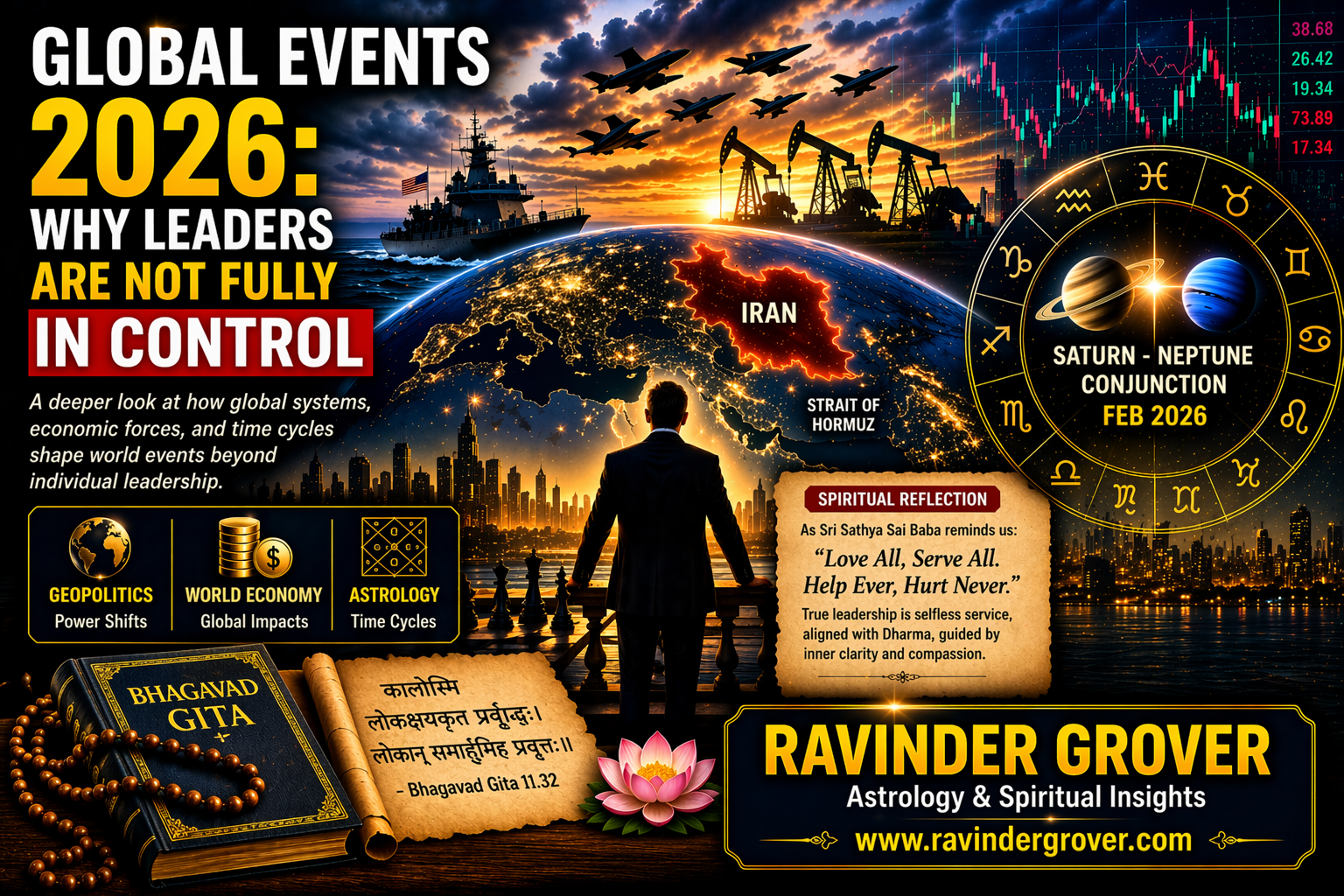
Global Events 2026
Why Leaders Are Not Fully in Control
A deeper look at how global systems, economic forces, and
Time cycles shape world events beyond individual leadership.
Introduction: The Illusion of Control
What if the biggest events shaping our world today are not being decided by leaders at all?
What if those in power are themselves responding to forces far beyond their control?
In moments of global uncertainty, when tensions rise and headlines become intense, our natural instinct is to look toward leaders. We assume that decisions are being taken at the highest levels, that powerful individuals are steering the direction of events.
They speak with authority. They announce policies. They appear decisive.
Yet, when we step back and observe more deeply, a fundamental question begins to arise:
Are leaders truly shaping events, or are they operating within a framework that has already defined their choices?
This insight is expressed with remarkable clarity in the Bhagavad Gita (Chapter 11, Verse 32):
कालोऽस्मि लोकक्षयकृत् प्रवृद्धो लोकान्समाहर्तुमिह प्रवृत्तः॥
Kālo’smi loka-kṣhaya-kṛit pravṛiddho lokān samāhartum iha pravṛittaḥ
“I am Time, the mighty destroyer of the world.”
This is not merely a philosophical statement. It is a profound revelation.
It tells us that beyond human intention, beyond strategy and policy, it is Time (Kala) that ultimately governs the unfolding of events.
Leaders may appear to act, but often they are responding to forces already set in motion.
The Five Structural Forces Behind Global Decisions
To understand what is happening today, we must move beyond personalities and examine the deeper forces at play.
Modern geopolitics is not shaped overnight. It is the result of systems built over decades, sometimes over generations. These systems now operate with their own momentum.
1. The Military–Industrial Structure
Since the mid-20th century, especially after World War II, nations have developed vast military infrastructures.
These include:
- Defence institutions
- Strategic command systems
- Private contractors and industries
Over time, these structures develop self-sustaining momentum.
They require:
- Budgets
- Justification
- Strategic threats
War is no longer just a decision taken in isolation.
It becomes part of a system that needs continuity.
2. Control of Information and Decision Framing
Leaders do not act in a vacuum. They rely on:
- Intelligence agencies
- Advisors
- Policy experts
However, the key point is this:
Leaders do not see all options. They see selected options.
The framing of threats, opportunities, and risks is controlled by institutions.
Control of information becomes control of decisions.
3. Alliance Pressure and Strategic Influence
No major nation acts alone.
Alliances bring:
- Support
- Security
- Influence
But they also bring:
- Expectations
- Pressure
- Strategic alignment
Highly motivated allies often exert disproportionate influence.
Decisions are not purely national. They are shaped within a network of expectations.
4. Financial Markets as Invisible Controllers
In today’s world, financial markets react instantly.
A single announcement can:
- Move global indices
- Impact currencies
- Affect economic stability
For any leader:
- Market collapse creates political pressure
- Economic instability reduces credibility
Over time, markets begin to constrain leaders.
5. Debt and the Petrodollar System (The Core Driver)
This is perhaps the most critical yet least understood force.
Modern economies operate under massive debt structures.
To sustain this:
- Borrowing must remain affordable
- Global demand for currency must remain strong
This is where the petrodollar system becomes central.
Oil is traded globally in dollars. Therefore, every nation needs dollars.
This creates:
- Continuous demand
- Financial stability
But this system depends on one crucial factor:
Control of key energy routes.
Control of oil is not just about energy — it is about control of the global financial system itself.
Why Iran and the Strait of Hormuz Become Central
The Strait of Hormuz is not just a geographical location. It is a global economic artery.
- A significant percentage of the world’s oil passes through it
- Any disruption affects global supply
Now consider the chain:
- Oil supply disruption leads to rising prices
- Rising prices create global economic stress
- Economic stress leads to market instability
- Market instability affects currency strength
If the dollar weakens:
- Borrowing becomes expensive
- Debt becomes unsustainable
With Iran’s strategic position, regional alliances, and global power competition, the situation becomes clear.
This is not merely a political issue.
It is a structural pressure point in the global system.
This structural pressure begins to visibly unfold during the February–March 2026 activation window, as reflected in both geopolitical developments and astrological cycles.
In such a situation, conflict is not driven by desire — it is driven by necessity.
The Trap Matrix: Why There Is No Easy Solution
When all these forces combine, leadership faces a trap.
- Escalation leads to costly conflict
- De-escalation appears as weakness
- Negotiation faces resistance
- Inaction leads to gradual decline
Every path carries risk. Every option has consequences.
What appears as indecision is, in reality, structural constraint.
History Repeats: When Systems Override Leaders
This pattern is not new. History offers powerful parallels.
Roman Empire (Late Stage)
The Roman Empire faced the following:
- Economic strain
- Military overextension
- Administrative burden
Leaders changed, but the structural issues remained.
The decline was driven by systemic imbalance.
World War II Build-Up
Before World War II:
- Economic depression spread globally
- Political tensions increased
- Treaty pressures created imbalance
War did not begin suddenly.
It emerged from accumulated pressures.
Large-scale conflicts are rarely sudden—they build over time.
Astrology: Understanding the Timing of Events
Astrology does not create events. It reveals when conditions mature.
What we observe in geopolitics externally is often a reflection of deeper cosmic cycles unfolding simultaneously.
Planets indicate the timing of karma unfolding.
Saturn in Pisces (2025–2027): Pressure and Correction
Saturn represents discipline, structure, and karma.
In Pisces:
- Hidden realities emerge
- Illusions weaken
- Systems are tested
This is a period of exposure, accountability, and correction.
Systems that appear stable begin to show stress.
Saturn–Neptune Conjunction (February 2026)
This rare alignment represents the following:
- Saturn as reality
- Neptune as illusion
When they meet, illusion cannot sustain itself.
Systems built on weak foundations begin to crack.
Eclipse Cycle (February–March 2026)
Eclipses represent sudden change and revelation.
- Aquarius relates to systems
- Leo relates to leadership
This dynamic creates tension between the system and authority.
Events during this period reveal what was already building beneath the surface.
Mars: The Trigger of Events
Mars represents action. And when Mars activates key zones, events move from potential to reality.
Scriptural Insight: The Mechanism Behind Action
The Bhagavad Gita (Chapter 18, Verse 61) states:
ईश्वरः सर्वभूतानां हृद्देशेऽर्जुन तिष्ठति।
भ्रामयन्सर्वभूतानि यन्त्रारूढानि मायया॥
“All beings act as if mounted on a machine under divine influence.”
This reflects that individuals act within a larger system.
Understanding Ego and Action
The Bhagavad Gita (Chapter 3, Verse 27) explains:
प्रकृतेः क्रियमाणानि गुणैः कर्माणि सर्वशः।
अहङ्कारविमूढात्मा कर्ताहमिति मन्यते॥
“All actions are carried out by nature, but the ego thinks ‘I am the doer.’”
Leaders believe they act independently, but they operate within larger forces.
Timeline of Activation (2026)
The unfolding of global events follows a clear sequence of activation. These dates are not isolated—they represent stages in a structured process:
TIMELINE 2026
- 17 February – Solar Eclipse (Initiation Phase)
- 20 February – Saturn–Neptune Conjunction (Structural Shift)
- Late February – Mars Activation (Trigger Phase)
- 3 March – Lunar Eclipse (Revelation Phase)
- April–May – Escalation Phase (Expansion of Events)
18–25 April 2026: Shock Window
This period stands out as a high-risk window for sudden and disruptive developments. Escalation during this phase could manifest through attacks on critical infrastructure, rising naval tensions, and sharp movements in global markets, underscoring the fragile and unpredictable nature of the conflict.
These stages reflect a pattern:
Built → Triggered → Revealed → Expanded
A detailed timeline analysis has been discussed in my earlier article.
Link to my previous article page:
https://ravindergrover.com/iran-war-2026-timeline-global-impact-and-astrology-alignment/
Key Insight
Leaders appear to act, but often they are responding to forces already set in motion.
The wise do not react to events.
They understand the pattern behind them.
Acknowledgement
This article has been shaped through reflection on a range of contemporary geopolitical discussions. In particular, insights from a talk by Prof. Jiang (Mr. Xiang) offered a valuable structural perspective on how global decisions are influenced by deeper systemic forces. The present analysis expands upon these ideas by integrating astrological, scriptural, and historical understanding.
Spiritual Reflection
As Sri Sathya Sai Baba reminds us,
“Love All, Serve All. Help Ever, Hurt Never.”
In times of uncertainty, while systems shape the external world, our inner response defines our path.
“Systems shape decisions
Structures limit choices
Time governs outcomes“
As revealed and said above, in the Bhagavad Gita (Chapter 11, Verse 32), time itself becomes the force behind transformation.
Understand the pattern before it unfolds—for it is in understanding that clarity replaces uncertainty.
What Happens Next?
The developments discussed here represent only the initial phase of a larger unfolding pattern.
In the next part, I have explored how these events may evolve through the second half of 2026:
Global Events 2026: What Happens Next (June to December Outlook)
https://ravindergrover.com/global-events-2026-what-happens-next-june-to-december-outlook/
Warm regards,
Ravinder Grover
Astrology & Spiritual Insights
Ravinder Grover
Mundane Astrology Research – Global Reset Series
🌐 www.ravindergrover.com
📲 Join my WhatsApp Channel for regular updates:
https://whatsapp.com/channel/0029Vai6rQz6rsQyMHx7nZ1z
© 2025 Ravinder Grover. All Rights Reserved.
This work is protected under copyright and DMCA. Unauthorized use is prohibited
Disclaimer: ‘Without Prejudice.’ I offer my insight into astrology solely based on my learnings of astrology principles and techniques, some of which I learnt from the Sages of the highest order. These predictions are offered for guidance purposes only. I offer absolutely no guarantee on my calculations and analysis. These predictions are not intended to harm anyone by any means. I expressly disclaim all warranties, implied or contingent, for making use of these predictions or for incurring any loss or loss of profit in any manner whatsoever. No notice or advice from anyone will create any liability whatsoever

Leave A Comment