

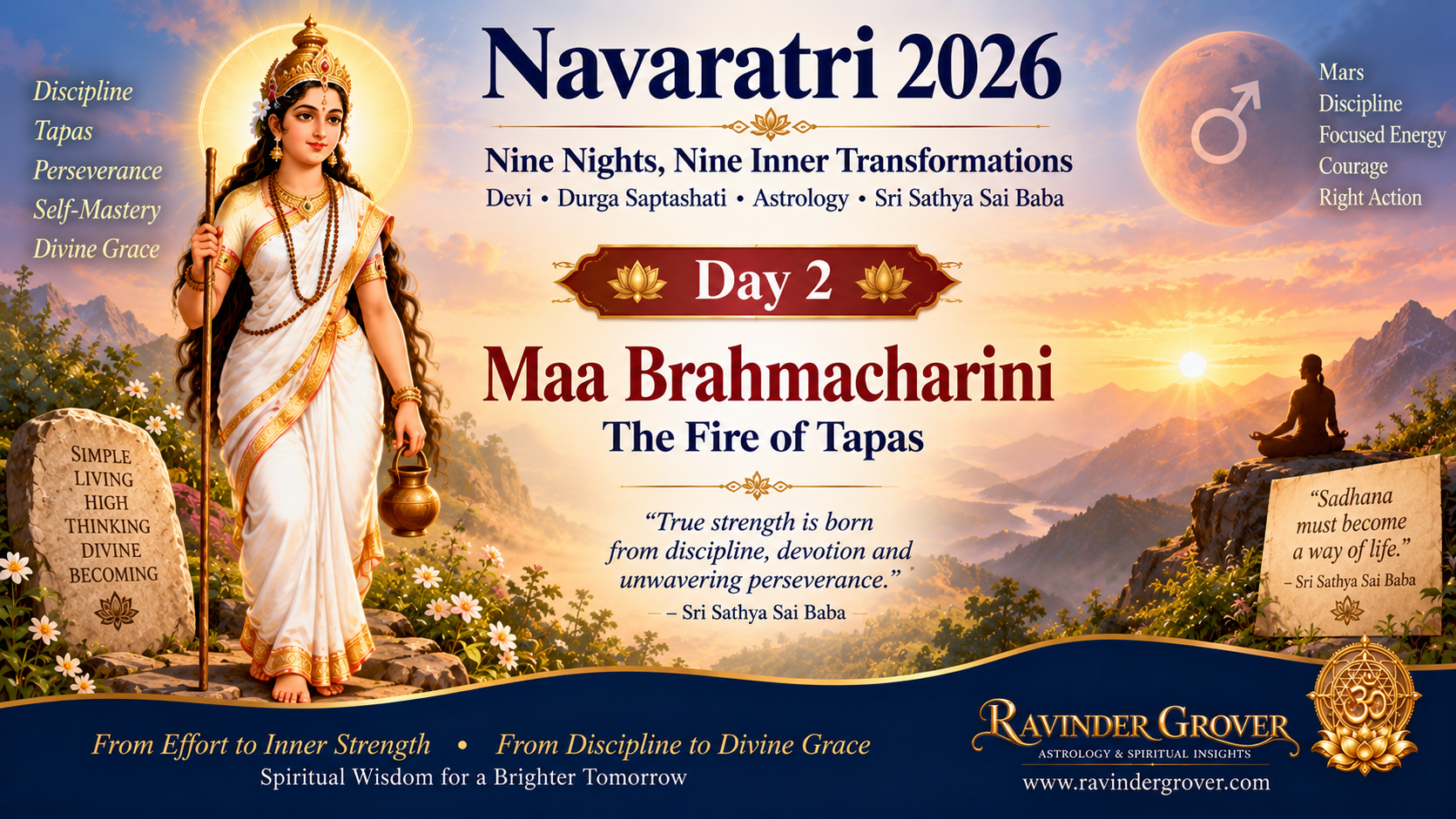
NAVARATRI 2026 – Nine Nights for Nine Inner Transformations
Sharad Navaratri 2026 (11–20 October 2026) and Vijayadashami 21 October 2026
Navaratri 2026 · Day 2 — Maa Brahmacharini: The Fire of Tapas
The first day of Navaratri asked us to become steady. On the second day, the Divine Mother asks something more demanding: Can we remain steady when enthusiasm fades?
Maa Brahmacharini represents tapas — disciplined spiritual effort, perseverance and the quiet fire of a life directed towards a higher purpose.
Spiritual progress rarely depends upon one extraordinary moment. More often, it is built through small disciplines repeated faithfully: prayer when we are tired, restraint when we are provoked, study when the mind wants distraction, and service when nobody is watching.
That is the path of Brahmacharini.
1. Who Is Maa Brahmacharini?
On the second day of Navaratri we worship Maa Brahmacharini, the form of the Divine Mother who walks in Brahman.
She represents Parvati during the years of intense tapas undertaken to attain Lord Shiva. She is traditionally depicted walking barefoot, dressed simply in white, holding a japa mala in her right hand and a kamandalu, or water pot, in her left.
Her austerity became so complete that, according to tradition, she eventually gave up even fallen leaves as food. For this she came to be known as Aparna — “the one without even a leaf.” Kalidasa refers to this name in Kumarasambhavam 5.28.
Unlike many other forms of the Goddess, Brahmacharini carries no weapon. She does not need one.
Her tapas is her weapon.
Her power lies in the extraordinary strength of a mind that has chosen its goal and refuses to be distracted from it.
In the Navadurga sequence of the Devi Kavacham she is named second:
dvitīyaṃ brahmacāriṇī
After the grounding of Shailaputri comes the discipline of Brahmacharini.
First we establish the foundation. Then we learn to walk the path.
2. The Durga Saptashati — When Scattered Energy Becomes One Power
The Madhyama Charitra of the Durga Saptashati or Devi Mahatmya — Chapters 2 to 4 — is presided over by Mahalakshmi and recounts the great battle with Mahishasura.
Chapter 2 contains an image that beautifully reflects the teaching of Brahmacharini.
Mahishasura has driven the devas from heaven. Their separate powers appear insufficient against him.
Then something extraordinary happens.
The anger, determination and divine radiance of Vishnu, Shiva, Brahma, Indra and the other devas blaze forth as light. Their separate tejas gathers into one concentrated radiance, and from that unified power the Goddess manifests.
Each deity then offers Her his own weapon.
Many scattered energies become one purposeful Shakti.
This is precisely what tapas does within us.
Our energy is often dispersed through worry, irritation, unfinished intentions, arguments, comparison, excessive entertainment, restless desires and constant distraction.
A scattered mind may possess great ability but accomplish little.
A disciplined mind gathers those fragments together.
The same energy that once fed distraction becomes concentration.
The same force that produced anger becomes determination.
The same desire that pulled us outward becomes longing for the Divine.
Mahishasura, the buffalo demon, may therefore also be contemplated as the heavy, stubborn force of tamas — inertia, resistance and uncontrolled impulse.
Such forces are not overcome by occasional enthusiasm.
They require steady spiritual effort.
3. The Astrological Lens — Mars Refined into Tapas
For this series, Maa Brahmacharini is contemplated through the symbolic lens of Mars — Mangala or Kuja.
Mars represents energy, courage, initiative, physical strength, blood, determination and the instinct to act.
In Vedic astrology, Mars rules Mesha and Vrishchika and is exalted in Makara, the sign associated with disciplined effort, responsibility and endurance.
Mars contains both possibilities of Day 2.
When uncontrolled, its energy may express itself as:
- anger
- impatience
- impulsiveness
- argument
- aggression
- conflict
- energy that begins strongly but quickly burns out
When disciplined, the very same Mars becomes:
- stamina
- courage
- determination
- protection
- focused effort
- the strength to complete a vow
Brahmacharini does not destroy the fire of Mars.
She purifies it.
Her teaching is not: “Do not have energy.” Her teaching is: “Give your energy a sacred direction.”
Patanjali expresses a related principle in the Yoga Sutras:
brahmacarya-pratiṣṭhāyāṃ vīrya-lābhaḥ
“When one is established in brahmacharya, vigour is gained.”
— Yoga Sutras 2.38
Virya — vital strength — is not lost through discipline.
It is conserved, concentrated and elevated.
4. Astrology Message for the Day — Give Mars Honest Work
Those experiencing difficult expressions of Mars may find the symbolism of this day particularly meaningful.
This may include, for example, Mars associated with Rahu or Saturn, Mars debilitated in Karka, or Mars involved in Kuja dosha considerations in relationship matters.
Such patterns may sometimes correspond with themes such as:
- quick temper
- impatience
- friction
- impulsive decisions
- difficulty sustaining effort
- strong energy without clear direction
But the spiritual answer is not fear of Mars.
Nor is it suppression.
The lesson of Brahmacharini is channelisation.
Give Mars something worthwhile to do.
Exercise.
Keep a disciplined routine.
Finish a difficult task.
Perform physical seva.
Clean your prayer space.
Keep a promise when it would be easier to break it.
When energy is given honest work, it becomes constructive.
When it has no direction, it often creates disturbance.
5. A Message for Youngsters — Success Also Has a Spiritual Side
Young people sometimes hear the word tapas and imagine extreme austerity.
But tapas can be understood very simply:
doing what needs to be done even when you do not feel like doing it.
The athlete who trains when it is cold is practising tapas.
The student who revises one more chapter is practising tapas.
The musician who repeats the same exercise until it becomes natural is practising tapas.
The young person who refuses to answer anger with anger is also practising tapas.
Try one small discipline today.
Perhaps:
- no social media until evening
- no unnecessary snacking
- one hour of focused study
- no angry reply when provoked
- finishing one task before beginning another
Then notice something interesting.
When energy is no longer leaking through constant distraction, you begin to feel stronger.
That energy was always yours.
Brahmacharini simply teaches you how to reclaim it.
6. Sri Sathya Sai Baba, the Gita and the Upanishads
Sri Sathya Sai Baba — The Demons Are Within
During Dasara, Bhagavan Sri Sathya Sai Baba repeatedly turned attention from outward mythology towards inner transformation.
In His discourse of 18 October 1991, Swami asked devotees to examine whether the Divine Mother had destroyed the demons within them.
He referred to qualities such as arrogance, bad thoughts, lust, anger, delusion, greed, pride, envy, ego and hatred, and explained:
“Rakshasas are not demonic beings but wicked qualities.”
This completely changes our understanding of Navaratri.
The battle is not merely between Devi and beings from an ancient story. It is also taking place every day within the human mind.
Brahmacharini’s tapas therefore becomes intensely practical.
What quality within me must be disciplined?
What reaction must I stop feeding?
What habit has become stronger because I repeatedly surrender to it?
Her austerity was the gradual removal of everything that stood between her and the Divine. Our journey is essentially the same.
Bhagavad Gita — Three Forms of Tapas
The Bhagavad Gita gives a beautiful threefold understanding of austerity.
Tapas of the body includes worship, purity, straightforwardness, brahmacharya and non-violence.
— Bhagavad Gita 17.14
Tapas of speech means words that do not agitate others and that are truthful, pleasant and beneficial, along with study of sacred teachings.
— 17.15
Tapas of the mind includes serenity, gentleness, silence, self-control and purity of feeling.
— 17.16
This is an important correction to the idea that tapas merely means fasting.
A person may fast all day and still speak harshly.
Another may eat normally but maintain patience, truthful speech and complete control over anger.
Which tapas is deeper?
Brahmacharini invites us to practise austerity of body, speech and mind.
Katha Upanishad — Hold the Reins
The Katha Upanishad offers another timeless image.
The Self is the rider.
The body is the chariot.
The intellect is the charioteer.
The mind is the reins.
The senses are the horses.
— Katha Upanishad 1.3.3–4
A powerful chariot is useless if the reins are uncontrolled.
Similarly, intelligence, energy and ability do not automatically produce a good life.
Someone must hold the reins.
Tapas is the training by which the inner charioteer learns to guide the senses rather than being dragged by them.
7. What Should We Understand from Maa Brahmacharini?
Several important lessons emerge from this second day.
Brahmacharya is broader than celibacy. At its deepest level it means conduct directed towards Brahman. For householders, this includes moderation, purity, fidelity, restraint and mastery of the senses rather than rejection of ordinary life.
Tapas is not self-punishment. The Bhagavad Gita itself warns against harsh austerities undertaken through ego or those that unnecessarily torment the body. True tapas makes us clearer and stronger, not bitter and damaged.
The demons are recognisable qualities. Anger, greed, pride, envy and hatred are not abstract theological ideas. We encounter them in ourselves in ordinary situations.
Small disciplines matter. One modest promise kept faithfully often changes us more than an impressive vow abandoned after two days.
Spiritual discipline grows through consistency, not drama.
8. Practical Orientation for Day 2
Choose One Inner Demon
From the qualities identified by Sri Sathya Sai Baba, select one to observe carefully for the rest of Navaratri.
Do not begin by trying to conquer ten things simultaneously.
Observe one honestly.
Chant the Mantra
Using a japa mala if you wish, chant:
ॐ देवी ब्रह्मचारिण्यै नमः॥
Om Devi Brahmacharinyai Namah
You may chant it 9, 27 or 108 times according to your time and capacity.
Mantra and Dhyana Shloka of Maa Brahmacharini
ॐ देवी ब्रह्मचारिण्यै नमः॥
दधाना करपद्माभ्यामक्षमालाकमण्डलू ।
देवी प्रसीदतु मयि ब्रह्मचारिण्यनुत्तमा ॥
dadhānā karapadmābhyām akṣamālākamaṇḍalū |
devī prasīdatu mayi brahmacāriṇyanuttamā ||
Meaning:
May the supreme Devi Brahmacharini, who holds the rosary and water pot in Her lotus hands, be gracious to me.
Read from the Durga Saptashati
Read Chapter 2, or at least contemplate the passage describing the appearance of the Divine Mother from the combined tejas of the devas.
Ask yourself: Where is my energy scattered, and what would happen if I gathered it around one noble purpose?
Keep One Simple Tapas
Choose something practical and appropriate to your health and circumstances:
- moderation in food
- one hour of silence
- reduced screen time
- disciplined prayer
- mindful speech
- completing an unfinished duty
The purpose is not suffering.
The purpose is mastery.
Channel Mars Constructively
Give your physical energy a positive outlet:
- take a brisk walk
- exercise
- clean your prayer space
- help someone with a demanding task
- perform seva requiring physical effort
Turn heat into strength.
Turn reaction into action.
Turn anger into courage.
The Inner Reflection
Brahmacharini teaches us that spiritual transformation does not happen simply because we admire spiritual ideals.
It happens when we live them repeatedly.
The mind says, “Tomorrow.”
Tapas says, “Today.”
The senses say, “Just this once.”
Tapas says, “Remember your purpose.”
Anger says, “React.”
Tapas says, “Choose.”
And gradually, almost invisibly, character begins to change.
That may be the real miracle of the second night of Navaratri.
Not that the Divine Mother removes every difficulty from our path, but that through Her grace we develop the strength to walk the path without abandoning it.
brahmacarya-pratiṣṭhāyāṃ vīrya-lābhaḥ
“When established in brahmacharya, vigour is gained.”
— Yoga Sutras 2.38
Tomorrow: Day 3 — Maa Chandraghanta: Courage with Grace
Ravinder Grover
Astrology & Spiritual Insights
📲 Join my WhatsApp Channel for regular updates:
https://whatsapp.com/channel/0029Vai6rQz6rsQyMHx7nZ1z
© 2026 Ravinder Grover. All Rights Reserved.
This work is protected under copyright and DMCA. Unauthorised reproduction or use is prohibited.
Disclaimer — Without Prejudice:
The astrological and spiritual observations shared in this article are based on my study and understanding of Vedic Astrology, spiritual teachings and traditional sources, including teachings passed down by respected sages and teachers. They are offered solely for spiritual reflection and general guidance. Astrology indicates tendencies and possibilities; it does not remove individual free will. No guarantee is made regarding any interpretation, calculation or outcome. Nothing in this article should be regarded as medical, legal, financial or other professional advice. The author accepts no liability for any decision, loss or consequence arising from reliance upon this material.


Leave A Comment