

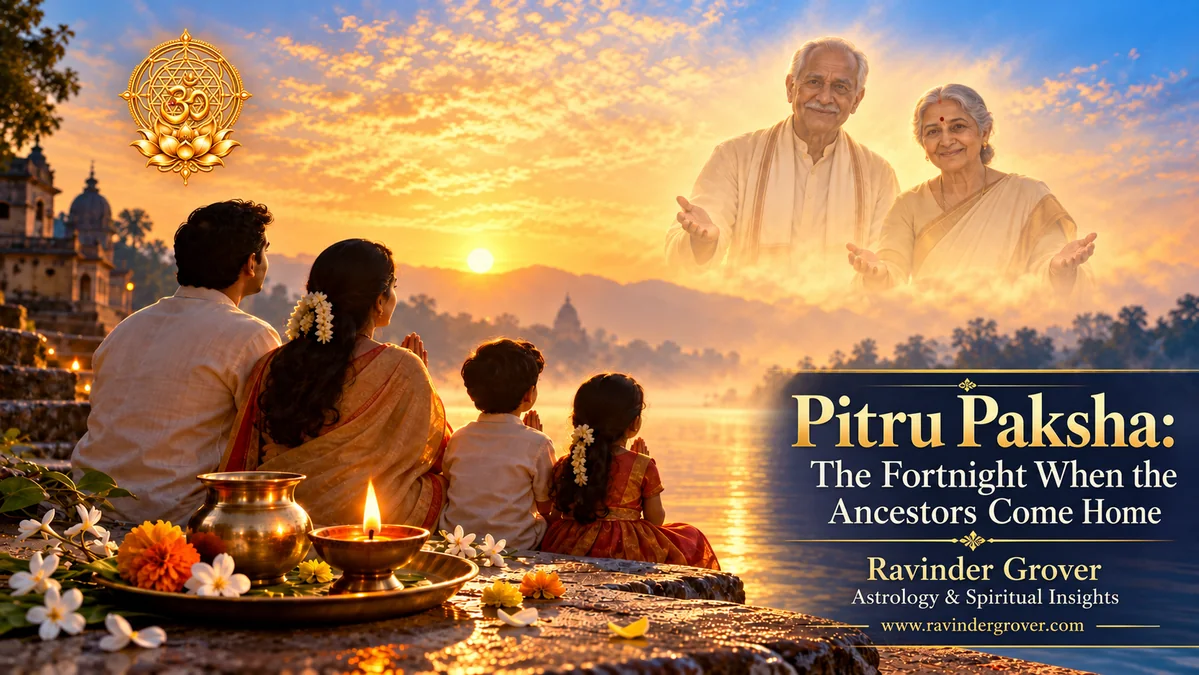
Pitru Paksha: The Fortnight When the Ancestors Come Home
Scriptural roots, cosmic meaning, and living practice for Pitru Paksha 2026
We inherit more than a family name. Our lives have been shaped by people we knew and by many we never met: their work, their sacrifices, their values, and their prayers. Tradition says that for one fortnight each year the veil between the worlds grows thin, and these ancestors return to the thresholds of their descendants. They do not come as ghosts but as guests. They come to see whether they are remembered, to receive water and rice offered with love, and to bless the lineage they began.
This is Pitru Paksha (पितृ पक्ष, Pitṛ Pakṣa), the Fortnight of the Fathers. Pitṛ means ‘ancestor’, and pakṣa means ‘a lunar fortnight’. It is also called Mahālaya, Shraddha Paksha, or Kanyāgata. The rites performed are called śrāddha, a word that carries the spirit of śraddhā, faith and sincerity. It is one of the oldest continuous observances on earth, and its roots go back to the Ṛgveda itself.
When is Pitru Paksha in 2026?
Pitru Paksha 2026 begins on Saturday, 26 September 2026, with Purnima Shraddha and ends on Saturday, 10 October 2026, with Sarvapitri (Mahālaya) Amāvasyā. Pratipada Shraddha, the first day of the waning fortnight, falls on Sunday, 27 September 2026.
A note for readers outside India: these dates are reckoned for Indian Standard Time. Because a tithi begins and ends at an astronomical moment rather than at midnight, the same tithi can fall on a different calendar date abroad. Families in New Zealand, Fiji, Australia, the UK, or North America should confirm the exact tithi from a pañcāṅga calculated for their own city or consult a knowledgeable priest before arranging a formal rite.
Each ancestor is honoured on the tithi of their passing. If the tithi is not known, Shraddha is performed on Sarvapitri Amāvasyā, 10 October, which is valid for all ancestors.
I. The Vedic Root: “May the Fathers Rise”
Long before temples, Purāṇas, or pilgrimage to Gayā, the Ṛṣis of the Ṛgveda were already calling to the Pitṛs. The tenth maṇḍala contains the Pitṛ Sūkta (Ṛgveda, Maṇḍala 10, Sūkta 15), which opens with this invocation:
उदीरतामवर उत्परास उन्मध्यमाः पितरः सोम्यासः।
असुं य ईयुरवृका ऋतज्ञास्ते नोऽवन्तु पितरो हवेषु॥
udīratām avara ut parāsa un madhyamāḥ pitaraḥ somyāsaḥ
asuṃ ya īyur avṛkā ṛtajñās te no ‘vantu pitaro haveṣu
“May the Fathers rise: the lower, the higher, and those of the middle realm, the Soma-worthy ones. They have passed into the breath of life, gentle and free of malice, knowers of Ṛta, the cosmic order. May these Fathers protect us when we call.” (Ṛgveda 10.15.1)
Three things in this verse are worth noticing. The ancestors are ṛtajña, knowers of cosmic truth. They are avṛka, harmless and without hostility. And they are asked to protect the living. From the very beginning, the ancestors were understood as benevolent guardians, not objects of fear.
The Taittirīya Upaniṣad makes remembrance a duty. In the famous convocation address, the teacher tells the departing student:
देवपितृकार्याभ्यां न प्रमदितव्यम्। मातृदेवो भव। पितृदेवो भव।
deva-pitṛ-kāryābhyāṃ na pramaditavyam. mātṛdevo bhava. pitṛdevo bhava.
“Do not be negligent in your duties to the gods and to the ancestors. Let your mother be a god to you. Let your father be a god to you.” (Taittirīya Upaniṣad, Śikṣāvallī, Anuvāka 11, verse 2 — 1.11.2)
II. The Three Debts: Why We Owe the Ancestors
The Vedic tradition teaches that every person is born owing three debts (ṛṇa-traya). The Taittirīya Saṃhitā says:
जायमानो वै ब्राह्मणस्त्रिभिरृणवा जायते — ब्रह्मचर्येणर्षिभ्यो यज्ञेन देवेभ्यः प्रजया पितृभ्यः।
“One who is born is born with three debts: to the Ṛṣis, repaid through study; to the Devas, repaid through sacrifice; and to the Pitṛs, repaid through progeny.” (Taittirīya Saṃhitā 6.3.10.5)
The debt to the Pitṛs (pitṛ-ṛṇa) is the easiest to overlook, because we did not choose it. We received it with our body, our name, our gotra, our language, our saṃskāras, and the very breath in our lungs. Every one of us is the living endpoint of an unbroken chain of mothers and fathers reaching back to the beginning of the human story. Had any single link failed, we would not exist.
Manu lists pitṛ-yajña among the five great daily sacrifices of the householder:
अध्यापनं ब्रह्मयज्ञः पितृयज्ञस्तु तर्पणम्।
होमो दैवो बलिर्भौतो नृयज्ञोऽतिथिपूजनम्॥
“Teaching is the sacrifice to Brahman, tarpaṇa is the sacrifice to the ancestors, the fire offering is the sacrifice to the gods, the bali is the sacrifice to beings, and honouring guests is the sacrifice to humanity.” (Manusmṛti 3.70)
Manu goes further and makes a striking claim:
दैवकार्याद् द्विजातीनां पितृकार्यं विशिष्यते।
“For the twice-born, the rite to the ancestors is superior even to the rite to the gods.” (Manusmṛti 3.203)
III. Why We Honour Our Forefathers
We offer gratitude to our ancestors because everything we are began with them. Our body, our breath, our name, our gotra, our language, our faith, and even the hardships they survived so that we could be born are gifts we did not earn. The ritual gives form to something we often feel but seldom say: Thank you for the life that has come to me through you.
Gratitude: The Root of All Dharma
The tradition treats ingratitude as the one fault without a remedy. In the Vālmīki Rāmāyaṇa, Lakṣmaṇa reminds Sugrīva:
गोघ्ने चैव सुरापे च चौरे भग्नव्रते तथा।
निष्कृतिर्विहिता सद्भिः कृतघ्ने नास्ति निष्कृतिः॥
“For the slayer of a cow, the drunkard, the thief, and the breaker of vows, the wise have prescribed atonement. For the ungrateful there is no atonement.” (Vālmīki Rāmāyaṇa, Kiṣkindhā Kāṇḍa, Sarga 34, Śloka 12 — 4.34.12)
Kṛtajñatā, knowing and acknowledging what has been done for us, is the soil from which every other virtue grows. Pitru Paksha is fifteen days set aside to practise it toward the people to whom we owe the most.
The Veda also teaches that the ancestor does not simply vanish but continues within us. When a father returns home from a journey, he touches his son’s head and says:
अङ्गादङ्गात्सम्भवसि हृदयादधिजायसे।
आत्मा वै पुत्रनामासि स जीव शरदः शतम्॥
“From every limb of mine you are born, from my very heart you arise. You are my own self, called by the name of son. Live a hundred autumns.” (Kauṣītaki Upaniṣad, Adhyāya 2, Khaṇḍa 11)
If our parents live on in us, then their parents live on in them, and so on back through time. Honouring the ancestors is therefore not worship of strangers. It is reverence for the life that flows through our own veins.
The Chain of Inheritance
Great-grandparents → Grandparents → Parents → Us → Future generations
This simple chain tells the story of every family. Our inheritance comes through both our maternal and paternal lines. Some ancestors are vivid in our memories; others are known only by a name, a photograph, or a family story. Their lives are part of the path by which we arrived here.
We can see this inheritance in the body: a familiar smile, the shape of a face, perhaps a shared tendency in health. Other inheritances are learned. A child grows up hearing a grandparent’s prayers, watching a parent welcome guests, or seeing how the family responds when someone needs help. Over time these experiences leave impressions, the saṃskāras that shape character. Families also pass down ways of handling fear, anger, money, and relationships.
Some of these are gifts. Others may need to change. Honouring our ancestors does not mean we must repeat everything they did. What our grandparents passed to our parents shaped what our parents passed to us, and what we practise today will shape what future generations receive. One day we will become the ancestors of someone else. What will we pass on?
Why Three Generations?
In Shraddha, piṇḍas are offered by name to three generations: the father, grandfather, and great-grandfather, and likewise on the mother’s side to the maternal grandfather, his father, and his grandfather. If a parent or grandparent is still living, the names used in the rite are adjusted; Manu gives the rule for this case (Manusmṛti 3.220–221), and families follow the form of their own tradition. There are several reasons for the three.
It is the span of living memory. Most of us knew, or our parents knew, these three generations personally. They are the ancestors whose faces, voices, and sacrifices are still remembered in the family. Looking back one generation beyond our grandparents reminds us that even the people who raised us were shaped by others before them.
It mirrors the cosmic order. As Manu teaches (see Section IX), the father, grandfather, and great-grandfather correspond to the Vasus, Rudras, and Ādityas. The three generations form a complete ladder from earth to sky.
It completes the seven-generation circle. Dharmaśāstra describes the sapiṇḍa bond as extending across seven generations (Manusmṛti 5.60). The three nearest ancestors receive the piṇḍa itself. The next three, the fourth to sixth generations, receive the portion wiped from the hands after the offering; Manu calls them the lepa-bhāgins, the sharers of the wiped portion (Manusmṛti 3.216). The performer is the seventh. So every Shraddha actually nourishes six generations of ancestors, not three.
It moves the lineage forward. At the first-year rite of sapiṇḍīkaraṇa, a newly departed person is united with the three generations of Pitṛs, and the eldest of the three passes onward into the wider company of all ancestors. The line is always moving, like a river flowing to the sea.
It reaches far beyond three. Through the final tarpaṇa verse (Section XI) and the Sarvapitri Amāvasyā offering, every ancestor is included. Think of the numbers: we each have 2 parents, 4 grandparents, and 8 great-grandparents. Ten generations back we have 1,024 ancestors. Twenty generations back, roughly five to six hundred years, we have more than a million. Each one of them had to survive, love, and raise a child for us to exist.
Mahālaya also traditionally includes teachers, friends, relatives without children, and those who died without anyone to perform their rites. The rite names three generations, but gratitude does not stop there, nor at the bloodline.
The Practical Reasons
Even set aside the metaphysics, Pitru Paksha has deep practical wisdom.
It heals grief. A yearly, structured time to remember the dead gives grief a place to go. Instead of avoiding loss, the family names it, cries if needed, and turns it into offering. Many who grieve find that a ritual of remembrance brings more peace than silence does.
It gives children roots. When children help prepare the offerings and hear their great-grandparents’ names and stories, they learn who they are and where they come from. Researchers at Emory University (Marshall Duke and Robyn Fivush) found that children who know more of their family’s history tend to show greater resilience and a stronger sense of control over their lives.
It teaches by example. The Gītā says: यद्यदाचरति श्रेष्ठस्तत्तदेवेतरो जनः, “Whatever a great person does, others follow” (Bhagavad Gītā 3.21). Children who see their parents honour their grandparents learn to honour their parents in turn. The way we treat our elders becomes the way we will be treated.
It preserves family knowledge. Remembering the ancestors also means remembering their lives: where they lived, what they did, what they overcame, what illnesses ran in the family, what wisdom they left. Much of this is lost within two generations unless someone takes the time to recall it.
It softens old wounds. Not every ancestor was kind or perfect, and remembering someone does not require pretending that they, or the past, were. Pitru Paksha is also a time to acknowledge painful family patterns, to forgive, to release inherited resentment, and to choose to change what caused harm. Offering water to a difficult ancestor can free the living as much as the dead.
It cultivates compassion for all beings. Pañca-bali feeds cows, dogs, crows, and ants. Dāna feeds the hungry. For fifteen days, the family’s kitchen serves the whole web of life.
It reminds us of our own mortality. One day we too will be ancestors. Pitru Paksha quietly asks: what will your descendants remember you for? What will they thank you for? This question changes how we live now.
It gives pause. The tradition of postponing new purchases and celebrations creates a fortnight of simplicity, restraint, and reflection in a world that rarely stops.
Love, Not Only Duty
In the end, we honour our ancestors not merely because scripture commands it, but because love wants to give back. A mother does not ask for thanks, yet a good child thanks her anyway. The ancestors gave us life without asking anything in return. A handful of water, a few grains of sesame, and a name spoken with love is the least we can offer.
IV. The Cosmic Clock: Why the Dark Fortnight?
Why is the ancestral fortnight a waning fortnight, and why does it culminate on the new moon? The answer lies in one of the most elegant ideas in Hindu cosmology: time moves differently in each world. Manu explains:
पित्र्ये रात्र्यहनी मासः प्रविभागस्तु पक्षयोः।
कर्मचेष्टास्वहः कृष्णः शुक्लः स्वप्नाय शर्वरी॥
“For the ancestors, one human month is a single day and night, divided by the two fortnights. The dark fortnight is their day, for activity. The bright fortnight is their night, for sleep.” (Manusmṛti 1.66)
So the kṛṣṇa pakṣa is the ancestors’ waking day, and Amāvasyā is their midday, the hour of their meal. That is why the new moon of every month is sacred for tarpaṇa, and why Mahālaya Amāvasyā is the greatest of them all.
The same logic governs the hour of the rite:
यथा चैवापरः पक्षः पूर्वपक्षाद्विशिष्यते।
तथा श्राद्धस्य पूर्वाह्णादपराह्णो विशिष्यते॥
“Just as the latter (dark) fortnight is superior to the former for Shraddha, so the afternoon is superior to the forenoon.” (Manusmṛti 3.278)
This is why Shraddha is performed in the aparāhṇa kāla, the afternoon.
The Path of Smoke: Where the Ancestors Dwell
The Upaniṣads describe two paths the soul may take after death. The devayāna, the path of the gods, leads to liberation. The pitṛyāna, the path of the fathers, leads to the lunar world and eventually back to rebirth. The Chāndogya Upaniṣad describes the second path: those who worship through sacrifices, charitable works, and gifts pass into smoke, from smoke into night, from night into the dark fortnight, and from there into the six months when the sun moves south. From there they go to the world of the fathers, and from the world of the fathers to the moon (Chāndogya Upaniṣad 5.10.3–4).
Śrī Kṛṣṇa echoes this teaching in the Gītā:
धूमो रात्रिस्तथा कृष्णः षण्मासा दक्षिणायनम्।
तत्र चान्द्रमसं ज्योतिर्योगी प्राप्य निवर्तते॥
“Smoke, night, the dark fortnight, the six months of the sun’s southern course: the one who departs by this path attains the lunar light and returns.” (Bhagavad Gītā 8.25)
Every element of Pitru Paksha matches this map. It falls in the dark fortnight. It falls in Dakṣiṇāyana, the sun’s southern journey. And its climax is the new moon, when the moon’s face turns fully toward the realm of the Pitṛs.
An Astrologer’s Lens: The Sun in Kanyā
Pitru Paksha is also called Kanyāgata, because it falls while the Sun transits Kanyā (Virgo). In most years the autumnal equinox falls within this fortnight, as the Sun crosses into the southern celestial hemisphere.
In Jyotiṣa, the Sun is the kāraka of the father and the soul, and the Moon is the kāraka of the mother and the mind. During Pitru Paksha the Sun, the father, travels through the sixth sign, the sign of service, debt, and purification. At the same time the Moon, the mind, wanes toward darkness. It is a sky-given season for clearing the debts of lineage. The ninth house, the pitṛ-bhāva and house of dharma and fortune, is traditionally read as the seat of ancestral blessing.
A birth chart can also offer a symbolic way to reflect on family inheritance: how a person experiences duty, belonging, separation, or responsibility within the family. Such reflection calls for care. A health problem, a delay in marriage, or a difficult career period should not automatically be blamed on Pitṛ Doṣa or on displeased ancestors, and no one should be frightened into believing that every obstacle comes from them. A chart can invite thoughtful questions; it cannot replace compassion, practical judgment, or the work of caring for one another. Fear should never be the foundation of remembrance. The most useful question is a simple one: What have I received from my family, and what can I make better for the next generation?
V. What the Gītā Says, and What It Does Not
The Bhagavad Gītā opens with Arjuna’s anguish over the collapse of family dharma, and ancestral rites are part of his fear:
पतन्ति पितरो ह्येषां लुप्तपिण्डोदकक्रियाः।
“Their ancestors fall, deprived of the offerings of rice-balls and water.” (Bhagavad Gītā 1.42)
Kṛṣṇa also names himself among the ancestors:
पितॄणामर्यमा चास्मि।
“Among the Pitṛs, I am Aryamā.” (Bhagavad Gītā 10.29)
Aryamā is the chief of the Pitṛs. When we offer water to our ancestors, the Lord himself receives it through them.
But the Gītā also places ancestral worship within a larger vision:
यान्ति देवव्रता देवान् पितॄन्यान्ति पितृव्रताः।
भूतानि यान्ति भूतेज्या यान्ति मद्याजिनोऽपि माम्॥
“Those devoted to the gods go to the gods. Those devoted to the ancestors go to the ancestors. Those who worship spirits go to the spirits. But those who worship Me come to Me.” (Bhagavad Gītā 9.25)
This is the mature understanding of Pitru Paksha. We honour the ancestors fully and gratefully, but we do not stop at them. We offer to them as forms of the Divine, and we pray not only for their comfort but for their liberation.
VI. The First Shraddha: A Grieving Father’s Story
The Mahābhārata’s Anuśāsana Parva contains Bhīṣma’s long teaching to Yudhiṣṭhira on the rules of Shraddha (śrāddha-kalpa). In Chapter 91, Bhīṣma tells how the rite began.
The sage Nimi, son of Dattātreya in the line of the great Ṛṣi Atri, lost his son Śrīmān after a thousand years of austerity. Consumed by grief, he gathered the foods his son had loved and offered them to the departed boy with sacred mantras. Afterward he was troubled, fearing he had done something no one had done before. His ancestor Atri came and reassured him: what he had done was not an invention of grief but a rite ordained by Svayambhū, the Self-born Creator himself (Mahābhārata, Anuśāsana Parva, Chapter 91).
Shraddha begins not as a rule but as an act of love, which the cosmos then recognises as dharma. The word itself says so. Śrāddha comes from śraddhā, faith: श्रद्धया यत् क्रियते तत् श्राद्धम्, “That which is done with faith is Shraddha.” This is the traditional definition (nirukti) used by the Dharmaśāstra commentators rather than a single verse of scripture.
VII. Rāma’s Humble Offering
In the Vālmīki Rāmāyaṇa (Ayodhyā Kāṇḍa, Sarga 103), Rāma learns of his father Daśaratha’s death while in exile. He has no royal kitchen and no priestly retinue. He goes to the Mandākinī river, offers water, and makes a piṇḍa from the pulp of the iṅgudī fruit mixed with jujube, saying: “Whatever a man eats, that is also the food of his gods” — यदन्नः पुरुषो भवति तदन्नास्तस्य देवताः (Ayodhyā Kāṇḍa, Sarga 103, Śloka 30 — 2.103.30).
The greatest prince of the Solar dynasty offered his father forest fruit. The scripture records this so that no descendant, however poor or far from home, would think the rite is beyond them. Sincerity is not measured by the expense of a ceremony.
VIII. The Story of Karṇa: A Popular Teaching
A much-loved story, told in many households but not found in the text of Vyāsa’s Mahābhārata, teaches the same lesson from another direction.
When Karṇa died and reached heaven, he was offered gold and jewels instead of food. He asked why, and was told that in life he had given gold generously but had never offered food to his ancestors. Karṇa replied that he had never known who his ancestors were. He was granted fifteen days to return to earth and make amends, and those fifteen days became Pitru Paksha.
Whatever its origin, the story holds a real truth. Wealth given without remembrance feeds no one. Food given with remembrance feeds generations.
IX. What the Ancestors Give Back
The Smṛtis are clear that Shraddha is not a one-way transaction. The Yājñavalkya Smṛti declares:
आयुः प्रजां धनं विद्यां स्वर्गं मोक्षं सुखानि च।
प्रयच्छन्ति तथा राज्यं प्रीता नॄणां पितामहाः॥
“When pleased, the forefathers bestow long life, children, wealth, learning, heaven, liberation, happiness, and even kingship.” (Yājñavalkya Smṛti, Ācārādhyāya, Śrāddha-prakaraṇa, Śloka 1.270)
Manu also reveals who truly receives our offerings:
वसून्वदन्ति तु पितॄन् रुद्रांश्चैव पितामहान्।
प्रपितामहांस्तथादित्यान् श्रुतिरेषा सनातनी॥
“The fathers are called the Vasus, the grandfathers the Rudras, and the great-grandfathers the Ādityas. This is the eternal teaching of the Veda.” (Manusmṛti 3.284)
Our three generations of ancestors are thus united with three great classes of cosmic deities. An offering to one’s grandfather is received in the realm of the Rudras. This is why a humble handful of sesame and water is said to reach wherever the ancestor now dwells, in whatever form or world.
X. The Living Practice
The form of observance varies between families and communities. Some arrange a full ceremony with a priest; others observe the period quietly at home. What follows describes common practice rather than a single set of rules for everyone. For a formal rite, follow your own family’s tradition and seek guidance from a priest or knowledgeable elder where needed.
Choosing the day. Many families perform Shraddha on the tithi of an ancestor’s passing. Others remember all their departed relatives together on Sarvapitri Amāvasyā. Where a death has occurred recently, the family’s rites may have particular requirements, so seek guidance before arranging the ceremony.
Tarpaṇa is the offering of water mixed with black sesame (tila) and kuśa grass, poured through the right hand between thumb and forefinger (pitṛ-tīrtha), facing south and naming each ancestor with their gotra where known. The exact mantras and procedure differ between traditions, so learn the form your family follows.
Piṇḍa-dāna is the offering of rice balls, usually made with cooked rice, sesame, ghee, and honey, representing the subtle body of the departed.
Pañca-bali sets aside five portions of the Shraddha meal: for the cow, the dog, the crow, the gods, and the ants. Manu directs that food be placed on the ground for dogs, crows, and insects (Manusmṛti 3.92). In popular belief, rather than any single verse, the crow is regarded as a messenger to the realm of Yama, and when a crow accepts the food, families take it as a sign that the offering has been received.
Brāhmaṇa-bhojana and dāna means feeding a learned and pious person, or the hungry, and giving in the ancestors’ name. When giving, consider what the recipients actually need. You might support a cause an ancestor cared about, or help someone facing a difficulty they once knew themselves. For those living abroad, feeding the poor, supporting a gośālā, or donating to a temple kitchen honours this principle fully.
Family remembrance. Light a lamp, offer flowers, recite a prayer, or simply sit together and speak about those who have died. Tell younger family members not only names and dates, but how their ancestors lived, what they overcame, and what they taught. In this way Pitru Paksha becomes a time for passing on family history as well as performing a rite.
Restraint completes the observance. Many families postpone new purchases, weddings, housewarmings, and other auspicious beginnings during this fortnight, and many keep a sāttvika diet without onion, garlic, meat, or alcohol. Customs differ between families. The purpose is not superstition: it is a fortnight of remembrance, and remembrance asks for a quieter heart.
If you are far from home. Even a modest observance is meaningful. Set aside a quiet time, remember the departed with affection, pray for their peace, and do a good deed in their memory.
XI. The Most Beautiful Verse of All
Of all the verses recited during tarpaṇa, one stands out for its compassion. After offering water to one’s own named ancestors, the performer offers a final handful for everyone:
ये बान्धवा अबान्धवा वा ये अन्यजन्मनि बान्धवाः।
ते तृप्तिमखिलां यान्तु मया दत्तेन वारिणा॥
ye bāndhavā abāndhavā vā ye ‘nya-janmani bāndhavāḥ
te tṛptim akhilāṃ yāntu mayā dattena vāriṇā
“Those who were my kin, those who were not my kin, and those who were my kin in other lives, may all of them be fully satisfied by the water I offer.”
This verse comes from the traditional tarpaṇa-vidhi recited in household practice, not from a single named scripture. Here Pitru Paksha opens out into something vast. It includes the ancestor whose name is lost, the soldier with no grave, the child who died before being named, and the soul with no descendant left to remember them. No one is excluded from this last handful of water.
XII. Remembrance in Other Traditions
Many religious and cultural traditions set aside time to remember the dead. Their prayers, beliefs about the soul, and forms of offering differ, but they share a concern for those who came before us.
In Catholic Christianity, All Souls’ Day on 2 November is dedicated to prayer for the faithful departed. Families may attend Mass or visit a cemetery, and its meaning rests within Christian belief about death, resurrection, and prayer.
In Judaism, a yahrzeit marks the anniversary of a person’s death on the Hebrew calendar. Customs include lighting a memorial candle, reciting Kaddish, studying Torah, and giving charity in the person’s memory.
In Islam, many people remember deceased parents and loved ones through duʿā, supplication to God, and through acts of charity on their behalf. This is remembrance through prayer and service rather than a lunar fortnight of ancestral offerings.
In some Buddhist traditions, Ullambana includes prayers for departed ancestors along with gratitude towards living parents and elders.
The Qingming Festival is a Chinese cultural tradition rooted in respect for ancestors. Families visit and clean graves, make offerings, and gather to remember those who have died.
These traditions are not interchangeable, and none is simply another name for Pitru Paksha. Each deserves to be understood on its own terms. Yet together they reveal something deeply human: the wish to remember loved ones and to keep gratitude alive across generations.
A Closing Prayer
The sage Ruci’s hymn to the Pitṛs, narrated by Mārkaṇḍeya, is preserved in the Garuḍa Purāṇa (Pūrva Khaṇḍa, Ācāra Kāṇḍa, Chapter 89). It begins:
अर्चितानाममूर्तानां पितॄणां दीप्ततेजसाम्।
नमस्यामि सदा तेषां ध्यानिनां दिव्यचक्षुषाम्॥
“I bow always to the worshipped ancestors, formless and radiant with light, absorbed in meditation, and possessed of divine sight.” (Garuḍa Purāṇa 1.89.51)
Pitru Paksha need not be approached with anxiety. This year, between 26 September and 10 October, set aside a moment each day. Light a lamp facing south. Offer a little water and sesame. Say their names aloud, the ones you remember and the ones you never knew. Feed someone who is hungry. Share a family story with someone younger.
Our ancestors lived through joys and difficulties of their own. We need not imagine that they were perfect to be grateful for them. We cannot choose all that we have inherited, but we can choose how to live with it, and what those who come after us will inherit from us.
You are the answer to prayers your ancestors prayed long before you were born. Pitru Paksha is the season to answer them back.
May our ancestors be at peace. May we receive their gifts with gratitude, learn from their struggles, heal what we can, and pass forward a legacy of love.
ॐ पितृभ्यः स्वधा नमः॥
A Note on Editions
Verse numbers for the Rāmāyaṇa and Mahābhārata follow the popular Gita Press editions. The Baroda and Pune Critical Editions number some chapters differently. The Manusmṛti numbering follows the standard Bühler/Olivelle edition.
Ravinder Grover
Astrology & Spiritual Insights
📲 Join my WhatsApp Channel for regular updates:
https://whatsapp.com/channel/0029Vai6rQz6rsQyMHx7nZ1z
© 2026 Ravinder Grover. All Rights Reserved.
This work is protected under copyright and DMCA. Unauthorised use is prohibited.
Disclaimer: ‘Without Prejudice’. I offer my insight into astrology solely based on my learnings of astrology principles and techniques, some of which I learnt from the Sages of the highest order. These predictions are offered for guidance purposes only. I offer absolutely no guarantee for my calculations and analysis. These predictions are not intended to cause harm to anyone in any way. I expressly disclaim all warranties, whether implied or contingent, for making use of these predictions or for incurring any loss or loss of profit in any manner whatsoever. No notice or advice from anyone will create any liability whatsoever

Leave A Comment