

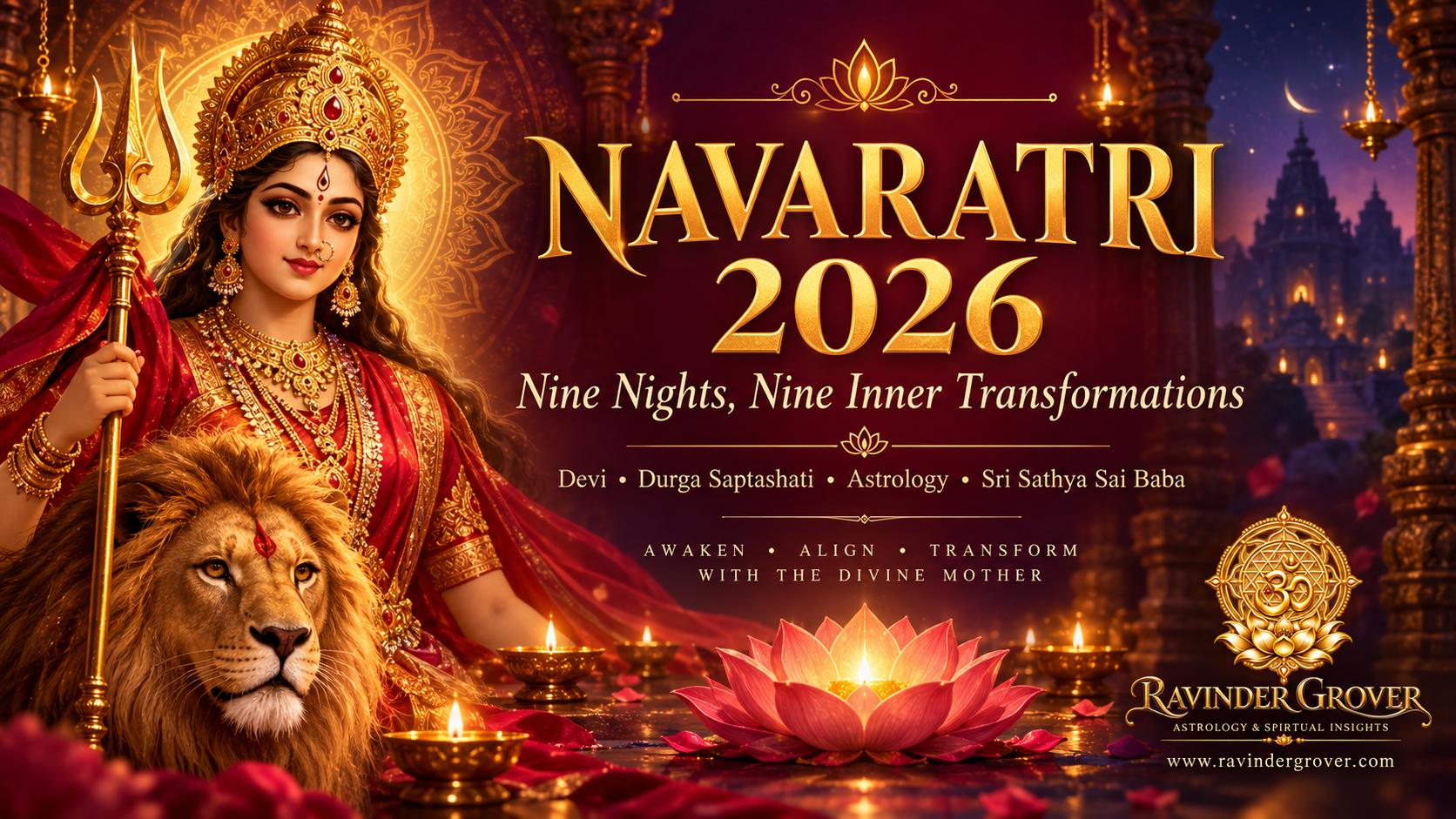
NAVARATRI 2026 – Nine Nights for Nine Inner Transformations
Sharad Navaratri 2026 (11–20 October 2026) and Vijayadashami 21 October 2026
Your Guide to the Nine Nights
The Mother We Worship and the Mother Within
Tomorrow, the nine sacred nights of Navaratri begin. For thousands of years, families across Bharat, and now around the world, have set aside these nights to worship the Divine as Mother. Over the next ten days I will publish a short post each morning: one for each form of the Devi, and a final one for Vijayadashami. This introduction explains what the festival means, what to prepare, and how to make the most of the series.
Navaratri is often introduced as nine nights dedicated to nine forms of the Divine Mother. That is true, but it is only the outer doorway. If the festival remains a change of flowers, colours, foods, and rituals, we may celebrate beautifully and still miss its most transformative invitation: to discover what the Goddess is asking us to change within ourselves.
The Durga Saptashati gives this inner journey a dramatic language. Its demons are formidable, its battles intense, and its hymns sublime. Yet the battlefield is not only in a mythic past. Madhu and Kaitabha, Mahishasura, Dhumralochana, Chanda and Munda, Raktabija, Nishumbha, and Shumbha can also be read as mirrors of our own inertia, uncontrolled desire, pride, clouded perception, recurring thought patterns, fear, and ego. The Mother who destroys them is the awakening power already present within us.
Each day, then, asks for more than devotion to a form. It asks for a small act of inner honesty. What must be steadied? What must be disciplined? What must be seen clearly? What must be released? And what must be offered back to the Divine?
What Is Navaratri?
Navaratri means “nine nights”. There are in fact four Navaratris in the year: Chaitra Navaratri in spring, Sharad Navaratri in autumn, and the two Gupta (hidden) Navaratris of Ashadha and Magha, observed mainly by sadhakas. Sharad Navaratri, in the bright half of Ashvina, is the most widely celebrated, and it culminates in Vijayadashami, or Dussehra.
On each of the nine days we worship one of the Navadurga, the nine forms of the Mother. Their sequence comes from the Devi Kavacham (shlokas 3–5): “prathamaṃ śailaputrī ca dvitīyaṃ brahmacāriṇī…”. Read in order, they form a complete spiritual journey, from steadiness at the start to fulfilment and freedom at the end.
Many traditions also group the nights into three sets of three. The first three belong to Durga, and may be approached as purification and strength. The middle three belong to Lakshmi: the cultivation of sacred abundance, divine qualities, and right relationship. The final three belong to Saraswati: the movement towards wisdom, purity, and self-knowledge.
The Durga Saptashati
The central scripture of Navaratri is the Durga Saptashati, also called the Devi Mahatmya or Chandi Path. It forms adhyayas 81–93 of the Markandeya Purana and contains 700 shlokas in 13 chapters, which is why it is called the Saptashati, “the seven hundred”.
It is told in three parts. The Prathama Charitra (Chapter 1) is presided over by Mahakali, who defeats Madhu and Kaitabha. The Madhyama Charitra (Chapters 2–4) is presided over by Mahalakshmi, who defeats Mahishasura. The Uttama Charitra (Chapters 5–13) is presided over by Mahasaraswati, who defeats Shumbha and Nishumbha. The whole story is framed by a king and a merchant who have lost everything and come to the sage Medhas seeking peace.
A full traditional recitation (path) places the 13 chapters within a frame of supporting texts, the angas. Before the chapters come the Devi Kavacham (the armour), the Argala Stotram (the bolt that opens), and the Kilakam (the pin that releases the mantra’s power); after them come the three Rahasyas, which explain the inner meaning. Many devotees also chant the Navarna mantra before and after the path.
You do not need to recite the whole text every day. Each daily post points to the chapter that matches that day, so that by Vijayadashami you will have walked through the whole Saptashati with the Mother.
The Saptashloki Durga: The Saptashati in Seven Shlokas
For those who cannot recite all 700 shlokas, the tradition offers the Saptashloki Durga, “Durga in seven verses”. It is framed as a dialogue in which Lord Shiva asks the Devi for a simple means of fulfillment in the Kali Yuga, and the Devi, out of love, reveals these seven shlokas. Every one of them is taken from the Durga Saptashati itself, so the seven together carry the essence of the whole text: from Mahamaya’s power over the mind, through refuge, protection, and healing, to the removal of all affliction.
Reciting the Saptashloki each day of Navaratri, ideally after lighting the lamp, is a complete and sincere practice. The seven shlokas, with their places in the Saptashati, are
-
(Devi Mahatmya 1.55)
ज्ञानिनामपि चेतांसि देवी भगवती हि सा ।
बलादाकृष्य मोहाय महामाया प्रयच्छति ॥
jñānināmapi cetāṃsi devī bhagavatī hi sā |
balādākṛṣya mohāya mahāmāyā prayacchati ||
The Divine Mother Mahamaya forcibly draws even the minds of the wise into delusion. We begin by admitting the power of Maya and our need for her grace.
-
(Devi Mahatmya 4.17)
दुर्गे स्मृता हरसि भीतिमशेषजन्तोः
स्वस्थैः स्मृता मतिमतीव शुभां ददासि ।
दारिद्र्यदुःखभयहारिणि का त्वदन्या
सर्वोपकारकरणाय सदार्द्रचित्ता ॥
durge smṛtā harasi bhītimaśeṣajantoḥ
svasthaiḥ smṛtā matimatīva śubhāṃ dadāsi |
dāridryaduḥkhabhayahāriṇi kā tvadanyā
sarvopakārakaraṇāya sadārdracittā ||
O Durga, remembered in distress you remove the fear of every being; remembered in good times you give a most auspicious mind. Who but you, whose heart is ever tender to help all, removes poverty, sorrow, and fear?
-
(Devi Mahatmya 11.10)
सर्वमङ्गलमाङ्गल्ये शिवे सर्वार्थसाधिके ।
शरण्ये त्र्यम्बके गौरि नारायणि नमोऽस्तु ते ॥
sarvamaṅgalamāṅgalye śive sarvārthasādhike |
śaraṇye tryambake gauri nārāyaṇi namo’stu te ||
Auspiciousness of all that is auspicious, the gracious one who fulfils every aim, the refuge, the three-eyed Gauri: salutations to you, O Narayani.
-
(Devi Mahatmya 11.12)
शरणागतदीनार्तपरित्राणपरायणे ।
सर्वस्यार्तिहरे देवि नारायणि नमोऽस्तु ते ॥
śaraṇāgatadīnārtaparitrāṇaparāyaṇe |
sarvasyārtihare devi nārāyaṇi namo’stu te ||
You who are devoted to rescuing the helpless and afflicted who take refuge in you, remover of the suffering of all: salutations to you, O Narayani.
-
(Devi Mahatmya 11.24)
सर्वस्वरूपे सर्वेशे सर्वशक्तिसमन्विते ।
भयेभ्यस्त्राहि नो देवि दुर्गे देवि नमोऽस्तु ते ॥
sarvasvarūpe sarveśe sarvaśaktisamanvite |
bhayebhyastrāhi no devi durge devi namo’stu te ||
You who are the form of all, the ruler of all, endowed with every power: protect us from fear, O Devi. Salutations to you, O Durga.
-
(Devi Mahatmya 11.29)
रोगानशेषानपहंसि तुष्टा
रुष्टा तु कामान् सकलानभीष्टान् ।
त्वामाश्रितानां न विपन्नराणां
त्वामाश्रिता ह्याश्रयतां प्रयान्ति ॥
rogānaśeṣānapahaṃsi tuṣṭā
ruṣṭā tu kāmān sakalānabhīṣṭān |
tvāmāśritānāṃ na vipannarāṇāṃ
tvāmāśritā hyāśrayatāṃ prayānti ||
When pleased you destroy all ills; when displeased you withhold what is desired. Those who take refuge in you meet no calamity, and they themselves become a refuge for others.
-
(Devi Mahatmya 11.39)
सर्वाबाधाप्रशमनं त्रैलोक्यस्याखिलेश्वरि ।
एवमेव त्वया कार्यमस्मद्वैरिविनाशनम् ॥
sarvābādhāpraśamanaṃ trailokyasyākhileśvari |
evameva tvayā kāryamasmadvairivināśanam ||
O Queen of all, in this same way may you calm every affliction of the three worlds and destroy our enemies, outer and inner.
Navaratri and Astrology
Sharad Navaratri begins on Ashvina Shukla Pratipada, the day after the new moon. For nine nights the Moon waxes, and the Moon is the karaka of the mind; as the Purusha Sukta says, “candramā manaso jātaḥ”, the Moon was born from the mind of the Cosmic Being (Rigveda 10.90.13). Navaratri is nine nights of the mind growing in light.
Astrology can add another contemplative layer. In this series, planetary symbolism is used as a spiritual language rather than as a fixed scriptural Navadurga–Navagraha correspondence. The Moon helps us contemplate the mind; Mars, disciplined effort; the Sun, centred courage; Jupiter, meaning and grace; Mercury, discrimination; Venus, the refinement of desire; Saturn, karma and endurance; and Rahu and Ketu, craving, illusion, and release. On the ninth day all nine grahas are brought together, as we move beyond planetary conditioning.
These are reflective lenses, not rules of worship and not predictions of fate. A chart describes the field on which we work; Navaratri reminds us that the Mother’s grace and our own sadhana shape what grows there.
The Ten Days at a Glance
| Day | Devi | Inner theme | Durga Saptashati connection | Astrology lens | Sri Sathya Sai Baba’s message |
| 1 | Shailaputri | Beginning again; becoming grounded | Ch. 1: Madhu–Kaitabha; awakening from spiritual sleep | Moon/Earth principle: emotional foundation | Your own mother is the living Divine Mother |
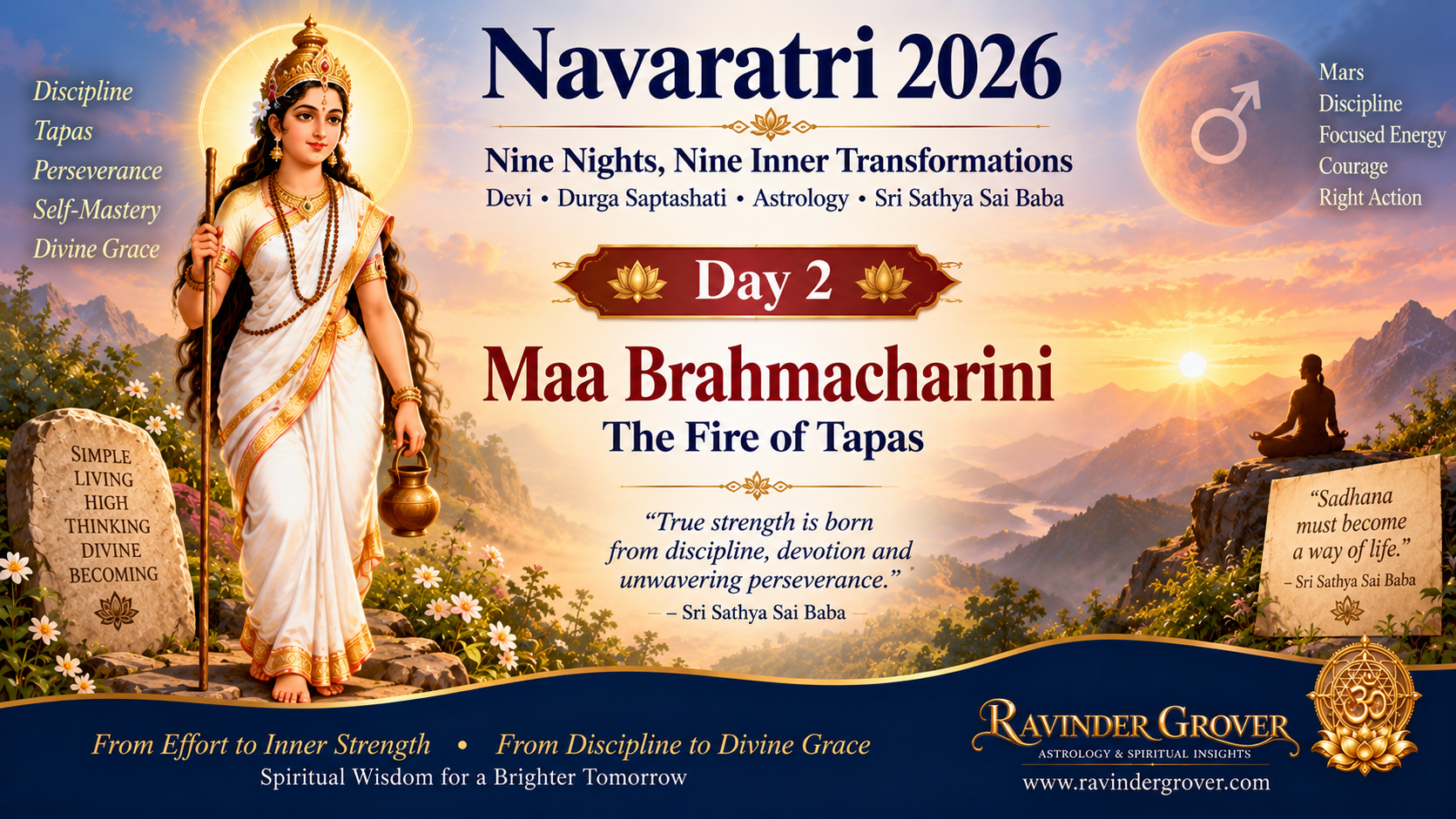
| 2 | Brahmacharini | Tapas, discipline, perseverance | Ch. 2: the Devi born of the gods’ united tejas; power awakened by concentrated effort | Mars: disciplined energy rather than anger | The demons are our own qualities; sadhana must become daily living |
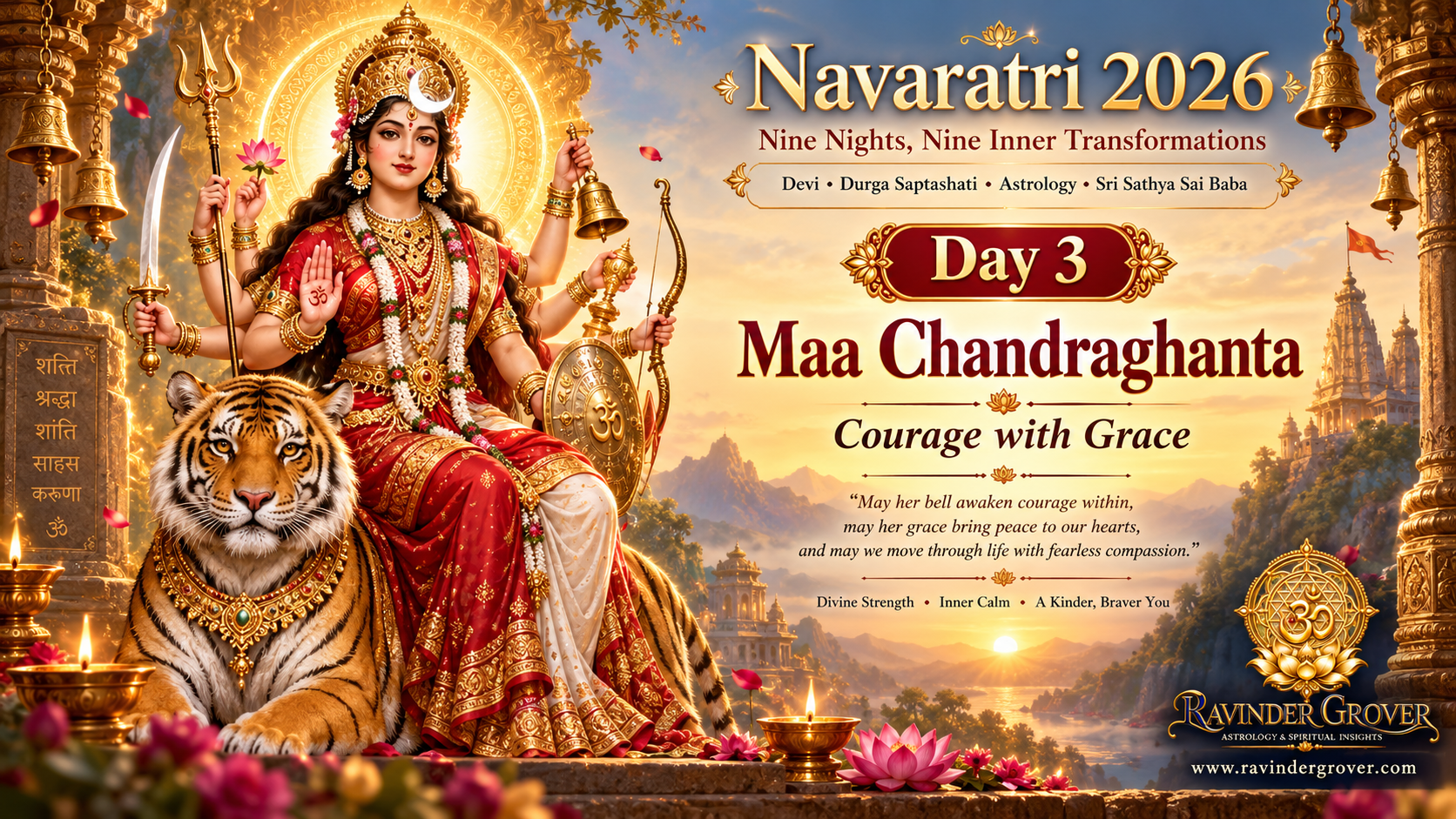
| 3 | Chandraghanta | Courage without aggression | Ch. 3: the fall of Mahishasura | Sun: courage, identity, righteous purpose | The Mother turns fierce only to protect goodness |
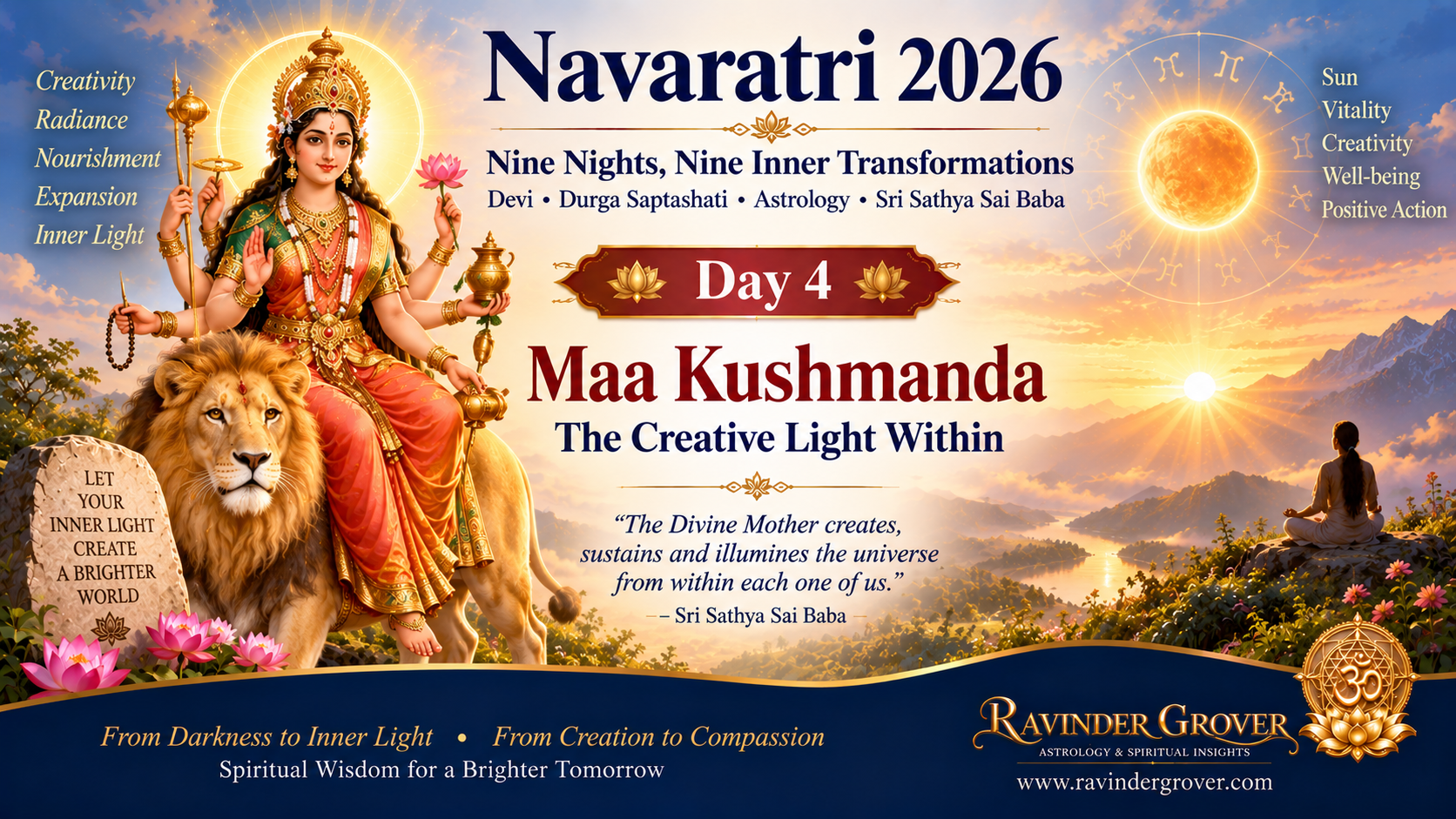
| 4 | Kushmanda | The Divine light within creation | Ch. 4: the Devi praised as the power permeating creation | Jupiter: expansion, wisdom, meaning | God is not distant; turn action and discernment into the Divine |
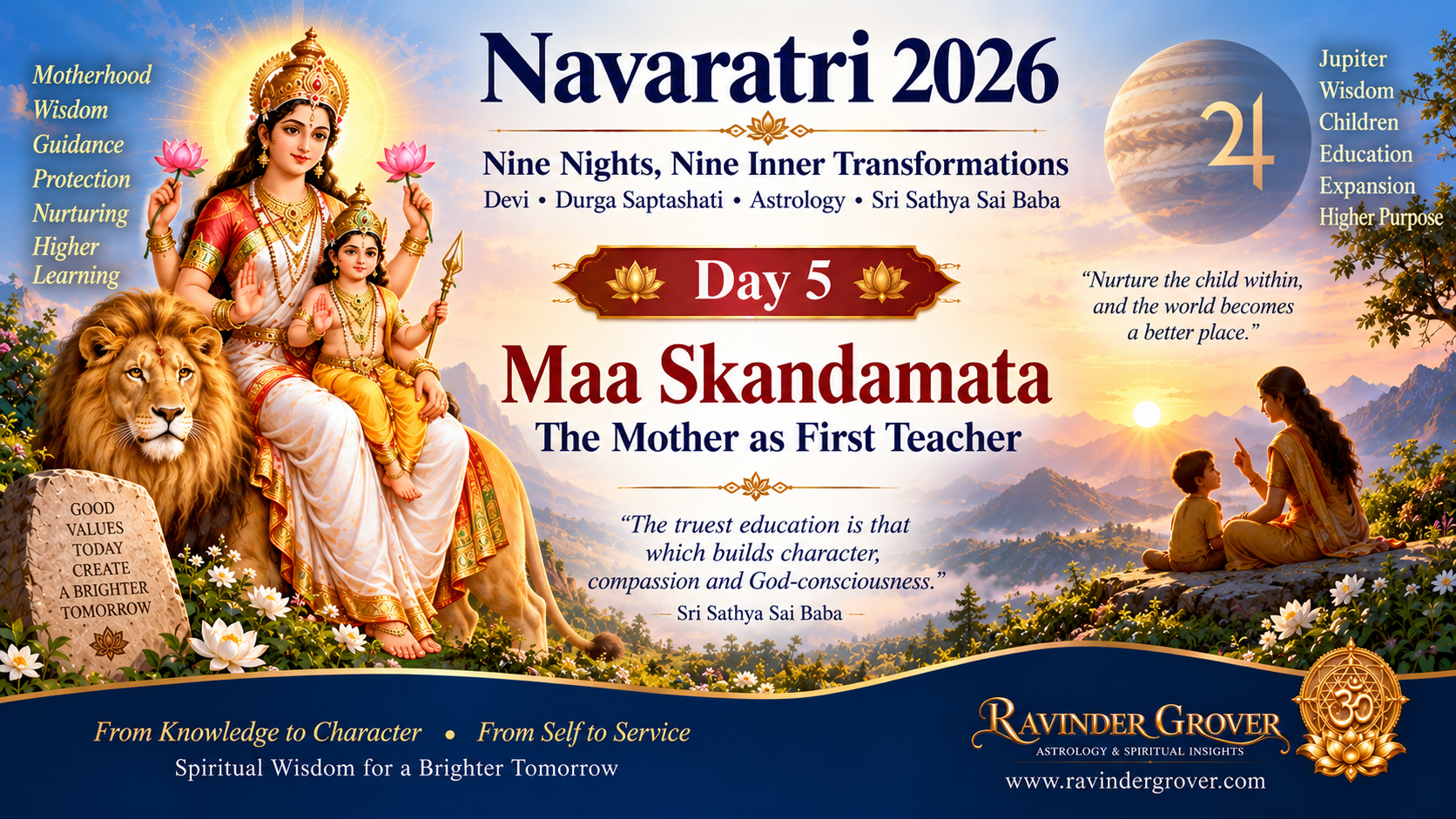
| 5 | Skandamata | Motherhood, compassion, selfless protection | Ch. 5: the Aparajita Stuti; the Mother in all beings | Mercury: purified mind and discrimination | Revere the mother as first teacher and embodiment of the Divine |
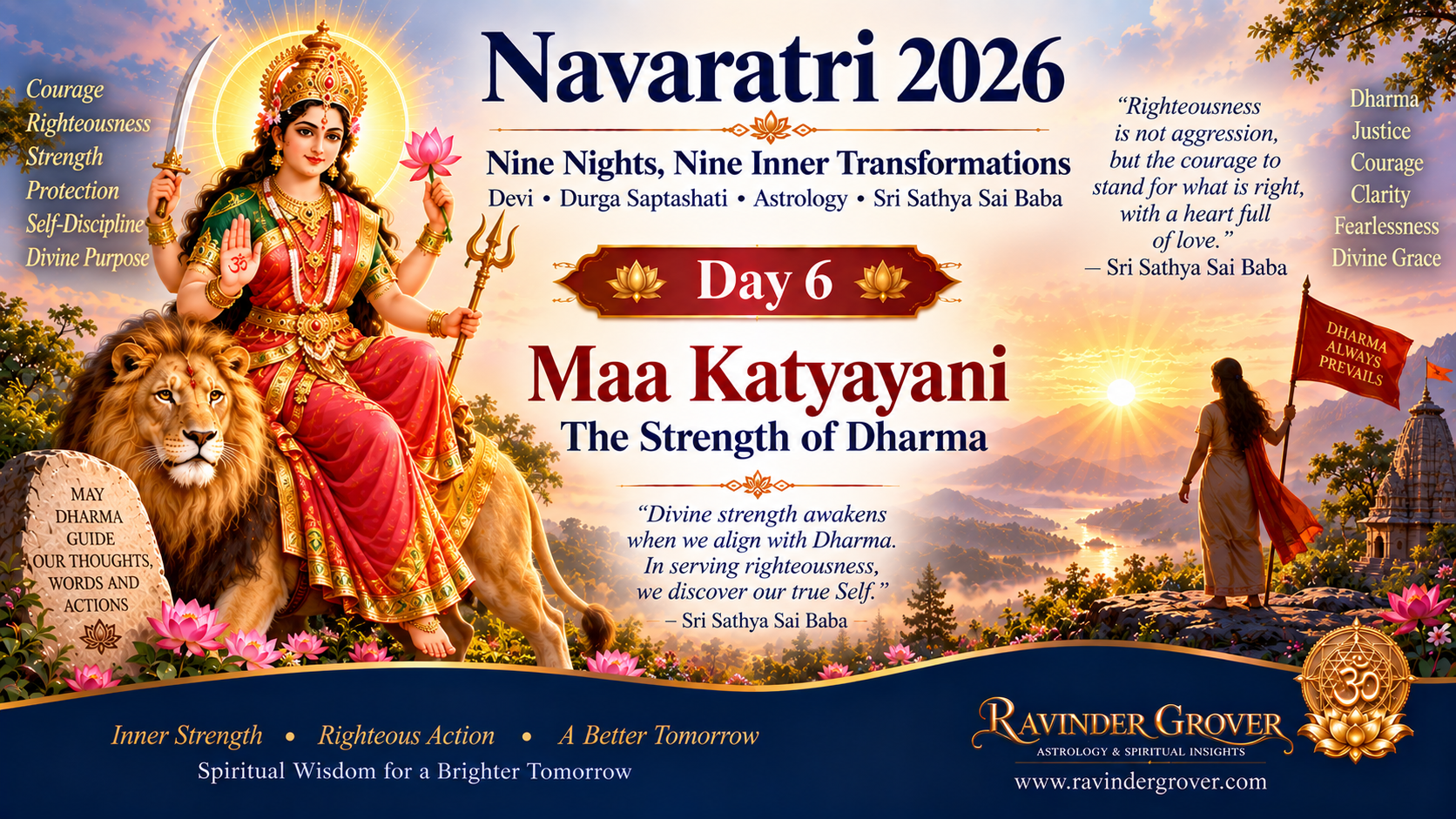
| 6 | Katyayani | Standing for dharma; confronting what we have avoided | Ch. 6: Dhumralochana and the obscuring “smoke” of perception | Venus: desire transformed into devotion | Make Sathya and Dharma your companions |
| 7 | Kalaratri | Entering the darkness without fear | Ch. 7–8: Chanda–Munda and especially Raktabija | Saturn: karma, fear, limitation, endurance | Purify karma and the ten senses; the demons are our own negative qualities |
| 8 | Mahagauri | Purification, surrender, inner peace | Ch. 9–10: Nishumbha and Shumbha; purification after the battle | Rahu–Ketu: release of illusion and attachment | Purity of thought, word and deed; worship the nine gates within |
| 9 | Siddhidatri | Wholeness, wisdom, union | Ch. 11–13: Narayani Stuti, blessings, restoration | Navagraha integrated: moving beyond planetary conditioning | Realise your innate Divinity; Love All, Serve All |
| 10 | Vijayadashami | Victory within | Ch. 12 reread | — | Vijayadasami is the day to begin a new life |
The Saptashati readings and Swami’s teachings in this table are developed in full in each day’s post.
The Mantras of the Nine Devis
Each day, chant the name mantra of that day’s Devi 108 times on a japa mala, and recite her dhyana shloka (meditation verse) before you begin, holding her form in your mind. If you have only a minute, the name mantra alone, said with feeling, is enough.
A note on sources: the name mantras are the standard forms used in worship. The dhyana shlokas are the traditional meditation verses recited across North India during Navaratri; they are not drawn from the Durga Saptashati and are not traced to a single scriptural source, though the Navadurga names themselves come from the Devi Kavacham (shlokas 3–5).
Day 1 · Maa Shailaputri
Name mantra: Om Devi Shailaputryai Namah
ॐ देवी शैलपुत्र्यै नमः
वन्दे वाञ्छितलाभाय चन्द्रार्धकृतशेखराम् ।
वृषारूढां शूलधरां शैलपुत्रीं यशस्विनीम् ॥
vande vāñchitalābhāya candrārdhakṛtaśekharām |
vṛṣārūḍhāṃ śūladharāṃ śailaputrīṃ yaśasvinīm ||
I bow to the glorious Shailaputri, who wears the crescent moon, rides the bull, and holds the trident, for the fulfilment of my sincere wishes.
Day 2 · Maa Brahmacharini
Name mantra: Om Devi Brahmacharinyai Namah
ॐ देवी ब्रह्मचारिण्यै नमः
दधाना करपद्माभ्यामक्षमालाकमण्डलू ।
देवी प्रसीदतु मयि ब्रह्मचारिण्यनुत्तमा ॥
dadhānā karapadmābhyām akṣamālākamaṇḍalū |
devī prasīdatu mayi brahmacāriṇyanuttamā ||
May the supreme Devi Brahmacharini, who holds the rosary and water pot in her lotus hands, be gracious to me.
Day 3 · Maa Chandraghanta
Name mantra: Om Devi Chandraghantayai Namah
ॐ देवी चन्द्रघण्टायै नमः
पिण्डजप्रवरारूढा चण्डकोपास्त्रकैर्युता ।
प्रसादं तनुतां मह्यं चन्द्रघण्टेति विश्रुता ॥
piṇḍajapravarārūḍhā caṇḍakopāstrakairyutā |
prasādaṃ tanutāṃ mahyaṃ candraghaṇṭeti viśrutā ||
May she who is renowned as Chandraghanta, mounted on the finest of creatures and armed with weapons of fierce power, extend her grace to me.
Day 4 · Maa Kushmanda
Name mantra: Om Devi Kushmandayai Namah
ॐ देवी कूष्माण्डायै नमः
सुरासम्पूर्णकलशं रुधिराप्लुतमेव च ।
दधाना हस्तपद्माभ्यां कूष्माण्डा शुभदास्तु मे ॥
surāsampūrṇakalaśaṃ rudhirāplutameva ca |
dadhānā hastapadmābhyāṃ kūṣmāṇḍā śubhadāstu me ||
May Kushmanda, who holds in her lotus hands two full vessels, one of nectar and one of blood, symbols of creation and its life-force, be auspicious to me.
Day 5 · Maa Skandamata
Name mantra: Om Devi Skandamatayai Namah
ॐ देवी स्कन्दमातायै नमः
सिंहासनगता नित्यं पद्माश्रितकरद्वया ।
शुभदास्तु सदा देवी स्कन्दमाता यशस्विनी ॥
siṃhāsanagatā nityaṃ padmāśritakaradvayā |
śubhadāstu sadā devī skandamātā yaśasvinī ||
May the glorious Devi Skandamata, ever seated on the lion throne and holding lotuses in her two hands, always grant auspiciousness.
Day 6 · Maa Katyayani
Name mantra: Om Devi Katyayanyai Namah
ॐ देवी कात्यायन्यै नमः
चन्द्रहासोज्ज्वलकरा शार्दूलवरवाहना ।
कात्यायनी शुभं दद्याद्देवी दानवघातिनी ॥
candrahāsojjvalakarā śārdūlavaravāhanā |
kātyāyanī śubhaṃ dadyād devī dānavaghātinī ||
May Devi Katyayani, slayer of demons, whose hand shines with the Chandrahasa sword and who rides the noble lion, grant us auspiciousness.
Day 7 · Maa Kalaratri
Name mantra: Om Devi Kalaratryai Namah
ॐ देवी कालरात्र्यै नमः
एकवेणी जपाकर्णपूरा नग्ना खरास्थिता ।
लम्बौष्ठी कर्णिकाकर्णी तैलाभ्यक्तशरीरिणी ॥
वामपादोल्लसल्लोहलताकण्टकभूषणा ।
वर्धनमूर्धध्वजा कृष्णा कालरात्रिर्भयङ्करी ॥
ekaveṇī japākarṇapūrā nagnā kharāsthitā |
lambauṣṭhī karṇikākarṇī tailābhyaktaśarīriṇī ||
vāmapādollasallohalatākaṇṭakabhūṣaṇā |
vardhanamūrdhadhvajā kṛṣṇā kālarātrir bhayaṅkarī ||
This shloka describes Kalaratri’s awe-inspiring form: dark, unadorned, riding a donkey, with flowing hair and an iron ornament on her foot. She is terrifying to darkness, but to the devotee she is Shubhankari, the giver of good.
Day 8 · Maa Mahagauri
Name mantra: Om Devi Mahagauryai Namah
ॐ देवी महागौर्यै नमः
श्वेते वृषे समारूढा श्वेताम्बरधरा शुचिः ।
महागौरी शुभं दद्यान्महादेवप्रमोददा ॥
śvete vṛṣe samārūḍhā śvetāmbaradharā śuciḥ |
mahāgaurī śubhaṃ dadyān mahādevapramodadā ||
May the pure Mahagauri, mounted on a white bull and clothed in white, who gives delight to Mahadeva, grant us auspiciousness.
Day 9 · Maa Siddhidatri
Name mantra: Om Devi Siddhidatryai Namah
ॐ देवी सिद्धिदात्र्यै नमः
सिद्धगन्धर्वयक्षाद्यैरसुरैरमरैरपि ।
सेव्यमाना सदा भूयात् सिद्धिदा सिद्धिदायिनी ॥
siddhagandharvayakṣādyair asurair amarair api |
sevyamānā sadā bhūyāt siddhidā siddhidāyinī ||
May Siddhidatri, served always by siddhas, gandharvas, yakshas, asuras, and gods alike, be for us the giver of attainment.
What Bhagavan Sri Sathya Sai Baba Taught About Navaratri
Swami spoke about Navaratri and Dasara in many discourses at Prasanthi Nilayam, where the festival was celebrated with the Veda Purusha Saptaha Jnana Yajna. Again and again He brought it back to its inward meaning: Durga, Lakshmi, and Saraswati are not only deities outside us, but powers of action, will, and wisdom operating within every human being. Here are the key themes, with the discourses they come from.
The three forms of the Mother. In His Dasara discourse of 14 October 1988 (Sri Sathya Sai Speaks, Vol. 21, “The Mother Divine”), Swami explained that the supreme Shakti manifests as Durga, Lakshmi, and Saraswati. Durga grants energy, physical, mental, and spiritual; Lakshmi grants wealth of many kinds, not only money but intellectual wealth and the wealth of character; and Saraswati grants intelligence, the capacity for inquiry, and the power of discrimination.
The Mother at home. In the same discourse, Swami taught that one’s own mother is the combination of all these divine beings, and that recognising and revering her is the true message of the nine-night festival. He warned that if one’s mother is unhappy, all the worship offered to Durga, Lakshmi, and Saraswati during Navaratri will yield no fruit.
The goddesses within. In His Dasara discourse of 9 October 1994, Swami said that “Durga, Lakshmi, and Saraswati dwell in the human heart.” He explained them as three powers in every person: the power of action, will power, and the power of wisdom, which also shows itself as speech. When we worship them in pictures and images, He said, we are giving outer form to the subtle powers already within us. He added that the human body has nine openings, and that during Navaratri one should be worshipped each day, not externally but with heart and soul.
The ten demons within. In His Dasara discourse of 18 October 1991, Swami asked each of us to examine, during the ten days of the festival, whether the Divine Mother has destroyed the ten demons within. He named them as arrogance, bad thoughts, lust, anger, delusion, greed, pride, envy, ego, and hatred, and explained that the rakshasas are not demonic beings but wicked qualities. Each person, He said, must decide whether they are a Ravana or a Rama according to their qualities.
Purifying the ten senses. In His Dasara discourse of 9 October 2008 (Sri Sathya Sai Speaks, Vol. 41, Ch. 16), Swami explained that Dasara is meant to purify the actions of the dasendriyas, the five senses of perception and five organs of action.
Each day a step in sadhana. Swami taught that the sages who established these festivals had a high purpose: they wanted us to grasp the inner meaning and use each day as a step in spiritual practice. The forces of good and evil, He said, contend within every being, and those who rely on the Divine Mother’s great power will win. [Source: Sai Messages for the Day, sathyasai.org, 4 October 2022; original discourse date not given]
A special day for Sai devotees. The first day of Navaratri has a further significance. In His discourse of 28 September 1990, Swami revealed that Shirdi Sai Baba was born on this day in 1838. And it was on Vijayadasami, 17 October 1953, that Swami gave His first public discourse, “Worship in the Mind” (Sri Sathya Sai Speaks, Vol. 1, Discourse 2), a title that captures the whole spirit of Navaratri.
What to Prepare Before Day 1
- A clean puja space: Clean and simplify the place where you will worship. The Mother is welcomed into a clean home and a clear heart.
- For Ghatasthapana (if it is your tradition): a kalash with water, mango leaves, and a coconut; a shallow tray with clean soil and barley seeds to sow; a red cloth; and a picture or murti of the Devi.
- A lamp: A ghee or oil lamp to light each day. Some families keep an akhanda jyoti burning for all nine days, but a lamp lit at the same time each day is equally sincere.
- A text: A copy of the Durga Saptashati (the Gita Press edition is widely available), or the Devi Kavacham alone if time is short.
- The Saptashloki: Print or copy the seven shlokas given above, so that even on the busiest day you can offer them to the Mother.
- A japa mala for chanting each day’s mantra 108 times.
- Your sankalpa: Decide in advance what you wish to cultivate or give up during the nine days.
How to Follow This Series
Each daily post has the same eight parts: who the Devi of the day is; the matching passage from the Durga Saptashati; the astrological link; an astrology message for the day; a message for youngsters; inner teachings from Swami, the scriptures, and the sages; what everyone should understand; and a short practical orientation for the day.
Read the post in the morning, choose one practice from it, and do it with full attention. That is enough. As Swami reminds us, the purpose of the nine days is not to perform more rituals but to change from within.
A Sankalpa for the Nine Nights
Before Day 1, sit quietly in front of a lamp. Think of one quality you want to grow over these nine days, such as patience, courage, discipline, or kindness, and one habit or inner enemy you want to let go of. Offer both to the Mother. On Vijayadashami we will return to this sankalpa together.
Navaratri is not only nine nights in which we worship the Mother. It is nine opportunities to discover what prevents the Mother already residing within us from expressing Herself.
या देवी सर्वभूतेषु शक्तिरूपेण संस्थिता ।
नमस्तस्यै नमस्तस्यै नमस्तस्यै नमो नमः ॥
yā devī sarvabhūteṣu śaktirūpeṇa saṃsthitā |
namastasyai namastasyai namastasyai namo namaḥ ||
“To that Divine Mother who abides in all beings in the form of Shakti, the Divine Power, salutations to Her, salutations to Her, salutations again and again.”
(Devi Mahatmya, adhyaya 5)
Tomorrow: Day 1, Maa Shailaputri, the steady mountain within.
Ravinder Grover
Astrology & Spiritual Insights
📲 Join my WhatsApp Channel for regular updates:
https://whatsapp.com/channel/0029Vai6rQz6rsQyMHx7nZ1z
© 2026 Ravinder Grover. All Rights Reserved.
This work is protected under copyright and DMCA. Unauthorised use is prohibited.
Disclaimer: ‘Without Prejudice’. I offer my insight into astrology solely based on my learnings of astrology principles and techniques, some of which I learnt from the Sages of the highest order. These predictions are offered for guidance purposes only. I offer absolutely no guarantee for my calculations and analysis. These predictions are not intended to cause harm to anyone in any way. I expressly disclaim all warranties, whether implied or contingent, for making use of these predictions or for incurring any loss or loss of profit in any manner whatsoever. No notice or advice from anyone will create any liability whatsoever

Leave A Comment